
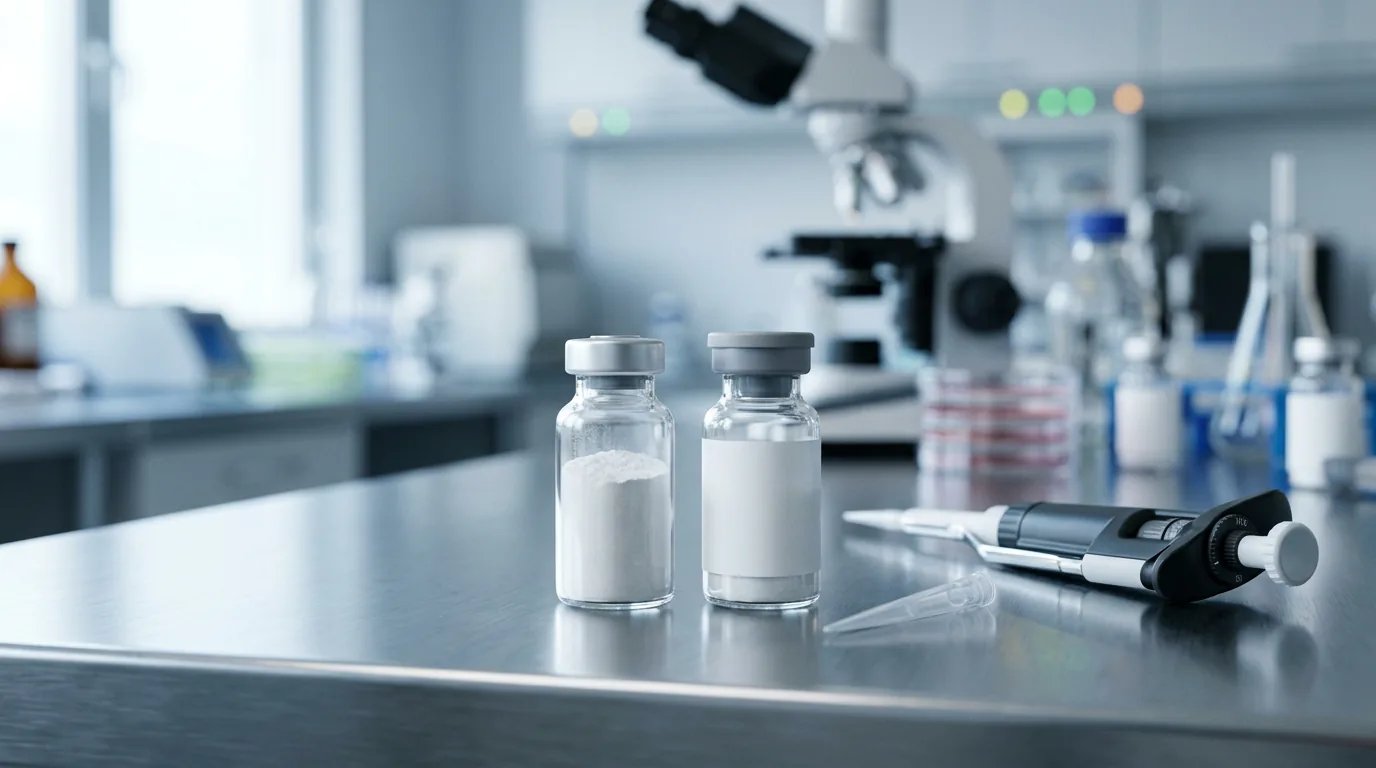
BPC-157 is a gastric juice derivative, while TB-500 is a synthetic fraction of Thymosin Beta-4, both investigated strictly for Research Use Only in preclinical cellular studies. In laboratory settings, researchers compare BPC-157 vs TB-500 based on their distinct molecular weights, amino acid sequences, and observed in-vitro mechanisms of action. Both compounds are handled as lyophilized powders requiring precise reconstitution, and neither is approved for human or veterinary administration.
This guide outlines the structural differences between these two peptides, their primary cellular targets observed in vitro, and the mandatory laboratory protocols for handling, reconstituting, and storing them safely.
What is the difference between BPC-157 and TB-500 in research?
The primary difference in research is structural: BPC-157 is a 15-amino-acid gastric pentadecapeptide[1], whereas TB-500 is a 7-amino-acid N-acetylated fragment of thymosin-beta4[2]. In laboratory settings, researchers compare BPC-157 and TB-500 based on their distinct molecular weights, amino acid sequences, and observed in-vitro mechanisms of action. The TB-500 molecular weight is approximately 0.89 kDa[2][3], making it significantly smaller than BPC-157 at 1.42 kDa[4][5].
While both compounds are investigated in cellular repair models, their primary targets differ significantly. The BPC-157 mechanism primarily involves the modulation of angiogenic signaling pathways, such as VEGFR2-Akt-eNOS and FAK-paxillin[6][7]. In contrast, TB-500 acts via high-affinity G-actin binding, which regulates cytoskeletal dynamics and cell migration[8][9]. Both BPC-157 and TB-500 are strictly for Research Use Only (RUO) and are never intended for human consumption, medical treatment, or veterinary use.
| Feature | BPC-157 | TB-500 |
|---|---|---|
| Origin | Synthetic gastric juice derivative[10] | Synthetic fragment of Thymosin Beta-4[2] |
| Amino Acid Length | 15 residues[1] | 7 residues[2] |
| Molecular Weight | ~1.42 kDa[4][5] | ~0.89 kDa[2][3] |
| Primary In-Vitro Target | VEGFR2, NO system, FAK-paxillin[6] | G-actin sequestration (1:1 stoichiometry)[8] |
| Cellular Mechanism | Angiogenesis and growth-factor sensitization[7] | Cytoskeletal regulation and cell migration[8][9] |
How do researchers reconstitute lyophilized BPC-157 and TB-500?
Preclinical researchers reconstitute lyophilized BPC-157 and TB-500 using sterile bacteriostatic water under aseptic laboratory conditions. The reconstitution process must avoid vigorous agitation to prevent shearing the delicate peptide bonds of the compounds. Reconstituted peptide solutions must be stored at 2 to 8 degrees Celsius for short-term preservation or frozen for long-term stability[11][12].
When evaluating how to reconstitute peptides safely, laboratories follow a strict methodology to preserve structural integrity:
- Equilibrate: Allow the lyophilized peptide vial to reach room temperature (approximately 15 to 20 minutes from refrigeration) before opening to prevent internal condensation[11].
- Disinfect: Swab the stoppers of both the peptide vial and the bacteriostatic water with 70% isopropyl alcohol and allow them to air-dry[13].
- Inject slowly: Using a sterile syringe, draw the required volume of bacteriostatic water. Insert the needle into the peptide vial at an angle and inject the solvent slowly down the inner glass wall over 30 to 60 seconds[12][14].
- Dissolve gently: Never shake or vortex the vial. Gently swirl the solution in a circular motion until the powder is fully dissolved, which typically takes 1 to 3 minutes[11][15].
- Store appropriately: Label the vial immediately. Store the reconstituted solution at 2 to 8 degrees Celsius for short-term laboratory use (up to 28 days in bacteriostatic water)[11][16], or aliquot and freeze at -20 to -80 degrees Celsius for long-term preservation[17][18].
What does Research Use Only mean for peptide handling?
RUO status means these compounds are strictly limited to laboratory in-vitro and preclinical testing and are not approved for human or animal therapeutic use. Compliance protocols dictate that research peptides must never be prepared or handled as injectable drugs or dietary supplements.
In the context of BPC-157 and TB-500, Research Use Only designates that the chemicals are synthesized solely for experimental observation. Researchers utilize these compounds in controlled environments – such as cell cultures or isolated tissue assays – to investigate fundamental biological mechanisms. Because they lack clinical safety data and regulatory approval, any application outside of a sterile laboratory setting violates compliance standards. Vendors supplying these materials enforce strict terms and conditions, retaining the right to refuse service if in-vivo administration or non-research applications are suspected.
Where can I buy BPC-157 with 99% purity for lab research?
Preclinical researchers sourcing these lyophilized compounds require verified third-party testing, such as the greater than 99% HPLC purity standard maintained by Nautilus Peptides. Legitimate research suppliers must provide batch-specific HPLC and Mass Spectrometry data to confirm peptide identity and purity before purchase.
When laboratories evaluate where to buy BPC-157 and TB-500, they apply rigorous analytical criteria to ensure reproducibility in their in-vitro assays. Impure compounds introduce variables that can compromise cellular data. For example, utilizing Nautilus Peptides BPC-157 ensures researchers receive a compound verified by independent third-party testing.
| Quality Criterion | Why It Matters in Research | Nautilus Peptides Standard |
|---|---|---|
| HPLC Purity | Quantifies the target compound against synthesis impurities. | Greater than 99% purity on every compound. |
| Mass Spectrometry | Confirms the exact molecular weight and identity of the sequence. | Independent third-party identity verification. |
| Batch-Specific COA | Ensures the specific lot received matches the published test results. | Certificate of Analysis provided per batch. |
| Lyophilized Format | Preserves the peptide bonds during transit and pre-reconstitution storage. | Solid-phase peptide synthesis (SPPS), freeze-dried. |
Frequently Asked Questions
What is the difference between BPC-157 and TB-500 in research?
The primary difference is their structural origin and cellular target. BPC-157 is a 15-amino-acid gastric derivative that modulates angiogenic pathways, while TB-500 is a 7-amino-acid synthetic fraction of Thymosin Beta-4 that binds to G-actin to regulate cell migration. Both are restricted to Research Use Only.
How do researchers reconstitute lyophilized BPC-157 and TB-500?
Researchers reconstitute these lyophilized powders by slowly injecting bacteriostatic water down the inner wall of the vial, followed by gentle swirling. The solution must never be shaken. Once reconstituted, the liquid is stored at 2 to 8 degrees Celsius for short-term laboratory use.
What does Research Use Only mean for peptide handling?
Research Use Only (RUO) strictly limits the handling of these compounds to in-vitro and preclinical laboratory environments. It legally and ethically prohibits any human consumption, veterinary administration, or medical application.
Where can I buy BPC-157 with 99% purity for lab research?
Laboratories can source high-purity BPC-157 from dedicated RUO suppliers like Nautilus Peptides, which maintains a minimum 99% HPLC purity standard. Buyers must always verify the compound’s integrity through a batch-specific Certificate of Analysis featuring independent mass spectrometry data.
References
- BPC-157 — Molecular Specifications & Research Monograph. https://peptidebiologix.com/bpc-157 (2026-05-31)
- TB-500 – Research Peptide. https://www.americanpeptides.us/products/tb-500
- TB500 | Thymosin β 4 Synthetic Molecule | MedChemExpress. https://www.medchemexpress.com/TB500-2.html (2025-01-01)
- BPC 157 | 137525-51-0 – ChemicalBook. https://www.chemicalbook.com/ChemicalProductProperty_EN_CB81343566.htm (2026-02-27)
- Bpc-157 | C62H98N16O22 | CID 9941957 – PubChem – NIH. https://pubchem.ncbi.nlm.nih.gov/compound/Bpc-157 (2026-06-20)
- BPC-157 Clinical Profile | Research & Applications – Delta Peptides. https://deltapeptides.com/bpc-157.html (2026-06-22)
- BPC-157: A Synthetic Pentadecapeptide Derived From Gastric Juice …. https://superpower.com/guides/bpc-157 (2026-04-18)
- TB-500 (Thymosin Beta-4) – Peptide Biologix. https://peptidebiologix.com/tb-500 (2026-05-31)
- BPC-157 vs. TB-500 | Peptides for sale. https://polarispeptides.com/bpc-157-vs-tb-500/ (2024-08-22)
- BPC-157: What Is the Gastric-Derived Pentadecapeptide?…. https://newtropin.com/blog/bpc-157-what-is-gastric-derived-pentadecapeptide (2026-05-02)
- Bacteriostatic Water for Peptide Research: What It Is | | Palmetto …. https://palmettopeptides.com/blogs/news/bacteriostatic-water-for-peptide-research (2026-04-09)
- How to Reconstitute Peptides: Lab-Ready Techniques and Solvent …. https://polarispeptides.com/how-to-reconstitute-peptides-lab-guide/ (2025-07-09)
- How to Reconstitute Peptides: A Complete Research Guide. https://www.regenpeptides.co.uk/blogs/news/how-to-reconstitute-peptides-guide (2026-03-25)
- Critical Bacteriostatic Water Guide [2026] – PurePep Vital. https://www.purepepvital.com/blog/bacteriostatic-water-for-peptides (2026-03-07)
- Peptide Reconstitution Instructions – YouTube. https://www.youtube.com/watch?v=b08QwxZW0Ig (2025-09-18)
- How 30ml Bacteriostatic Water Supports Peptide Stability and …. https://tydes.is/30ml-bacteriostatic-water-peptide-stability-reconstitution/ (2025-04-07)
- Handling and Storage Guidelines for Peptides and Proteins. https://www.sigmaaldrich.com/US/en/technical-documents/technical-article/research-and-disease-areas/cell-and-developmental-biology-research/handling-and-storage (2023-10-14)
- Peptide Stability: How Long Do Peptides Last?. https://www.jpt.com/blog/how-long-last-peptides/ (2026-06-19)