
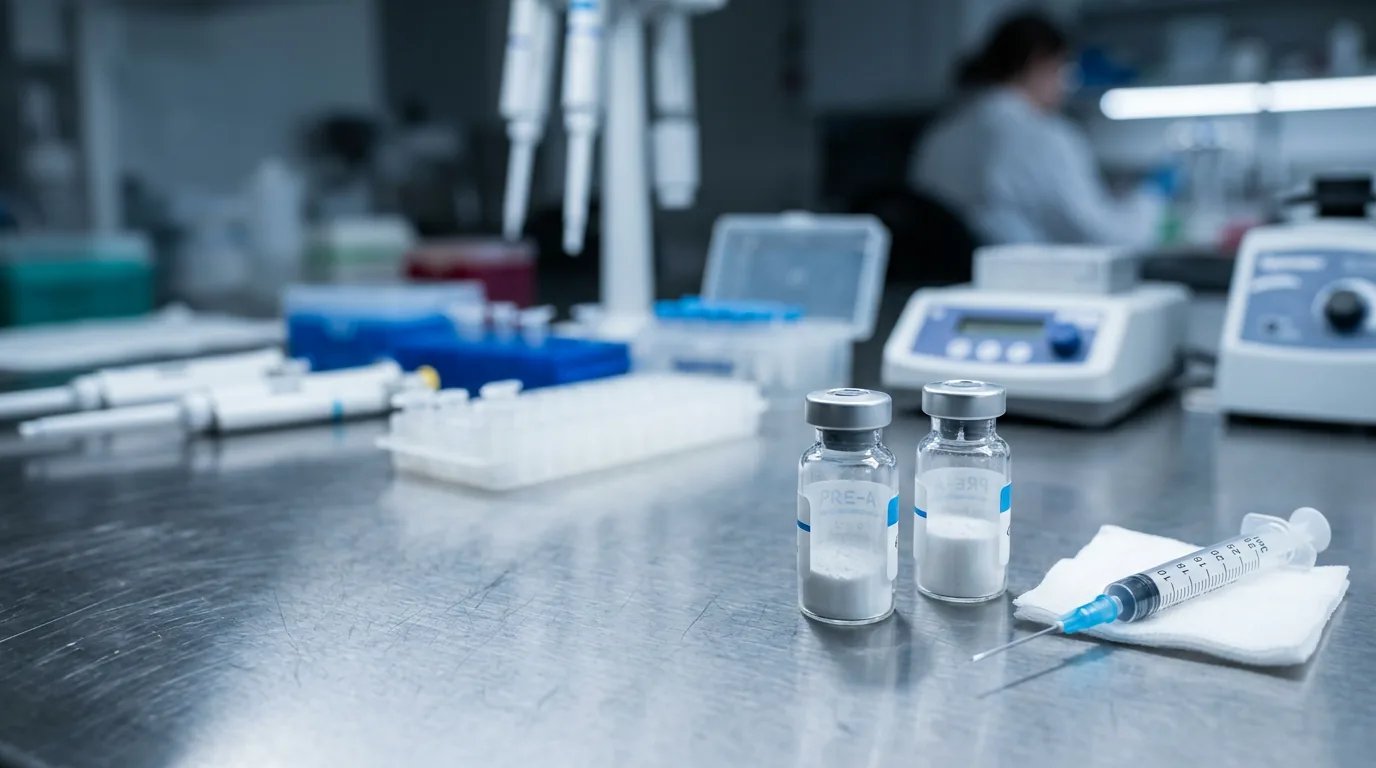
CJC-1295 No DAC and Ipamorelin are growth hormone secretagogues investigated in laboratory models for their synergistic binding to the ghrelin and GHRH receptors. In preclinical research, this combination is evaluated for its ability to amplify growth hormone (GH) secretion without causing long-term receptor desensitization. Both CJC-1295 No DAC and Ipamorelin are strictly for Research Use Only (RUO) and are not intended for human consumption, medical treatment, or veterinary use.
Understanding the independent mechanisms and combined pharmacokinetics of these compounds is critical for designing accurate studies. CJC-1295 No DAC targets the growth hormone-releasing hormone (GHRH) receptor, while Ipamorelin selectively binds the ghrelin receptor (GHS-R1a). Together, they produce a synergistic effect on somatotroph cells.
This guide details the cellular mechanisms, specific receptor pathways, half-life differences, and strict laboratory handling protocols required for evaluating this combination in preclinical research.
What is the mechanism of action for CJC-1295 No DAC and Ipamorelin?
CJC-1295 No DAC and Ipamorelin operate as distinct growth hormone secretagogues that act on separate G-protein coupled receptors on pituitary somatotrophs to trigger synergistic growth hormone release[1][2]. Both compounds are strictly for Research Use Only (RUO) and are not intended for human consumption, medical treatment, or veterinary use.
In laboratory models, CJC-1295 No DAC functions as a modified analog of growth hormone-releasing hormone (GHRH). It binds to the Gs-coupled GHRH receptor, activating the adenylyl cyclase pathway to increase intracellular cAMP and activate protein kinase A (PKA)[1][3]. This cascade leads to calcium ion influx and upregulates GH gene transcription, priming the cell by increasing its synthetic capacity for growth hormone[1].
Conversely, Ipamorelin is a highly selective agonist of the ghrelin receptor, GHS-R1a[4][2]. This Gq/11-coupled receptor triggers the phospholipase C (PLC) pathway[2]. This rapidly mobilizes stored intracellular calcium via IP3 and activates protein kinase C (PKC), serving as a potent trigger for GH vesicle exocytosis[2].
When researchers administer research-grade CJC-1295 No DAC and Ipamorelin simultaneously, the distinct second-messenger systems converge on the calcium exocytotic machinery[2]. This dual activation results in a synergistic growth hormone pulse approximately 1.5 to 3 times greater than the arithmetic sum of the individual peptide responses[5][2].
What is the difference in half-life between CJC-1295 No DAC and Ipamorelin?
In laboratory settings, CJC-1295 No DAC exhibits a half-life of approximately 30 minutes, while Ipamorelin demonstrates a half-life of roughly 2 hours during preclinical evaluation[6][7][8]. The absence of the Drug Affinity Complex (DAC) in CJC-1295 No DAC results in a shorter half-life compared to its DAC-bound counterpart, allowing for distinct pulsatile study designs[1][6].
These pharmacokinetic profiles dictate how researchers structure dosing intervals. Because CJC-1295 No DAC lacks the maleimidopropionyl linker that binds to serum albumin, it avoids multi-day receptor occupancy and clears rapidly[1][9]. Ipamorelin, while slightly longer-lasting, remains a short-acting secretagogue producing a discrete growth hormone pulse without significant accumulation[6][7].
| Pharmacokinetic Parameter | CJC-1295 No DAC | Ipamorelin |
|---|---|---|
| Target Receptor | GHRH receptor[1] | GHS-R1a[2] |
| Plasma Half-Life | ~30 minutes[6][10] | ~1.5 to 2 hours[6][7] |
| Pulse Pattern | Rapid, acute pulse[1][10] | Single discrete pulse[6][7] |
| Half-Life Modifier | Lacks DAC[1][6] | Short-acting pentapeptide[2] |
By utilizing Ipamorelin alongside CJC-1295 No DAC, researchers investigate acute neuroendocrine responses. The rapid clearance of both compounds prevents the prolonged receptor desensitization observed with longer-acting analogs, maintaining the natural pulsatile rhythm required for specific preclinical investigations[1][10].
How do researchers properly store and handle CJC-1295 and Ipamorelin in the laboratory?
Lyophilized peptide vials must be stored at sub-zero temperatures (-20 degrees Celsius or lower) to prevent degradation prior to reconstitution[11][12]. Reconstitution should be performed using sterile laboratory solvents with minimal physical agitation to preserve the delicate peptide structure[13][14].
Proper laboratory handling maintains the structural integrity of both compounds during preclinical evaluation. Researchers must strictly adhere to temperature controls and aseptic techniques.
- Lyophilized storage: Keep unmixed vials in a laboratory freezer at -20 degrees Celsius. Ensure the environment is dry, sealed, and protected from light to maintain stability for up to 24 months[11][12].
- Temperature equilibration: Allow lyophilized vials to sit at room temperature for 10 to 30 minutes before opening. This prevents ambient moisture from condensing inside the vial[13][15].
- Solvent addition: Swab septums with 70 percent isopropyl alcohol. Using a sterile syringe, slowly inject Bacteriostatic Water against the inner glass wall, rather than directly onto the lyophilized cake[13][14].
- Gentle dissolution: Swirl the vial in a slow circular motion for 30 to 60 seconds until clear. Never shake or vortex, as aggressive agitation fractures the peptide bonds[13][14][16].
- Refrigerated storage: Immediately transfer the reconstituted solution to a refrigerator (2 to 8 degrees Celsius). Reconstituted peptides must never be frozen and should be utilized within 28 to 30 days[11][12][16].
Where can researchers buy third-party tested CJC-1295 and Ipamorelin?
Researchers evaluating this peptide combination must source compounds with greater than 99 percent HPLC purity and verify batch-specific Certificates of Analysis prior to laboratory reconstitution. Verifying third-party laboratory credentials and batch-specific documentation is critical to ensuring the validity of preclinical research data.
The unregulated nature of the research chemical market introduces significant variables. Impurities or degraded compounds can completely invalidate an experiment’s findings. To maintain rigorous scientific standards, laboratories must evaluate vendors based on strict analytical transparency.
- HPLC Purity: This analytical technique separates components to quantify exact purity. Research-grade applications require a minimum HPLC purity exceeding 99 percent to eliminate variables caused by synthetic byproducts.
- Mass Spectrometry Identity: While HPLC confirms purity, mass spectrometry verifies the exact molecular weight, ensuring the peptide matches the chemical structure of CJC-1295 No DAC and Ipamorelin.
- Batch-Specific COA: A generic sitewide document is insufficient. Vendors must provide a downloadable, lot-specific Certificate of Analysis issued by an independent third-party laboratory that matches the vial’s lot number.
- Synthesis: Premium research peptides are manufactured using solid-phase peptide synthesis (SPPS) and delivered as a lyophilized powder, maximizing stability prior to laboratory reconstitution.
Frequently Asked Questions
What is the mechanism of action for CJC-1295 No DAC and Ipamorelin?
CJC-1295 No DAC binds to the GHRH receptor to increase intracellular cAMP and upregulate growth hormone synthesis[1]. Ipamorelin binds to the ghrelin receptor (GHS-R1a) to mobilize intracellular calcium and trigger immediate vesicle exocytosis[2]. Together, they produce a synergistic growth hormone pulse in preclinical models[5].
What is the difference in half-life between CJC-1295 No DAC and Ipamorelin?
In laboratory models, CJC-1295 No DAC has a rapid plasma half-life of approximately 30 minutes because it lacks the albumin-binding Drug Affinity Complex[1][6]. Ipamorelin operates with a terminal half-life of roughly 1.5 to 2 hours[6][7]. Both are short-acting secretagogues.
How do researchers properly store and handle CJC-1295 and Ipamorelin in the laboratory?
Lyophilized powder must be stored in a freezer at -20 degrees Celsius away from light[11]. Upon reconstitution with bacteriostatic water, the liquid solution must be refrigerated at 2 to 8 degrees Celsius, never frozen, and utilized within 28 to 30 days[12][16].
Where can I buy third-party tested CJC-1295 and Ipamorelin research peptides?
Laboratories should source CJC-1295 and Ipamorelin from vendors that publish batch-specific Certificates of Analysis. The documentation must originate from an independent testing laboratory and demonstrate greater than 99 percent HPLC purity alongside mass spectrometry identity verification.
References
- CJC-1295: A Long-Acting GHRH Analog – Superpower. https://superpower.com/guides/cjc-1295 (2026-04-18)
- Ipamorelin Clinical Profile | Growth Hormone Research. https://deltapeptides.com/ipamorelin.html (2026-06-24)
- How Does CJC-1295 Work? | Honest Peptide. https://honestpeptide.com/research/how-does-cjc-1295-work
- Ipamorelin: Mechanism, Effects & Research Studies – Peptpedia. https://peptpedia.org/peptide/ipamorelin (2026-05-20)
- CJC-1295: Mechanism, Effects & Research Studies – Peptpedia. https://peptpedia.org/peptide/cjc-1295 (2026-05-20)
- CJC-1295 vs Ipamorelin: GH Peptide Comparison – Peptpedia. https://peptpedia.org/compare/cjc-1295-vs-ipamorelin (2025-12-03)
- Pharmacokinetic-pharmacodynamic modeling of ipamorelin, a …. https://pubmed.ncbi.nlm.nih.gov/10496658/ (1999-09-26)
- Ipamorelin – Wikipedia. https://en.wikipedia.org/wiki/Ipamorelin (2015-06-11)
- Prolonged stimulation of growth hormone (GH) and insulin-like …. https://pubmed.ncbi.nlm.nih.gov/16352683/ (2006-03-25)
- CJC-1295 with DAC vs. Without DAC: A Technical Comparison for …. https://www.hlextract.com/info/cjc-1295-with-dac-vs-without-comparison-103168490.html (2025-10-15)
- How to Store CJC-1295 + Ipamorelin Blend — Lab Storage Guide. https://www.peptifyuk.com/research/cjc-1295-ipamorelin-blend/how-to-store/ (2026-04-09)
- Peptide Storage Temperature Chart | PeptideCase. https://peptidecase.com/blog/peptide-storage-temperature-chart (2026-03-25)
- Step-by-Step Reconstitution Protocols for CJC-1295 Research …. https://palmettopeptides.com/blogs/news/cjc1295-reconstitution-guide (2026-04-02)
- Why Bacteriostatic Water is Essential for Peptide Reconstitution. https://arpovohealth.com/blog/why-bacteriostatic-water-is-essential-for-peptide-reconstitution/ (2026-03-17)
- How to Reconstitute Lyophilized Peptides: Best Practices. https://verifiedpeptides.com/knowledge-hub/how-to-reconstitute-lyophilized-peptides-best-practices/ (2025-05-23)
- How to Store CJC-1295 No DAC & Ipamorelin After. https://www.realpeptides.co/how-to-store-cjc-1295-no-dac-ipamorelin-after-reconstitution/ (2026-04-15)