
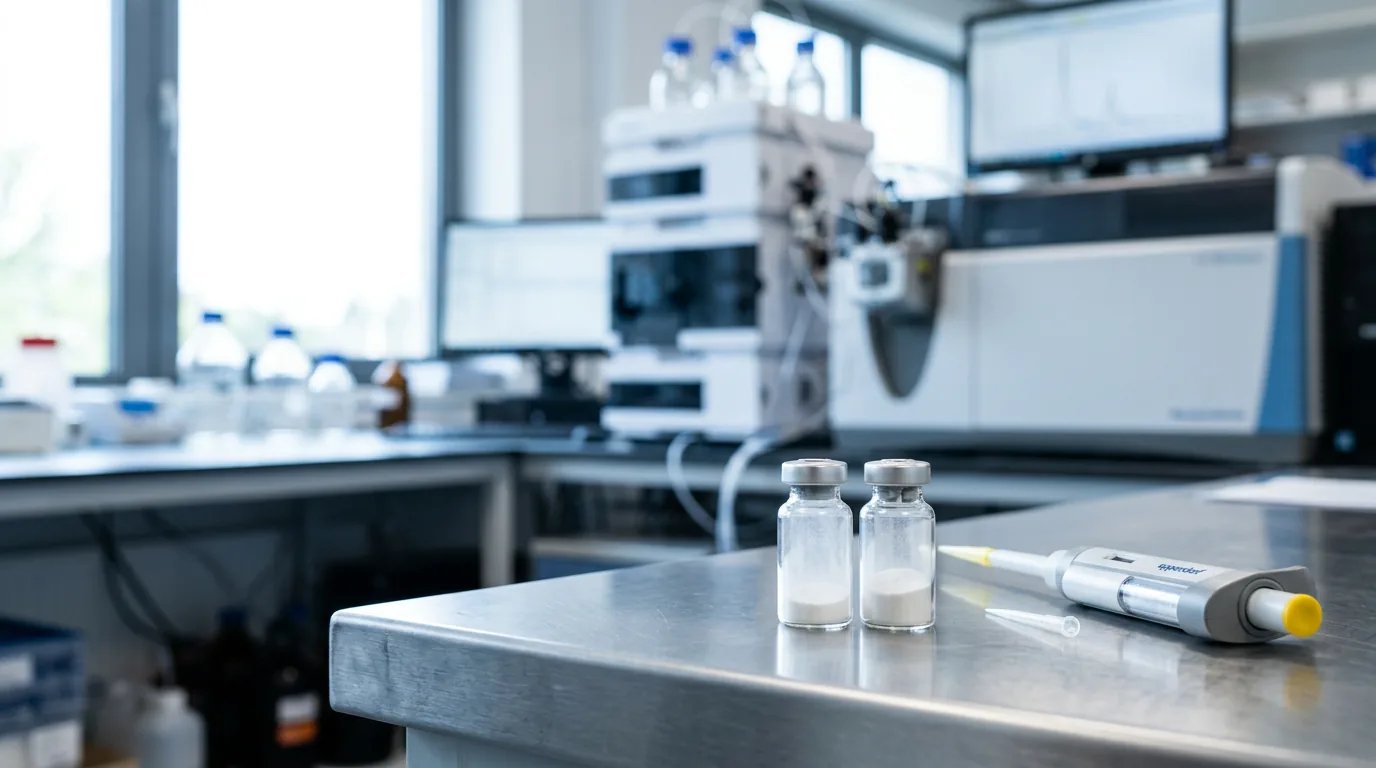
Tesamorelin and sermorelin are synthetic growth hormone-releasing hormone (GHRH) analogues investigated strictly for in vitro laboratory research purposes[1][2]. Both peptides are restricted strictly to research use only (RUO) and are not for human consumption, medical, veterinary, or cosmetic use. Laboratory comparisons of these two GHRH analogues focus on their distinct molecular weights, sequence lengths, and in vitro stability profiles. This guide compares their mechanisms, structural differences, and the impact of the trans-3-hexenoic acid modification on stability for preclinical models.
What is the difference between tesamorelin and sermorelin?
Tesamorelin and sermorelin are synthetic growth hormone-releasing hormone (GHRH) analogues investigated strictly for in vitro laboratory research purposes[1][2]. The primary difference lies in their amino acid sequence length and N-terminal modifications, dictating their stability in experimental environments. Both bind to the GHRH receptor to stimulate endogenous growth hormone secretion in preclinical models, but their distinct structures suit different laboratory applications[1][3].
Sermorelin is an unmodified, truncated GHRH(1-29) fragment containing the first 29 amino acids of native human GHRH[1][2]. Lacking an N-terminal cap, it functions as a short-acting GHRH tool, optimized for short-window, pulse-response experiments[1][2]. Tesamorelin utilizes the full 44-amino-acid GHRH sequence and features a stabilizing N-terminal modification[1][2]. Engineered as a degradation-resistant analog, tesamorelin is selected when laboratory protocols require sustained GHRH receptor activation over extended time courses[1][2].
Both peptides are restricted strictly to research use only (RUO). Sourcing requires relying on high-purity analytical standards to ensure reproducibility in in vitro and animal models.
How do the structures and sequences of tesamorelin and sermorelin compare?
Laboratory comparisons of these two GHRH analogues focus on their distinct molecular weights, sequence lengths, and in vitro stability profiles. Sermorelin consists of the first 29 amino acids of endogenous GHRH, whereas tesamorelin features a modified 44-amino-acid sequence[2][4]. This structural divergence dictates their respective molecular weights and enzymatic vulnerabilities.
Sermorelin (GHRH 1-29 amide) has a molecular weight of 3357.9 g/mol and an unmodified N-terminus[1][2]. Tesamorelin contains the full 44-amino-acid sequence plus a trans-3-hexenoyl group attached to the N-terminal tyrosine residue, resulting in a heavier molecular weight of approximately 5136 g/mol[5][6]. The extra 15 C-terminal residues in tesamorelin contribute to its mass, but the critical receptor-binding domain remains within residues 1-29[7].
| Specification | Sermorelin | Tesamorelin |
|---|---|---|
| Sequence Length | 29 amino acids[1][2] | 44 amino acids[1][2] |
| Molecular Weight | 3357.9 g/mol[1][2] | ~5136 g/mol[5][6] |
| N-Terminal Modification | None (unmodified Tyr-Ala)[7] | trans-3-hexenoyl group[4][8] |
| Lyophilized Storage | -20°C for up to 2 years[2] | -20°C for up to 2 years[3] |
Both lyophilized peptides exhibit comparable in vitro storage stability, maintaining integrity for up to two years at -20°C[2][3].
How does the trans-3-hexenoic acid group affect tesamorelin stability?
Tesamorelin features a trans-3-hexenoic acid group that researchers observe increases its resistance to enzymatic degradation compared to the standard sermorelin sequence[9][10]. This structural modification alters the peptide’s interaction with dipeptidyl peptidase IV (DPP-IV) in vitro, prolonging its half-life in experimental models[9][10].
Native GHRH and unmodified sermorelin are rapidly cleaved by DPP-IV at the N-terminal Tyr-Ala bond, resulting in a short plasma half-life of approximately 11-12 minutes[2][11]. The addition of the trans-3-hexenoic acid moiety to tesamorelin’s N-terminal tyrosine introduces steric hindrance and local hydrophobicity[9][12]. This cap effectively shields the dipeptidyl cleavage motif, blocking DPP-IV access without materially reducing GHRH receptor affinity[10].
Consequently, tesamorelin demonstrates enhanced metabolic stability in biological matrices. In comparative studies, tesamorelin exhibits an elimination half-life of 26-38 minutes, significantly longer than unmodified GHRH fragments[11][13]. For researchers sourcing tesamorelin, this DPP-IV resistance translates to more sustained receptor engagement and prolonged cAMP signaling at the GHRH receptor during preclinical investigations[1][14].
Where can researchers buy third-party tested GHRH analogues?
Both peptides are restricted strictly to research use only (RUO) and require third-party HPLC testing to verify greater than 99% purity. Nautilus provides verified, third-party tested inventories of GHRH analogues exclusively for in vitro laboratory investigations. When sourcing synthetic GHRH analogues, researchers must evaluate vendors based on strict analytical criteria.
- HPLC Purity Verification: Research-grade peptides must achieve greater than 99% purity. HPLC quantifies the target compound against synthesis impurities, ensuring the peptide will not introduce confounding variables into sensitive assays.
- Mass Spectrometry Confirmation: Purity alone does not prove identity. Mass spectrometry testing verifies that the observed molecular weight matches the theoretical mass (e.g., 3357.9 g/mol for sermorelin[1]), confirming the exact amino acid sequence.
- Batch-Specific Certificates of Analysis (COA): A legitimate vendor provides lot-specific, independent third-party lab results for every batch. Generic, sitewide COAs do not guarantee the specific vial’s integrity.
- Strict RUO Compliance: Legitimate suppliers explicitly designate all compounds for laboratory research only, strictly prohibiting human consumption.
Frequently Asked Questions
What is the structural difference between tesamorelin and sermorelin?
Sermorelin is a 29-amino-acid truncated fragment of native GHRH with an unmodified N-terminus[1][2]. Tesamorelin utilizes the full 44-amino-acid GHRH sequence and features a trans-3-hexenoic acid group attached to its N-terminus to enhance enzymatic stability[4][15].
How does the trans-3-hexenoic acid group affect tesamorelin stability?
The trans-3-hexenoic acid modification creates steric hindrance that blocks dipeptidyl peptidase IV (DPP-IV) from cleaving the peptide[9][10]. This resistance to degradation extends tesamorelin's plasma half-life to 26-38 minutes, compared to sermorelin's 11-12 minutes[2][11].
What are the sequence lengths of tesamorelin and sermorelin?
Sermorelin consists of 29 amino acids, representing the active functional fragment of endogenous GHRH[1][2]. Tesamorelin contains 44 amino acids, mirroring the full length of native human GHRH, plus its N-terminal modification[1][4].
Where can researchers buy third-party tested GHRH analogues?
Researchers should source GHRH analogues from specialized suppliers that provide batch-specific, independent third-party Certificates of Analysis (COAs). Nautilus Peptides supplies research-grade compounds exceeding 99% purity, verified by HPLC and mass spectrometry, strictly for in vitro laboratory use.
References
- Tesamorelin vs Sermorelin: Differences Between GHRH Analogs in …. https://palmettopeptides.com/blogs/news/tesamorelin-vs-sermorelin-differences-between-ghrh-analogs-in-laboratory-research (2026-04-06)
- Tesamorelin vs Sermorelin: Comparing GHRH Analogs | Apex. https://apexlaboratory.org/tesamorelin-vs-sermorelin/ (2026-04-29)
- Safety and metabolic effects of tesamorelin, a growth hormone …. https://journals.plos.org/plosone/article?id=10.1371%2Fjournal.pone.0179538 (2017-06-15)
- Tesamorelin Peptide | Benefits, Safety, & Buying Advice [2026]. https://www.innerbody.com/tesamorelin (2026-01-13)
- Tesamorelin: A Clinically Proven Peptide for Visceral Fat. https://www.theevergreeninstitute.org/post/tesamorelin-a-clinically-proven-peptide-for-visceral-fat-what-science-tells-us (2025-11-28)
- It Crushes Visceral Fat, But the Scale Barely Moves! – YouTube. https://www.youtube.com/watch?v=m5BcB5_dWic (2026-05-28)
- Tesamorelin vs Sermorelin: A Physician-Led Comparison – TrufaMED. https://trufamed.com/blog/tesamorelin-vs-sermorelin/ (2026-05-01)
- Long-term safety (52 weeks) and effects of tesamorelin, a growth …. https://www.natap.org/2008/HIV/082908_02.htm (2026-06-25)
- Tesamorelin (Egrifta SV): A Synthetic GHRH Analog … – Superpower. https://superpower.com/guides/tesamorelin (2026-04-18)
- [PDF] PHARMACOLOGY REVIEW(S) – accessdata.fda.gov. https://www.accessdata.fda.gov/drugsatfda_docs/nda/2010/022505Orig1s000PharmR.pdf (2010-11-04)
- Effects of a Growth Hormone-Releasing Hormone Analog on … – PMC. https://pmc.ncbi.nlm.nih.gov/articles/PMC3038486/ (2010-10-13)
- The Ultimate Guide to Tesamorelin | Las Vegas | Sky Health. https://www.skyhealthnv.com/tesamorelin (2026-02-02)
- Tesamorelin: Reshape Optimal Body Composition. https://peptidesindex.com/peptide/tesamorelin/ (2025-07-10)
- Tesamorelin vs Sermorelin: Full Comparison 2026. https://agelessvitalitypeptides.com/tesamorelin-vs-sermorelin/ (2026-04-20)
- Tesamorelin: Molecular Characterization and Metabolic Research. https://biotechpeptides.com/2026/03/25/tesamorelin-molecular-characterization-growth-hormone-axis-modulation-and-metabolic-research/ (2026-03-25)