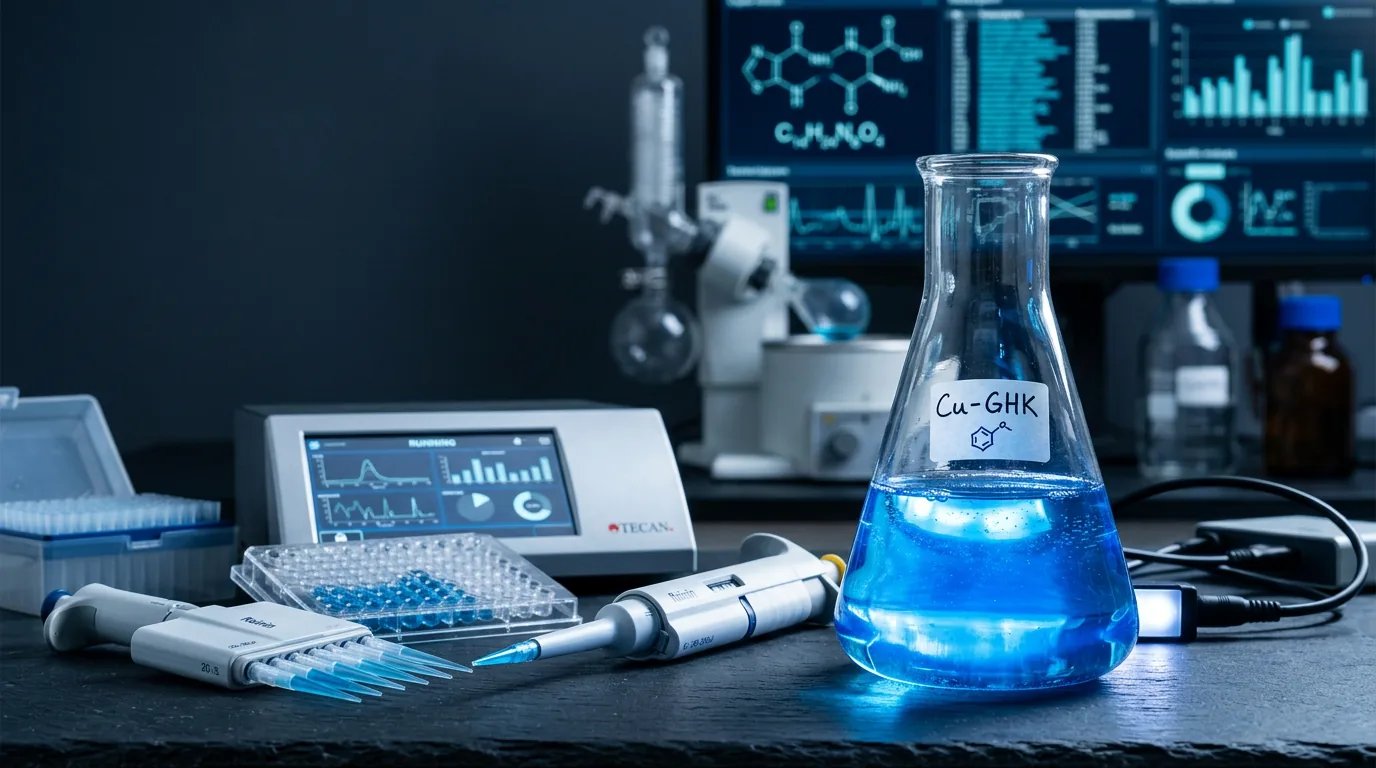
GHK-Cu (glycyl-L-histidyl-L-lysine) is a naturally occurring copper-complex tripeptide investigated in preclinical research, strictly available for laboratory Research Use Only. The compound functions as a high-affinity copper chaperone, transferring the trace metal to structural matrices and intracellular cuproenzymes while silencing its redox reactivity. Preclinical studies analyzing GHK-Cu focus on its cellular pathways and copper-binding mechanisms, utilizing high-purity compounds exceeding 99 percent verified by HPLC testing.
RESEARCH USE ONLY DISCLAIMER: The information provided in this article and the compounds supplied by Nautilus Peptides are intended exclusively for laboratory research and scientific investigation. Nautilus Peptides supplies third-party tested GHK-Cu explicitly prohibiting human consumption, medical, veterinary, or cosmetic applications. The peptide is not approved for the diagnosis, treatment, cure, mitigation, or prevention of any disease.
Laboratory investigators study this tripeptide to understand how it modulates gene expression, tissue repair pathways, and cellular signaling. The following sections detail the molecular properties, sequence data, and preclinical mechanisms observed in controlled in vitro models.
What is GHK-Cu?
GHK-Cu is a high-affinity copper(II)-binding tripeptide complex (Gly-His-Lys-Cu²⁺) studied exclusively in vitro and in animal models to understand its coordination dynamics[1][2]. The compound is a naturally occurring copper complex originally identified in human plasma, where it operates as a low-molecular-weight chelator[3]. Nautilus Peptides supplies third-party tested GHK-Cu exclusively for laboratory studies, explicitly prohibiting human consumption, medical, veterinary, or cosmetic applications.
Structurally, GHK forms a highly stable 1:1 complex with a single copper(II) ion[1][2]. The copper is coordinated by the N-terminal amino group of the glycine residue, the deprotonated amide nitrogen of the glycine-histidine peptide bond, and the imidazole nitrogen of the histidine side chain[1][4]. This specific 3N1O coordination environment creates a square-planar geometry that gives the tripeptide its exceptional binding affinity[4][5]. Research models investigate how this coordination allows the peptide to extract copper from larger transport proteins, such as albumin, with a binding constant (log K) of approximately 16.4[1][6].
For laboratory investigators establishing protocols, utilizing precise molecular data is critical for accurate molarity calculations. The table below outlines the established physicochemical properties for the monocopper salt utilized in standardized preclinical research.
| Property | Value | Research Significance |
|---|---|---|
| Peptide Sequence | Gly-His-Lys[7][1] | Linear tripeptide joined in sequence |
| Molecular Formula | C₁₄H₂₄CuN₆O₄[8][9] | Standard 1:1 monocopper complex |
| Molecular Weight | 403.92 g/mol[8][9] | Essential for precise laboratory dosing |
| Exact Mass | 403.1155 Da[8] | Used for mass spectrometry verification |
| Solubility | Water-soluble[3] | Facilitates aqueous preclinical formulation |
Researchers must ensure they utilize batch-matched, third-party tested materials to confirm the exact mass and purity of the GHK-Cu complex before initiating experimental procedures.
How does GHK-Cu work in preclinical research?
Preclinical studies analyzing GHK-Cu focus on its cellular pathways and copper-binding mechanisms, utilizing high-purity compounds exceeding 99 percent verified by HPLC testing. Research models investigate how the tripeptide modulates gene expression and cellular signaling without direct physiological application. By forming a stable complex, the peptide silences the redox activity of the copper ion, delivering non-toxic copper into the cell and reducing free-radical-driven Fenton chemistry[1][3].
Laboratory investigations reveal that the complex functions as a multi-pathway signal peptide rather than a single-receptor ligand[1][10]. Whole-genome transcriptomic analyses demonstrate that the tripeptide can up-regulate and down-regulate approximately 4,000 human genes in vitro, affecting pathways related to extracellular matrix remodeling, antioxidant defense, and DNA repair[1][11][12]. In cellular models, the compound increases the expression of core matrix components, including collagens (COL1A1, COL3A1), while modulating matrix metalloproteinases to support balanced tissue turnover[1][13].
Sourcing protocols require third-party verification to ensure batch-to-batch consistency in laboratory environments. Investigators must evaluate reagents based on strict analytical criteria to maintain experimental validity.
- Purity Verification: Research-grade peptides must exceed 99 percent purity. Laboratories confirm this using HPLC and mass spectrometry to quantify the target compound.
- Identity Confirmation: Mass spectrometry must confirm the exact monoisotopic mass of 403.1155 Da[8] to ensure the sequence matches the theoretical Gly-His-Lys-Cu²⁺ structure.
- Pathway Targeting: Researchers select this compound to investigate specific cellular axes, including the SIRT1/STAT3 pathway, where the peptide increases SIRT1 protein expression and decreases phosphorylated STAT3 in tissue models[14].
- Antioxidant Modulation: Experimental models utilize the peptide to study the upregulation of antioxidant enzymes, observing two-to-four-fold increases in superoxide dismutase (SOD1) and catalase activity[13].
Frequently Asked Questions
What is GHK-Cu?
GHK-Cu (glycyl-L-histidyl-L-lysine) is a naturally occurring copper-complex tripeptide investigated in preclinical research, strictly available for laboratory Research Use Only. It functions as a high-affinity physiological copper chaperone, transferring copper to extracellular matrices and intracellular cuproenzymes[1][10].
How does the GHK-Cu peptide work in preclinical research?
In preclinical research, the GHK-Cu peptide works by modulating gene expression and cellular signaling pathways. Experimental models demonstrate that it silences copper's redox activity, safely delivering the ion to cells while regulating approximately 4,000 genes associated with matrix remodeling and antioxidant defense[1][11][3].
What is the molecular weight and sequence of GHK-Cu?
The sequence of the free tripeptide is Gly-His-Lys[7][1]. For the standard 1:1 copper(II) complex utilized in preclinical research, the molecular formula is C₁₄H₂₄CuN₆O₄[8][9], with an average molecular weight of 403.92 g/mol[8][9] and an exact mass of 403.1155 Da[8].
Where can researchers buy third-party tested GHK-Cu?
Researchers can buy third-party tested GHK-Cu from Nautilus Peptides. The company supplies high-purity compounds exceeding 99 percent, verified by independent HPLC and mass spectrometry testing, explicitly intended for laboratory Research Use Only.
References
- GHK Peptide as a Natural Modulator of Multiple Cellular Pathways …. https://pmc.ncbi.nlm.nih.gov/articles/PMC4508379/ (2015-07-07)
- The copper(II)-binding tripeptide GHK, a valuable crystallization and …. https://pmc.ncbi.nlm.nih.gov/articles/PMC7709198/ (2020-11-19)
- Copper peptide GHK-Cu – Wikipedia. https://en.wikipedia.org/wiki/Copper_peptide_GHK-Cu (2010-08-26)
- GHK-Cu Clinical Profile | Copper Peptide Research. https://deltapeptides.com/ghk-cu.html (2024-11-01)
- Theoretical study of copper binding to GHK peptide – PubMed. https://pubmed.ncbi.nlm.nih.gov/32371360/ (2020-06-29)
- The Effect of the Human Plasma Molecule GHK-Cu on Stem Cell …. https://www.lidsen.com/journals/geriatrics/geriatrics-02-03-009 (2018-08-14)
- glycyl-L-histidyl-L-lysine | C14H24N6O4 | CID 73587 – PubChem. https://pubchem.ncbi.nlm.nih.gov/compound/glycyl-L-histidyl-L-lysine (2026-06-23)
- Cu-GHK | C14H24CuN6O4 | CID 378611 – PubChem – NIH. https://pubchem.ncbi.nlm.nih.gov/compound/Cu-GHK (2025-07-13)
- GHK-Cu 2+, Copper Peptide; CAS [49557-75-7]. https://www.peptide.com/product/ghk-cu-2-49557-75-7-cosmetic-grade/ (2021-08-19)
- GHK-Cu Peptide: Complete Research Guide 2026. https://99puritypeptides.com/ghk-cu-copper-peptide-research-guide/ (2026-05-27)
- Regenerative and Protective Actions of the GHK-Cu Peptide … – PMC. https://pmc.ncbi.nlm.nih.gov/articles/PMC6073405/ (2018-07-07)
- GHK-Cu vs BPC-157 for Anti-Ageing Research UK 2026. https://peptideslabuk.com/ghk-cu-vs-bpc-157-for-anti-ageing-research-comparing-tissue-repair-longevity-biology-and-regenerative-mechanisms-uk-2026/ (2026-04-12)
- GHK-Cu: Mechanism, Effects & Research Studies – Peptpedia. https://peptpedia.org/peptide/ghk-cu (2026-02-12)
- Exploring the beneficial effects of GHK-Cu on an experimental …. https://www.frontiersin.org/journals/pharmacology/articles/10.3389/fphar.2025.1551843/full (2025-07-01)