
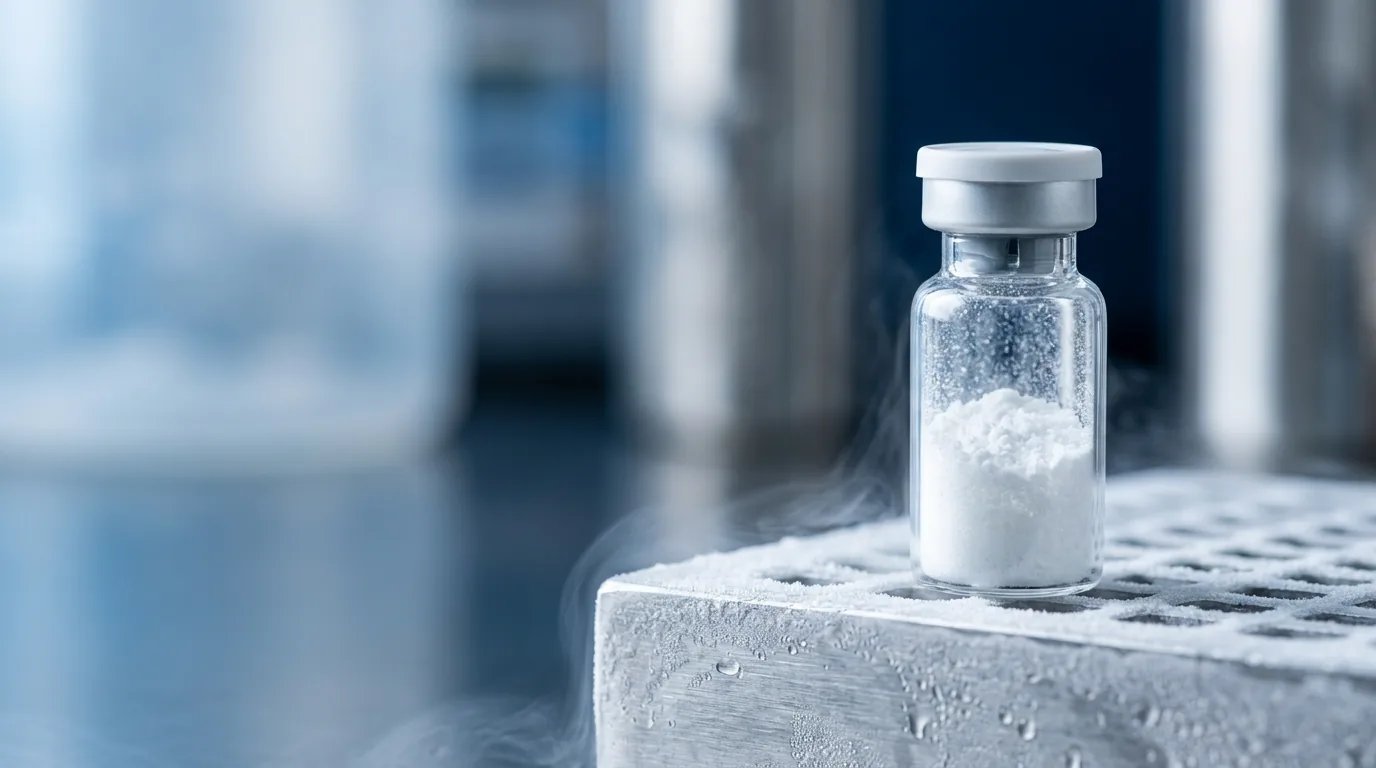
To maintain greater than 99% purity, laboratory personnel must store lyophilized research peptides at -20 degrees Celsius for long-term stability and away from direct light[1][2]. Once reconstituted with bacteriostatic water, research peptides typically remain stable for up to 30 days when refrigerated between 2 and 8 degrees Celsius[3][4]. Understanding how to store research peptides correctly is a fundamental standard operating procedure for any laboratory. Proper handling prevents degradation, preserves the integrity of the compounds, and ensures accurate preclinical investigation over extended timelines.
CRITICAL COMPLIANCE NOTICE: All Nautilus Peptides products, information, and handling protocols discussed in this guide are strictly for Research Use Only (RUO). These compounds are not for human consumption, medical, veterinary, or cosmetic use. The following guidelines are strictly for laboratory methodology and preclinical investigation.
How do you store lyophilized research peptides?
To maintain greater than 99% purity, laboratory personnel must store lyophilized research peptides at -20 degrees Celsius for long-term stability and away from direct light[2][5]. The solid-state, freeze-dried powder form is highly stable, but improper handling – such as exposure to moisture, oxygen, or temperature fluctuations – can rapidly compromise the integrity of the laboratory sample. Most lyophilized peptides are stable for several years when stored at -20 degrees Celsius in a dry, tightly sealed, light-protected container[2][6].
When researchers receive shipments from Nautilus Peptides, the compounds arrive as lyophilized powder. Before opening any vial for a preclinical study, the container must be allowed to equilibrate to room temperature to prevent condensation and moisture absorption[7][8]. Moisture exclusion is as important as cold temperature for reliable multi-year shelf life. Ultraviolet and visible light can induce photooxidation, especially in peptides containing tryptophan, tyrosine, or methionine, so lyophilized peptides should be stored away from bright light in amber or opaque containers inside secondary packaging[9][5].
| Storage Form | Recommended Temperature | Maximum Stability Window | Light Protection |
|---|---|---|---|
| Lyophilized (Short-term) | 4 degrees Celsius[8] | Days to weeks | Keep away from direct light |
| Lyophilized (Long-term) | -20 degrees Celsius[2][10] | Several years | Store in dark conditions |
| Reconstituted Solution | 2 to 8 degrees Celsius[3][11] | Up to 30 days | Opaque container required |
All peptide storage and handling protocols are strictly for Research Use Only (RUO) laboratory environments, as these compounds are not for human consumption. Proper solid-phase preservation is critical before proceeding to the peptide reconstitution phase. Implementing these strict environmental controls ensures that the compounds retain their intended sequence characteristics for accurate scientific testing.
What temperature should reconstituted peptides be kept at?
Once reconstituted with bacteriostatic water, research peptides typically remain stable for up to 30 days when refrigerated between 2 and 8 degrees Celsius[3][11]. Researchers must avoid repeated freeze-thaw cycles, as temperature fluctuations rapidly degrade peptide bonds and compromise the integrity of the laboratory sample[12][13]. The liquid state accelerates degradation pathways like hydrolysis and oxidation, meaning standard operating procedures must strictly control the handling environment.
To prevent peptide degradation after liquid preparation, laboratory personnel follow specific handling steps:
- Refrigerate immediately: Transfer the vial to a dedicated laboratory refrigerator maintained between 2 and 8 degrees Celsius immediately after adding the solvent[3][4].
- Minimize light exposure: Keep the reconstituted solution inside a dark environment. Light exposure accelerates photochemical degradation in liquid states, leading to reactive oxygen species formation[5].
- Avoid freeze-thaw cycles: Never return a reconstituted solution to the freezer. Repeated freeze-thaw cycles must be avoided because they can damage peptide structure, induce aggregation, and reduce experimental viability[3][12].
- Monitor the 30-day window: Discard any remaining solution after 30 days, as stability and purity standards cannot be guaranteed beyond this timeframe[3][11].
Maintaining the cold chain is a critical component of laboratory methodology. While lyophilized powder can withstand long-term freezing, the introduction of a solvent fundamentally changes the molecular stability profile. By strictly adhering to these temperature controls, investigators ensure that their Research Use Only (RUO) compounds remain viable for accurate, reproducible preclinical investigation. Any deviation from these standard operating procedures introduces variables that can invalidate study data.
Frequently Asked Questions
How do you store lyophilized research peptides?
To maintain greater than 99% purity, laboratory personnel must store lyophilized research peptides at -20 degrees Celsius for long-term stability and away from direct light[2][10]. The vials must be kept dry and tightly sealed to prevent moisture absorption.
What temperature should reconstituted peptides be kept at?
Once reconstituted with bacteriostatic water, research peptides typically remain stable for up to 30 days when refrigerated between 2 and 8 degrees Celsius[3][11]. They should never be stored at room temperature or subjected to freezing once in liquid form.
Does light exposure degrade research peptides?
Yes, ultraviolet and visible light can induce photooxidation, especially in peptides containing susceptible residues like tryptophan or tyrosine[9][5]. Vials must be stored away from bright light in opaque or amber containers to prevent photochemical degradation.
How many freeze-thaw cycles can a peptide withstand?
Researchers must avoid repeated freeze-thaw cycles entirely, as temperature fluctuations rapidly degrade peptide bonds and compromise the integrity of the laboratory sample[3][12]. If long-term storage is required, the compound must remain in its lyophilized state.
References
- Lyophilized Peptide Storage: Temperature, Humidity, & Light. https://verifiedpeptides.com/knowledge-hub/lyophilized-peptide-storage-temperature-humidity-light/ (2025-06-08)
- Peptide Storage and Handling Guidelines – GenScript. https://www.genscript.com/peptide_storage_and_handling.html (2025-01-01)
- Peptide Storage & Shelf Life: How to Store BPC-157, Tirzepatide …. https://www.durhampeptides.ca/post/peptide-storage-shelf-life-guide (2026-04-30)
- Peptide Stability Guide: Freezer vs. Refrigerator Storage Protocols. https://onyxbiolabs.com/2026/01/25/peptide-stability-guide-freezer-vs-refrigerator-storage-protocols/ (2026-01-25)
- Peptide Storage Guide. https://www.creative-peptides.com/resources/peptide-storage-guidelines.html (2026-06-19)
- Peptide Stability: How Long Do Peptides Last?. https://www.jpt.com/blog/how-long-last-peptides/ (2026-06-29)
- Handling and Storage of Peptides – FAQ | AAPPTEC. https://www.peptide.com/faqs/handling-and-storage-of-peptides/ (2022-09-16)
- Peptide Handling, dissolution & Storage – NIBSC. https://nibsc.org/science_and_research/virology/cjd_resource_centre/available_samples/peptide_library/peptide_storage.aspx (2026-06-25)
- Protein photodegradation in the visible range? Insights into … – PMC. https://pmc.ncbi.nlm.nih.gov/articles/PMC9926095/ (2022-12-27)
- Peptide Solubility and Storage Tips | Product Guides – Biosynth. https://www.biosynth.com/resources-and-educational-material/product-guides/peptide-solubility-and-storage-tips
- How Long Do Reconstituted Peptides Last in Fridge? Storage Guide. https://www.seekpeptides.com/blog/articles/how-long-reconstituted-peptides-last-fridge (2025-12-26)
- Peptide Stability and Potential Degradation Pathways – Sigma-Aldrich. https://www.sigmaaldrich.com/US/en/technical-documents/technical-article/research-and-disease-areas/cell-and-developmental-biology-research/peptide-stability (2023-10-14)
- Handling and Storage Guidelines for Peptides and Proteins. https://www.sigmaaldrich.com/US/en/technical-documents/technical-article/research-and-disease-areas/cell-and-developmental-biology-research/handling-and-storage (2023-10-14)