
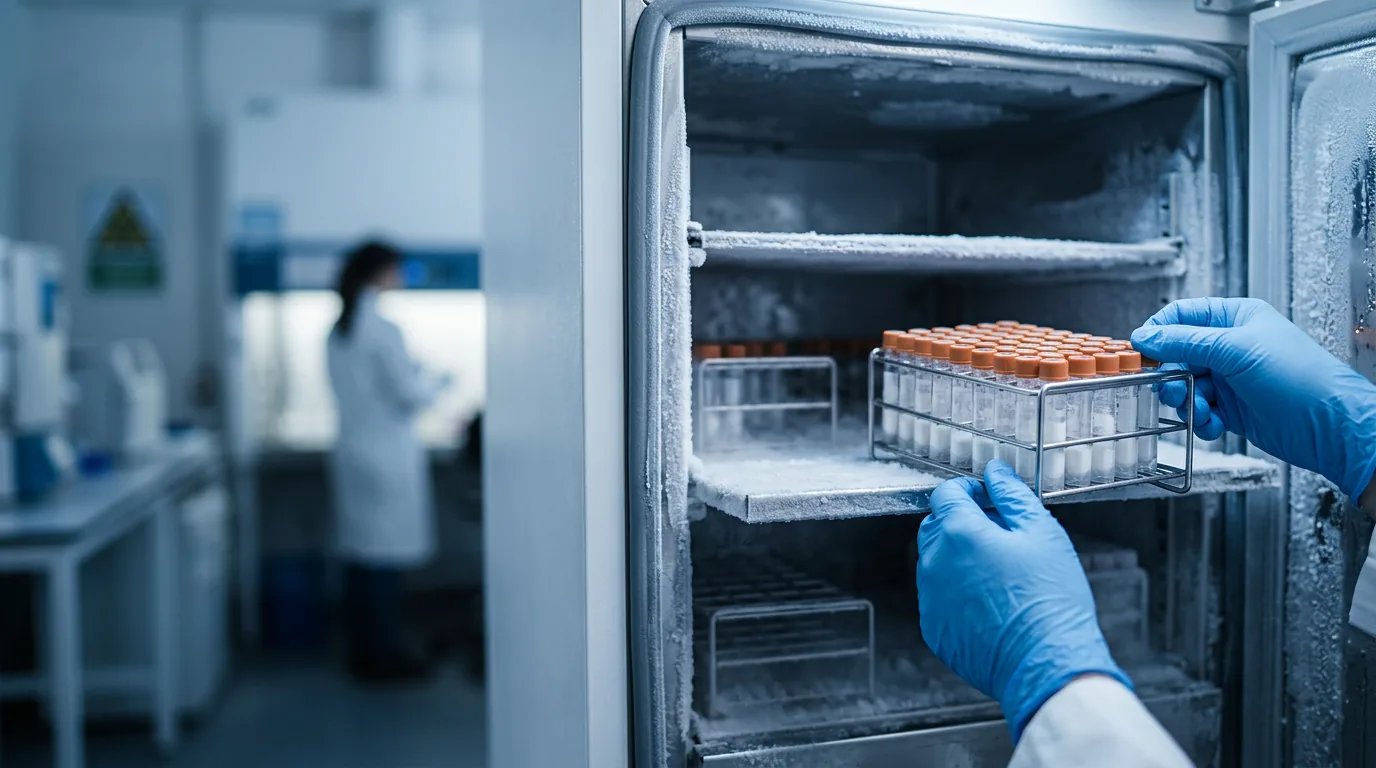
For optimal stability, researchers must store lyophilized Research Use Only (RUO) peptides at -20°C for long-term preservation, or at 4°C for short-term laboratory handling under 30 days. How to store research peptides correctly is a foundational laboratory protocol, as improper temperature control, ultraviolet light exposure, and ambient humidity rapidly degrade these high-purity compounds. All peptide storage and handling protocols discussed in this guide are strictly for laboratory methodology, as these compounds are exclusively for Research Use Only (RUO) and not for human consumption, medical, veterinary, or cosmetic use.
Maintaining the structural integrity of lyophilized peptide storage requires meticulous environmental control. Researchers investigating cellular mechanisms rely on consistent compound stability to ensure reproducible preclinical data. When storing freeze-dried peptides, laboratory technicians must utilize sealed, opaque vials to prevent moisture contamination and light-induced degradation. Furthermore, minimizing freeze-thaw cycles through precise aliquoting protocols is critical, as repeated temperature fluctuations cause mechanical stress and aggregation that compromise the accuracy of high-purity RUO compound research.
How do you store lyophilized research peptides?
For optimal stability, researchers must store lyophilized Research Use Only (RUO) peptides at -20°C for long-term preservation, or at 4°C for short-term laboratory handling under 30 days[1][2][3]. All peptide storage protocols are strictly for laboratory methodology, as these compounds are exclusively for Research Use Only (RUO) and not for human consumption.
Establishing a rigorous temperature control protocol is vital for maintaining the stability of freeze-dried compounds. Lyophilized research peptides should generally be stored at -20°C or colder, ideally in a dry, dark, tightly sealed container[1][2][3]. While 4°C may be acceptable for short-term handling, room temperature is usually limited to brief periods or shipping, because stability at ambient conditions is highly sequence-dependent and humidity-dependent[1][2][3]. For the most sensitive sequences, laboratories often utilize -80°C deep-freeze storage[1][2][4].
| Storage Environment | Temperature Range | Stability Timeline | Laboratory Application |
|---|---|---|---|
| Room Temperature | 20°C to 25°C | Days to weeks, highly dependent on moisture[3][5] | Brief handling and transit only |
| Standard Refrigeration | 4°C | Weeks, generally suitable for short-term use[6][4] | Active experimental phases |
| Standard Freezer | -20°C | Months to years under dry, sealed conditions[1][2] | Routine long-term preservation |
| Deep Freeze | -80°C | Extended long-term preservation[1][2][4] | Maximum shelf life for labile sequences |
Laboratory technicians must note that dry peptide stability significantly exceeds solution stability. Reconstituted peptides are far less stable and are often only viable for about a week at 4°C, whereas frozen aliquots at -20°C or below maintain integrity for much longer durations[1][3][4]. Because there is no universal room-temperature stability timeline for lyophilized peptides, laboratory personnel must adjust protocols based on the specific sequence and residual moisture of the high-purity RUO compounds[1][3][4].
How do you protect RUO peptides from moisture and light?
Lyophilized research peptides degrade rapidly when exposed to ultraviolet light and ambient humidity, requiring storage in sealed, opaque vials away from direct laboratory lighting[2][3][4]. Allowing vials to equilibrate to room temperature before opening prevents condensation and moisture contamination within the container[7][8][5].
Humidity is a primary failure mode in RUO peptide handling. Even when thoroughly lyophilized, peptides can degrade swiftly if they absorb ambient moisture, making airtight seals, desiccants, and limited vial opening essential laboratory practices[1][3][4]. When researchers transfer vials from -20°C or -80°C storage to the laboratory bench, the temperature differential creates a high risk of condensation forming directly on the hygroscopic peptide powder. To prevent this, technicians must allow the sealed vial to reach room temperature in a desiccator before opening[9][7][8]. This equilibration step ensures that ambient moisture does not compromise the structural integrity of the compound prior to reconstitution.
Light exposure also plays a significant role in preventing peptide degradation. Multiple laboratory guidelines recommend storing peptides away from bright light or utilizing amber packaging to shield the compounds from ultraviolet radiation[2][3][4]. Photodegradation can alter the molecular structure of sensitive residues, skewing the data in preclinical models.
Furthermore, the specific amino acid sequence dictates the compound’s vulnerability to environmental factors. Peptides containing residues such as cysteine, methionine, asparagine, glutamine, and tryptophan are frequently cited as more sensitive during storage, particularly once placed in solution[3][4][7]. For these highly reactive sequences, laboratories must employ stringent controls, often utilizing inert gas purging to displace oxygen and prevent oxidative degradation[9][10][6]. By combining desiccation, light-protective packaging, and proper temperature equilibration, researchers ensure the reliability of their peptide reconstitution laboratory guide protocols.
Does freezing and thawing degrade laboratory peptides?
Laboratory technicians must minimize freeze-thaw cycles, as repeated temperature fluctuations degrade peptide integrity and compromise the accuracy of high-purity RUO compound research[9][11][12]. Aliquoting peptides into single-use experimental volumes is the standard laboratory methodology to avoid repeated freezing and thawing[9][13][2].
Freeze-thaw cycles measurably damage peptide structural integrity through several destructive mechanisms, primarily aggregation, oxidation, hydrolysis, and pH shifts around ice crystals[9][11][12]. Freezing aqueous peptide solutions produces ice crystals that physically disrupt molecular structure[14][12][15]. Concurrently, as water freezes, salts, buffers, and peptides become highly concentrated in the remaining unfrozen microvolumes, driving protein unfolding at the ice-aqueous interface[12][16]. Repeated cycles predominantly cause aggregation, which removes the peptide from the soluble, active fraction and diminishes its functional properties in research applications[9][2][11].
To prevent this degradation, laboratories must implement strict aliquoting protocols immediately following reconstitution.
- Equilibrate and Reconstitute: Allow the lyophilized vial to reach room temperature in a desiccator[9][7]. Add the appropriate solvent, dissolving the peptide by gentle swirling[9][14].
- Immediate Aliquoting: Dispense the stock solution into single-use aliquots using sterile, low-protein-binding microcentrifuge tubes[9][13][14].
- Controlled Storage: Store the aliquots at -20°C for short-term handling or -80°C for long-term preservation[9][13][2].
- Rapid Thawing: When required for an assay, remove one aliquot and thaw it quickly to minimize the time the peptide spends at a high solute concentration, as slow thawing increases aggregation[9][14][12]. Use the aliquot immediately and discard any remaining solution[9][2][14].
By ensuring each aliquot is thawed only once, researchers maintain the rigorous standards required for peptide quality control and analytical testing procedures, preserving the molecular stability necessary for precise scientific investigation.
Frequently Asked Questions
How do you store lyophilized research peptides?
Lyophilized research peptides must be stored at -20°C or colder in a dry, dark, tightly sealed container for long-term preservation[1][2][3]. For short-term laboratory handling under 30 days, 4°C is acceptable, but room temperature storage should be strictly limited to brief transit periods[1][2][3]. These protocols apply exclusively to Research Use Only (RUO) compounds, which are not for human consumption.
How long do freeze-dried peptides last at room temperature?
At room temperature, lyophilized peptides may remain stable for days to weeks, but this timeline depends heavily on the specific amino acid sequence, residual moisture, and packaging[3][5][8]. Because ambient stability is unreliable, laboratories should avoid room temperature storage and utilize -20°C freezers[1][2][3].
Does freezing and thawing degrade laboratory peptides?
Yes, freeze-thaw cycles measurably damage peptide structural integrity by inducing mechanical stress from ice crystals, accelerating oxidation, and causing widespread aggregation[9][11][12]. To prevent this, researchers must divide reconstituted solutions into single-use aliquots, ensuring each volume is thawed only once before experimental application[9][13][2].
How do you protect RUO peptides from moisture?
To protect RUO peptides from ambient humidity, technicians must store vials in tightly sealed containers with desiccants[1][3][4]. Frozen vials must be allowed to equilibrate to room temperature inside a desiccator before opening, preventing ambient moisture from condensing directly onto the hygroscopic lyophilized powder[9][7][8].
References
- [PDF] WORKING WITH PEPTIDES – ProImmune. https://www.proimmune.com/wp-content/uploads/2021/08/ST55.pdf (2026-03-11)
- How to Store Peptides | Best Practices for Researchers. https://www.jpt.com/blog/how-to-store-peptides/ (2026-06-19)
- Peptide Handling, dissolution & Storage – NIBSC. https://nibsc.org/science_and_research/virology/cjd_resource_centre/available_samples/peptide_library/peptide_storage.aspx (2026-06-25)
- Handling and Storage Guidelines for Peptides and Proteins. https://www.sigmaaldrich.com/US/en/technical-documents/technical-article/research-and-disease-areas/cell-and-developmental-biology-research/handling-and-storage (2023-10-14)
- How Long Do Peptides Last at Room Temperature?. https://www.creative-peptides.com/resources/how-long-do-peptides-last.html (2025-01-10)
- Lyophilized Peptide Storage: Temperature, Humidity, & Light. https://verifiedpeptides.com/knowledge-hub/lyophilized-peptide-storage-temperature-humidity-light/ (2025-06-08)
- Handling and Storage Guidelines for Peptides – Bachem. https://www.bachem.com/knowledge-center/handling-and-storage-guidelines-for-peptides/ (2026-03-15)
- Peptide solubility and storage – AltaBioscience. https://altabioscience.com/articles/peptide-storage-and-solubility/ (2020-02-11)
- [PDF] How to prevent repeated freeze-thaw cycles of peptide stock solutions. https://www.benchchem.com/pdf/How_to_prevent_repeated_freeze_thaw_cycles_of_peptide_stock_solutions.pdf (2025-12-03)
- Peptide Storage & Shelf Life: How to Store BPC-157, Tirzepatide …. https://www.durhampeptides.ca/post/peptide-storage-shelf-life-guide (2026-04-30)
- The Effects of Iterative Freeze–Thaw Cycles on the Structure … – PMC. https://pmc.ncbi.nlm.nih.gov/articles/PMC12610318/ (2025-10-23)
- Freeze–thaw characterization process to minimize aggregation and …. https://www.nature.com/articles/s41598-021-90772-9 (2021-05-31)
- Best Practices for Peptide Storage and Stability. https://argpeptides.com/best-practices-for-peptide-storage-and-stability/ (2025-11-21)
- Reconstituting and Storing MOTS-c Research Peptide. https://palmettopeptides.com/blogs/news/motsc-reconstitution-storage-lab-best-practices (2026-04-14)
- Freeze–thaw induced structural destabilization and oxidation of beef …. https://www.sciencedirect.com/science/article/abs/pii/S0308814626012264
- Freeze-Thaw Cycles and Why We Shouldn't Do It – Bitesize Bio. https://bitesizebio.com/19700/freeze-thaw-cycles-and-why-we-shouldnt-do-it/ (2025-06-06)