
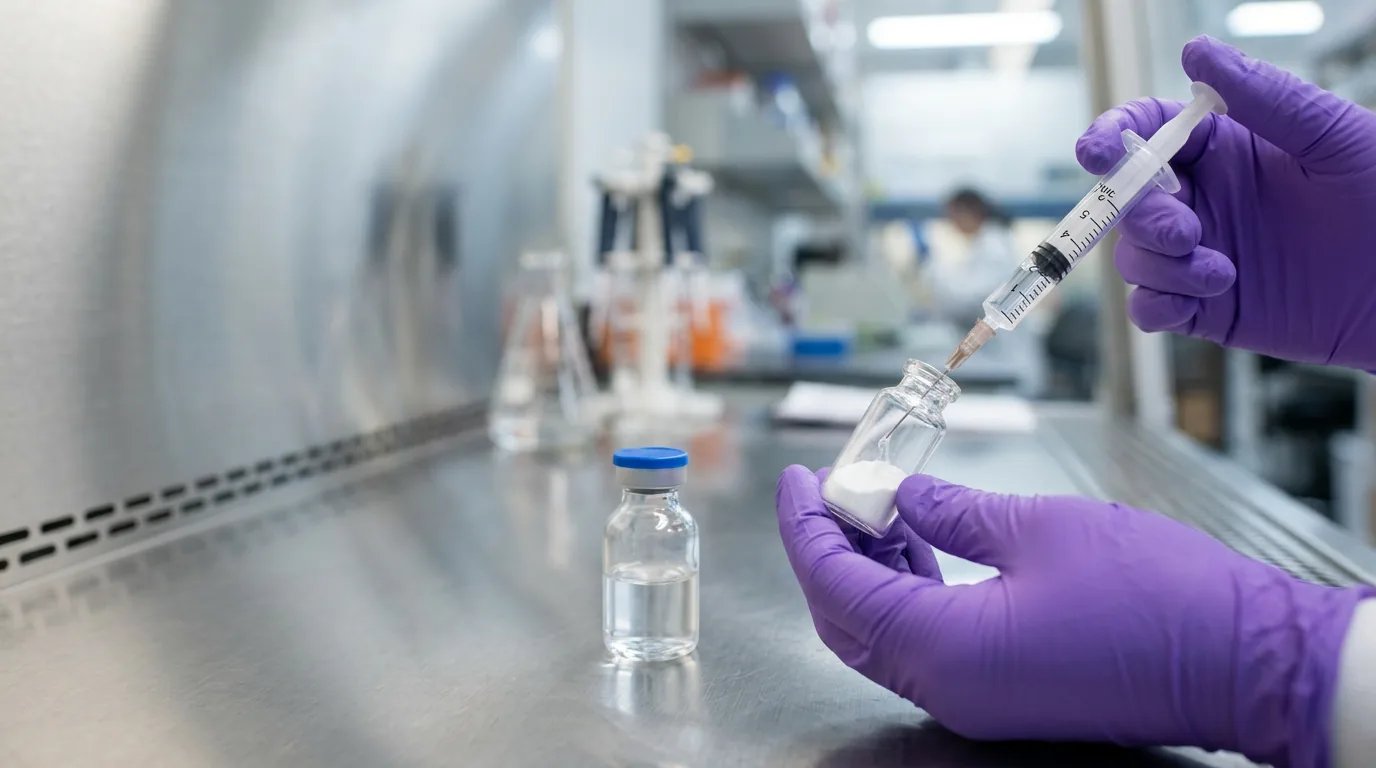
Reconstituting research peptides involves dissolving lyophilized powder with a sterile solvent, typically bacteriostatic water, strictly for in vitro laboratory analysis and Research Use Only (RUO). This process requires precise temperature acclimation and gentle mixing to preserve the compound’s molecular integrity before laboratory testing begins. All peptide reconstitution protocols—and Nautilus Peptides products—are strictly for Research Use Only (RUO) and are never intended for human consumption, medical administration, or veterinary use.
This guide details the standard laboratory methodology for how to reconstitute peptides, compares solvent options, and outlines handling procedures required to maintain stability during prolonged research.
How do you reconstitute research peptides?
Reconstituting research peptides involves dissolving lyophilized powder with a sterile solvent, typically bacteriostatic water, strictly for in vitro laboratory analysis and Research Use Only (RUO). A properly reconstituted peptide solution must appear 100% clear and free of floating particulates before researchers can proceed with any laboratory testing or molecular evaluation[1][2][3][4].
Laboratory technicians follow a standardized methodology to prevent mechanical shear, aggregation, and temperature stress during solvent addition.
- Acclimate the vial: Allow lyophilized peptide vials to equilibrate from refrigerated or frozen storage to room temperature (~20–25 °C) before breaking the seal[5][6][7][8][9]. This requires 10–15 minutes from a refrigerator[5][3][4] or 15–30 minutes from a freezer[6][7][9]. This prevents condensation from introducing uncontrolled moisture into the powder[10][5][8][4].
- Prepare the solvent: Wipe the stoppers with 70% isopropanol and allow 30 seconds for evaporation[8][3][4][11]. Draw the calculated volume of bacteriostatic water.
- Inject down the wall: Insert the syringe needle through the rubber stopper at a 45° angle, directing the tip toward the inner glass wall rather than the lyophilized cake[5][12][2][13][7][8][3][9]. Deliver the solvent in a slow, steady stream over 10–15 seconds so it flows down the wall and pools gently[10][14][1][12][2][8][15][3]. Directly blasting the powder causes foaming and mechanical shear that can denature sensitive peptide structures[1][13][8][3][16].
- Mix gently: Never vortex or shake vigorously[10][17][18][19][2][6][7][8][3][4][16]. Instead, roll the vial between the palms or gently swirl it in a slow circular motion for 10–15 rotations[10][20][14][1][21][2][8][3]. Most well-lyophilized peptides dissolve within 30–60 seconds[22][7][8].
All resulting solutions are strictly for laboratory evaluation.
Should I use bacteriostatic water or sterile water for peptides?
Laboratory technicians primarily use bacteriostatic water containing 0.9% benzyl alcohol to reconstitute peptides, preventing bacterial growth and extending compound stability during prolonged research. While sterile water is suitable for immediate single-use laboratory assays, bacteriostatic water is required for multi-use vials to maintain sterility over extended observation periods[23][24][25].
The choice of solvent dictates how researchers store research peptides after the initial puncture. Benzyl alcohol is a bacteriostatic agent that disrupts bacterial cell membranes, inhibiting the replication of bacteria and fungi over time[25][26][27][28].
| Solvent Type | Composition | Laboratory Application | Usable Refrigerated Shelf Life |
|---|---|---|---|
| Bacteriostatic Water | Sterile water with 0.9% benzyl alcohol (9 mg/mL)[23][26][29][30] | Multi-dose research vials accessed repeatedly over weeks[31][24][25][32] | Up to 28 days[33][23][34][35][24][27][30][36][37] |
| Sterile Water | Preservative-free sterile water[34][25] | Single-session assays or assays highly sensitive to preservatives[35][25][26] | 24–48 hours[33][35][26] |
For multi-day dosing studies, bacteriostatic water is the standard. Studies show that compounds like Melanotan II reconstituted in bacteriostatic water at 4°C retained 98.2% integrity after 21 days, whereas the same peptide in preservative-free saline dropped to 76% purity due to microbial protease activity[27]. Sterile water contains no antimicrobial protection, meaning each needle puncture risks introducing microbes that will proliferate freely[24][38]. Researchers treating a vial with sterile water must either consume the volume immediately or freeze aliquots at −20°C to halt degradation[34][24][39]. For questions regarding bulk laboratory supplies or specific RUO protocols, researchers can contact our team to get started.
Frequently Asked Questions
How do you reconstitute research peptides?
Reconstituting research peptides involves acclimating the lyophilized vial to room temperature, injecting a sterile solvent like bacteriostatic water slowly down the inner glass wall, and gently swirling the vial to dissolve the powder. Vigorous shaking or vortexing must be avoided to prevent mechanical shear and structural degradation.
Should I use bacteriostatic water or sterile water for peptides?
Laboratory technicians primarily use bacteriostatic water containing 0.9% benzyl alcohol to reconstitute peptides for multi-use vials, as the preservative inhibits bacterial growth for up to 28 days[33][23][34][35][24][27][30][36][37]. Sterile water lacks preservatives and is restricted to immediate, single-use laboratory assays where the solution is utilized within 24 to 48 hours[33][35][26].
What is the correct solvent ratio for peptide reconstitution?
The solvent ratio depends on the target concentration for the assay. A common laboratory standard for a 5 mg vial is 2 to 3 mL of bacteriostatic water, yielding a concentration of roughly 1.6 to 2.5 mg/mL[20][40]. Concentrations exceeding 3 to 5 mg/mL increase the risk of peptide aggregation and cold-induced precipitation[37][41][42][43].
Why is my reconstituted peptide solution cloudy?
A properly reconstituted peptide solution must appear 100% clear. Persistent cloudiness indicates incomplete dissolution, structural aggregation, cold-induced precipitation, or microbial contamination[37][44][45][46][47][48][49]. If the solution remains cloudy after 30 minutes of gentle swirling, researchers should increase the solvent volume to lower the concentration; if it fails to clear, the solution should not be used.
References
- How to Mix Retatrutide Peptide for Accurate Research. https://www.realpeptides.co/how-to-mix-retatrutide-peptide/ (2025-12-12)
- How to Reconstitute Peptides (2026) | GP. https://greypeptides.com/articles/how-to-reconstitute-peptides/ (2026-03-01)
- Peptide Reconstitution Guide – Protocols & Best Practices. https://peptiderecon.com/guides/safety/reconstitution-guide (2024-11-01)
- Complete Guide to Research Peptide Reconstitution (2025). https://www.bioinfinitylab.com/research/guides/peptide-reconstitution (2025-02-14)
- How to Reconstitute Peptides: Ultimate Guide with … – Peptides.SO. https://peptides.so/learn/how-to-reconstitute-peptides (2026-01-27)
- How to Reconstitute Lyophilized Peptides: Step-by- …. https://biolongevitylabs.com/quality/how-to-reconstitute-peptides/ (2025-11-26)
- How to Reconstitute Peptides (2026 Lab Protocol). https://bestpeptidesforyou.com/guides/how-to-reconstitute-peptides (2026-05-01)
- Peptide Reconstitution Guide for Research | Step-by-Step. https://blackandwhitepeptides.co.uk/research/reconstitution-guide.html (2026-04-26)
- How to Reconstitute Retatrutide Research Peptide. https://palmettopeptides.com/blogs/news/06-how-to-reconstitute-retatrutide-research-peptide (2026-03-30)
- How To Handle And Weigh Lyophilized Powder – Eurolab Peptides. https://eurolabpeptides.com/2026/06/26/how-to-handle-and-weigh-lyophilized-powder-a-technical-laboratory-guide/ (2026-06-26)
- The Complete Peptide Guide: Reconstitution, Injection & …. https://extension.health/the-complete-peptide-guide-reconstitution-injection-storage/ (2026-01-16)
- Peptide Reconstitution: Complete Research Guide (2026) | Peptide …. https://peptidemind.com/peptide-reconstitution-guide (2026-04-02)
- How to mix peptides: a precise guide for researchers. https://genetra.io/how-to-mix-peptides-precise-guide-for-researchers/ (2026-04-06)
- Mixing Peptides: The Correct Process for Reconstitution – Biology Insights. https://biologyinsights.com/mixing-peptides-the-correct-process-for-reconstitution/ (2025-07-29)
- Peptide Reconstitution & Storage. https://peptidesupply.org/guides/peptide-reconstitution-storage/ (2026-02-12)
- Reconstitution of Peptides. https://life-peptide.com/page/reconstitution-of-peptides (2026-03-26)
- How to Reconstitute Peptides. https://www.jpt.com/blog/how-to-reconstitute-peptides/ (2026-06-29)
- Frequently Asked Questions. https://exploring-peptides.com/article/common-mistakes-when-reconstituting-peptides/ (2026-04-29)
- How to Reconstitute Peptides Properly. https://legendarypeptides.com/articles/how-to-reconstitute-peptides-properly/ (2026-05-23)
- Everything You Need to Know About Reconstituting / Mixing Peptides. https://www.uk-peptides.com/reconstituting-for-peptides (2026-06-30)
- How to Reconstitute Ipamorelin — Peptide Mixing Guide. https://www.realpeptides.co/how-to-reconstitute-ipamorelin-2/ (2026-03-25)
- Lyophilization Basics: Why Research Peptides Ship as Powder – Frontier Peptide Labs. https://frontierpeptidelabs.com/guides/lyophilization-basics-why-research-peptides-ship-as-powder/ (2026-05-18)
- Bacteriostatic Water vs Sterile Water for Peptides: Which to Use. https://peptidereconstitute.com/blog/bacteriostatic-water-vs-sterile-water/ (2026-02-13)
- Bacteriostatic Water For Peptide Research | Cenexa Labs. https://cenexalabs.com/bacterostatic-water-peptide-reconstitution-solution/ (2026-03-24)
- BAC Water vs Sterile Water for Peptide Reconstitution: Lab Guide | Palmetto Peptides. https://palmettopeptides.com/blogs/news/bac-water-vs-sterile-water-peptide-reconstitution (2026-05-14)
- Bacteriostatic Water for Peptide Research: What It Is. https://palmettopeptides.com/blogs/news/bacteriostatic-water-for-peptide-research (2026-04-09)
- Amazon Bacteriostatic Water Ban: Peptide Reconstitution Guide. https://peptide.express/research/amazon-bacteriostatic-water-ban-peptide-reconstitution (2026-04-01)
- BAC Water | Research Peptide – VivePeptides. https://vivepeptides.com/product/bac-water/ (2026-07-01)
- Bacteriostatic Water: Research Reconstitution Guide 2026. https://hatipeptides.co.uk/research/bacteriostatic-water (2026-06-05)
- Critical Bacteriostatic Water Guide [2026] – PurePep Vital. https://www.purepepvital.com/blog/bacteriostatic-water-for-peptides (2026-03-07)
- Bacteriostatic Water & Why Essential for Peptide Research. https://ck-peptides.com/what-is-bacteriostatic-water-bac-water/ (2026-01-08)
- Bacterial Contamination In Peptide Solutions. https://cenexalabs.com/bacterial-contamination-prevention-peptide-solutions/ (2026-06-29)
- Understanding Peptide Reconstitution: Bacteriostatic Water …. https://uaepeptides.com/peptide-reconstitution-guide/ (2026-03-11)
- Bacteriostatic Water vs Sterile Water in Research Peptide Reconstitution – Frontier Peptide Labs. https://frontierpeptidelabs.com/guides/bacteriostatic-water-vs-sterile-water-in-research-peptide-reconstitution/ (2026-05-18)
- Reconstitution Solution vs Bacteriostatic Water for Peptides. https://biolongevitylabs.com/quality/reconstitution-solution-vs-bacteriostatic-water/ (2026-02-04)
- Peptide Contamination Risks: What Can Go Wrong and How to. https://formblends.com/articles/safety-hub/peptide-contamination-risks (2026-04-06)
- Peptide solutions: complete guide to reconstitution, solvents, and …. https://www.seekpeptides.com/blog/articles/peptide-solutions (2026-04-02)
- Bacteriostatic Water: The Superior Choice for Reconstituting Peptides. https://www.uk-peptides.com/blog/bacteriostatic-water-the-choice-for-peptides (2023-07-19)
- Small Research Kit | Syringes, Prep Pads & Bac Water. https://aminocoreresearch.com/peptides/small-research-kit-syringes-prep-pads-and-bac-water (2026-06-06)
- How to Reconstitute Peptides: A Step-by-Step Guide for …. https://www.elementsarms.com/blog/post/how-to-reconstitute-peptides-a-step-by-step-guide-for-beginners (2023-10-31)
- How to Reconstitute Lyophilized Peptides: Best Practices. https://verifiedpeptides.com/knowledge-hub/how-to-reconstitute-lyophilized-peptides-best-practices/ (2026-02-04)
- Why Did My Peptide Turn Cloudy or Gel After Reconstitution?. https://www.polybiotech.co/blogs/news/why-did-my-peptide-turn-cloudy-or-gel-after-reconstitution (2025-12-21)
- Complete Peptide Reconstitution Guide (2026) — Every Ratio,. https://www.bodyhackguide.co/blog/complete-peptide-reconstitution-guide-2026 (2026-04-21)
- Why did my peptide solution turn cloudy after reconstitution?. https://peptidehelpdesk.com/reconstitution/why-did-my-peptide-solution-turn-cloudy-after-reconstitution (2024-11-01)
- why is my peptide cloudy Reconstituted peptides should be clear. https://dfhqhq.guru/1d29a/86-why-is-my-peptide-cloudy/ (2026-03-07)
- What Does It Mean If Your Peptide Solution Is Cloudy?. https://www.reddit.com/r/PeptideProgress/comments/1q976w5/what_does_it_mean_if_your_peptide_solution_is/ (2026-01-10)
- Why Did My Peptide Turn Cloudy or Gel-Like?. https://revitalizepeptidelab.com/why-did-my-peptide-turn-cloudy-or-gel-like/ (2026-01-17)
- How to Reconstitute Peptides: Complete UK Laboratory …. https://peptideslabuk.com/how-to-reconstitute-peptides-complete-uk-laboratory-guide-2026/ (2026-04-11)
- Guide: peptide reconstitution | The Element Research. https://the-element-research.com/en/guide/ (2026-06-29)