
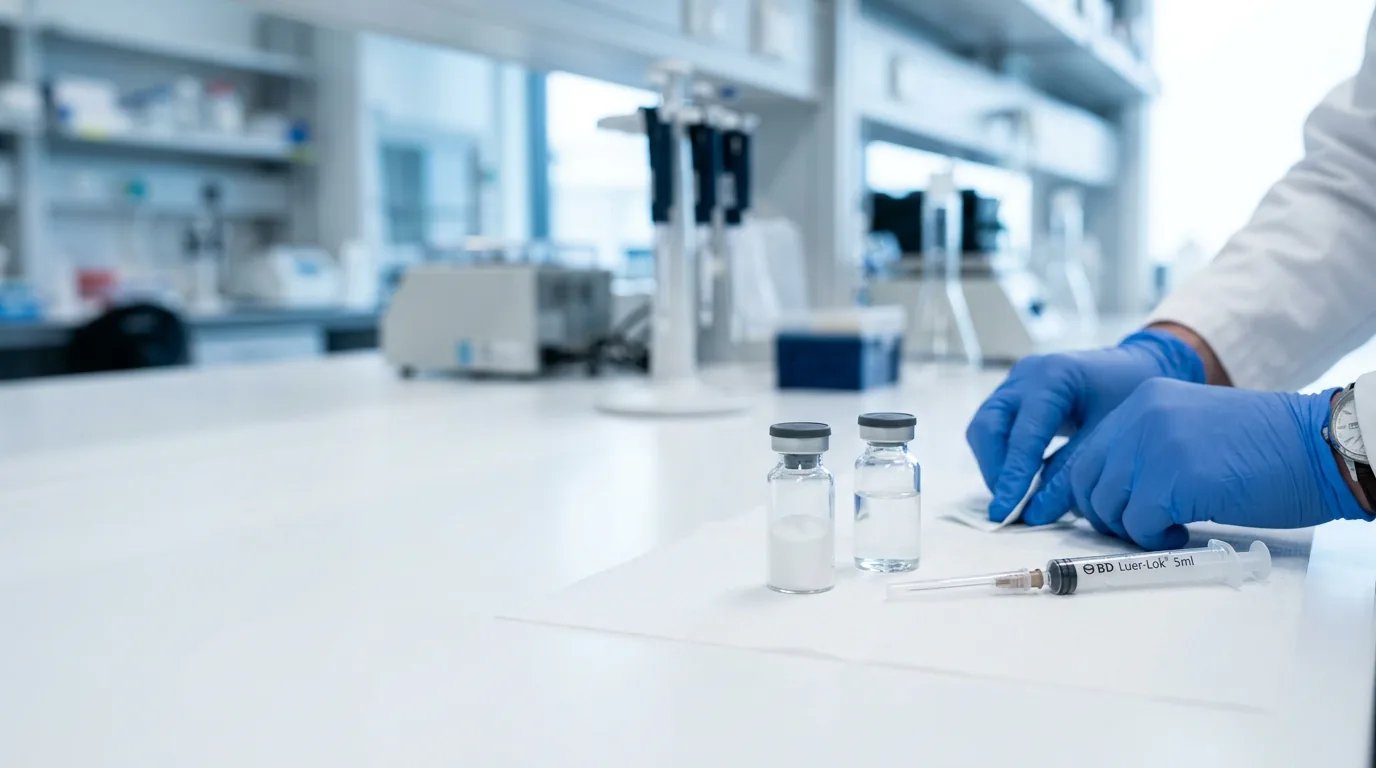
Peptide reconstitution is the laboratory process of dissolving lyophilized research peptides into a liquid solution, typically using bacteriostatic water, strictly for in vitro research use only. Researchers must add the solvent slowly and swirl the vial gently, as shaking can permanently degrade fragile peptide bonds and ruin the research compound. All protocols and materials are designed exclusively for laboratory research and are strictly not for human consumption.
⚠️ RESEARCH USE ONLY (RUO) NOTE: The products and methodologies detailed in this guide are strictly for laboratory research and in vitro studies. They are not intended for human consumption, medical, veterinary, or cosmetic use. No compounds should be used to diagnose, treat, cure, or prevent any disease.
This guide details the precise laboratory methodology for how to reconstitute peptides, including preparation steps, required materials, and critical storage parameters to maximize shelf stability.
How do you reconstitute lyophilized peptides?
To reconstitute lyophilized peptides, laboratory personnel must slowly add a sterile solvent – typically bacteriostatic water – down the inside wall of the vial and mix the solution using a gentle swirling motion. This process converts the freeze-dried powder into a liquid solution suitable for in vitro research. Researchers must avoid direct impact of the solvent on the powder cake, as this can cause uneven wetting and foaming[1][2].
The laboratory methodology requires strict adherence to sterile techniques to prevent contamination.
- Prepare the workspace: Sanitize the laboratory bench and ensure all materials, including the peptide vial and the bacteriostatic water, are at room temperature.
- Sanitize the vials: Wipe the stoppers of both the solvent and the peptide vial with sterile alcohol swabs. Allow the alcohol to evaporate.
- Extract the solvent: Using a sterile laboratory syringe, withdraw the precise volume of bacteriostatic water required for the research protocol.
- Inject the solvent slowly: Insert the needle into the peptide vial. Researchers must direct the stream of water slowly down the inside wall of the vial rather than directly onto the lyophilized powder[1][3].
- Mix gently: Once transferred, gently swirl or roll the vial until the powder is fully dissolved[1][4]. Researchers must never shake or vortex the vial, as excessive mechanical stress can cause structural perturbation, aggregation, and denaturation of sensitive peptides[3][5]. Many peptides dissolve within 30 to 60 seconds of gentle swirling[1][6].
Following these steps ensures the compound remains viable for precise laboratory investigation. If you require materials, contact Nautilus Peptides to equip your laboratory.
How do you store research peptides after reconstitution?
Unreconstituted lyophilized peptides can remain stable at -20 degrees Celsius for years, but reconstituted solutions must be refrigerated at 2 to 8 degrees Celsius. The introduction of water accelerates degradation pathways, including hydrolysis, oxidation, and deamidation, significantly reducing the usable window of the compound[7][8].
Lyophilization removes water, which dramatically limits microbial growth and chemical breakdown[7][9]. In this freeze-dried state, peptides stored in sealed, light-protected vials at -20 degrees Celsius maintain stability for 2 to 5 years, often retaining over 90 percent purity[10][11]. However, once researchers reconstitute the peptide with bacteriostatic water, the shelf life drops from years to weeks. The preservative in bacteriostatic water inhibits bacterial growth, allowing the solution to remain viable for approximately 28 to 30 days under refrigeration[12][13]. If plain sterile water without a preservative is used, the solution must typically be utilized within 24 hours to one week[14][15].
The table below outlines the comparative stability of research peptides based on their state and storage temperature.
| Peptide State | Storage Temperature | Typical Stability Window |
|---|---|---|
| Lyophilized powder | -20 degrees Celsius | 2 to 5 years[10][9] |
| Lyophilized powder | 2 to 8 degrees Celsius | 12 to 24 months[12][14] |
| Reconstituted solution (bacteriostatic water) | 2 to 8 degrees Celsius | 28 to 30 days[12][13] |
| Reconstituted solution (sterile water) | 2 to 8 degrees Celsius | 24 hours to 1 week[14][15] |
Researchers must monitor storage conditions rigorously. Moving a reconstituted vial from refrigerated conditions to room temperature can shrink the usable window from weeks to mere days[16][17]. For reliable in vitro studies, laboratory personnel should store all working stocks in dark environments and avoid unnecessary temperature fluctuations.
Frequently Asked Questions
How do you reconstitute lyophilized peptides?
Laboratory personnel reconstitute lyophilized peptides by slowly injecting a sterile solvent, such as bacteriostatic water, down the inner wall of the vial. The vial is then gently swirled or rolled until the powder dissolves completely[1][4]. This procedure is strictly for in vitro research use only.
What kind of water do you use to reconstitute peptides?
Researchers typically use bacteriostatic water, which contains a 0.9 percent benzyl alcohol preservative to inhibit microbial growth[13][15]. This extends the refrigerated shelf life of the reconstituted solution to approximately 28 to 30 days[12][13]. Plain sterile water is only used for immediate laboratory applications.
Should you shake a peptide vial to mix it?
No, researchers should never shake or vortex a peptide vial. Shaking creates excessive mechanical stress and foaming, which can cause structural perturbation, aggregation, and denaturation of the compound[3][5]. Mixing must be done through gentle swirling.
How do you store research peptides after reconstitution?
After reconstitution, peptide solutions must be stored in a refrigerator at 2 to 8 degrees Celsius, protected from light. Under these conditions, solutions mixed with bacteriostatic water remain stable for approximately 28 to 30 days before significant degradation occurs[12][13].
References
- Bacteriostatic Water for Peptide Research: What It Is. https://palmettopeptides.com/blogs/news/bacteriostatic-water-for-peptide-research (2026-04-09)
- Peptide Calculator: Reconstitution, Dosage & Syringe Units (Free). https://riteaid.com/tools/peptide-dosage-calculator (2026-07-17)
- Peptide Reconstitution Guide for Research | Step-by-Step. https://blackandwhitepeptides.co.uk/research/reconstitution-guide.html (2026-04-26)
- How to Reconstitute Peptides Step by Step | WPA. https://worldpeptideassociation.com/learn/peptide-reconstitution-guide (2025-01-01)
- How to Reconstitute Lyophilized Peptides: Best Practices. https://verifiedpeptides.com/knowledge-hub/how-to-reconstitute-lyophilized-peptides-best-practices/ (2025-05-23)
- Peptide Reconstitution Guide – Protocols & Best Practices. https://peptiderecon.com/guides/safety/reconstitution-guide (2024-11-01)
- Peptide Storage and Handling Guidelines – GenScript. https://www.genscript.com/peptide_storage_and_handling.html (2026-07-14)
- Handling and Storage Guidelines for Peptides and Proteins. https://www.sigmaaldrich.com/US/en/technical-documents/technical-article/research-and-disease-areas/cell-and-developmental-biology-research/handling-and-storage (2023-10-14)
- Recommendations for the generation, quantification, storage …. https://pmc.ncbi.nlm.nih.gov/articles/PMC4830481/ (2026-07-14)
- Peptide Storage & Stability: Temperature, Light, Degrad | FormBlends. https://formblends.com/research/guides/peptide-storage-stability-guide (2026-03-14)
- How to Store and Handle Synthesized Peptides. https://www.lifetein.com/How-to-store-and-handle-synthesized-peptides.html (2017-01-01)
- Peptide Storage Guide: How to Keep Your Research Peptides Stable. https://www.durhampeptides.ca/post/how-to-store-peptides (2026-04-01)
- Peptide Storage & Shelf Life: How to Store BPC-157, …. https://www.durhampeptides.ca/post/peptide-storage-shelf-life-guide (2026-05-01)
- Peptide Storage Stability Research Guide | Spartan Peptides. https://spartanpeptides.com/blog/peptide-storage-stability-reconstitution-research-guide/ (2026-06-20)
- How Long Do Peptides Last at Room Temperature?. https://www.creative-peptides.com/resources/how-long-do-peptides-last.html (2025-01-10)
- How to Store Peptides: Complete Storage and Handling Guide. https://peptidedossier.com/guides/peptide-storage/ (2026-02-27)
- Peptide Storage – OceanX Research. https://oceanxresearch.net/storage/ (2024-11-15)