
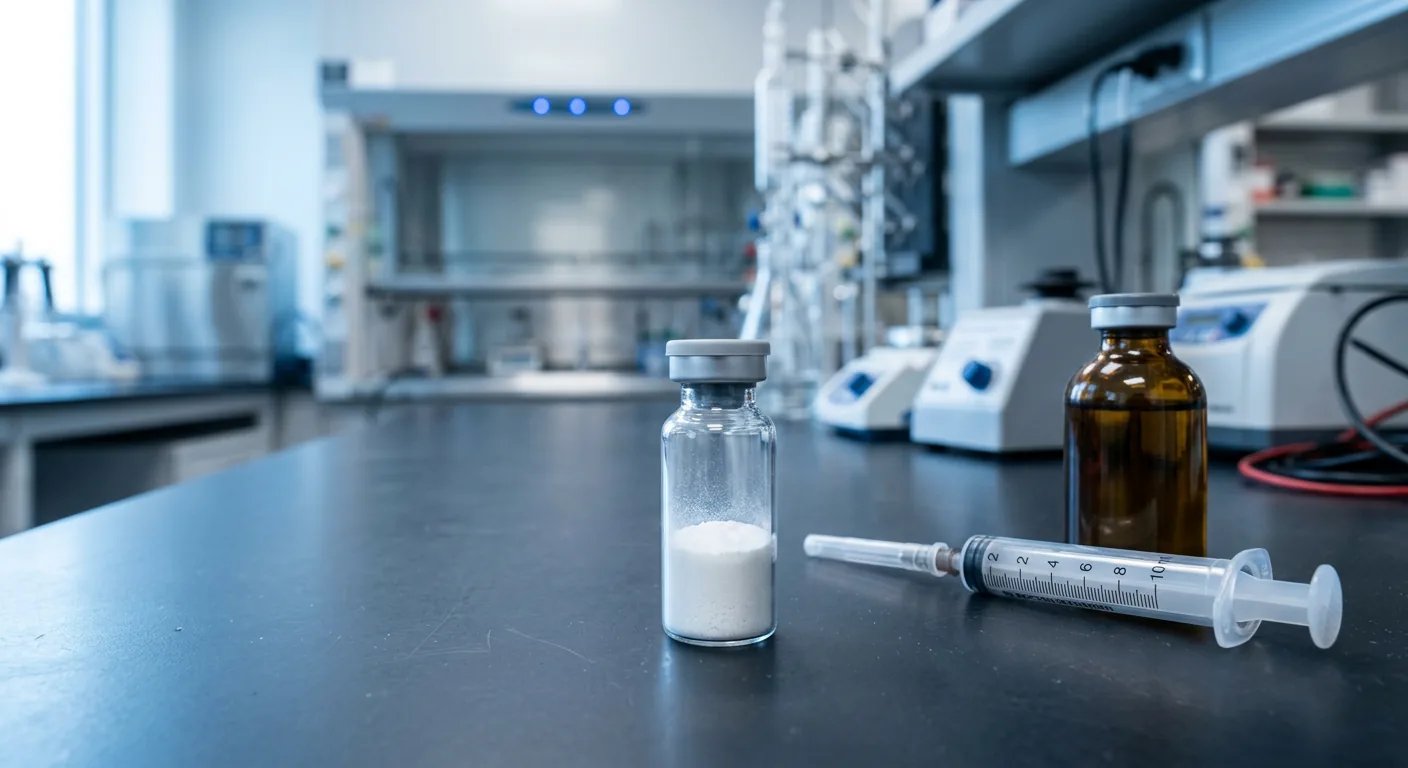
Nautilus Peptides provides research compounds in a lyophilized format to prevent rapid hydrolysis, ensuring greater than 99 percent purity is maintained during transport and laboratory storage. Lyophilized research peptides are freeze-dried under vacuum to remove moisture, creating a highly stable powder that resists the rapid chemical degradation typically observed in liquid solutions.
Critical Notice: All information and products discussed are strictly for Research Use Only (RUO). These compounds are not for human consumption, medical, veterinary, or cosmetic use. Proper laboratory methodology is strictly required, and these materials are intended exclusively for in vitro scientific investigation.
By supplying peptides in a lyophilized state, laboratories can confidently store unmixed compounds for extended periods without compromising their structural integrity. Once a researcher is ready to conduct an assay, the peptide is reconstituted with a sterile liquid medium immediately prior to application. This strategic approach isolates the compound from oxidative and hydrolytic stress until the exact moment of experimental use, ensuring highly reproducible data and protecting the laboratory’s investment in pure materials.
Why are research peptides sold as a lyophilized powder?
Research peptides are sold as a lyophilized powder primarily to halt rapid hydrolysis and preserve molecular integrity over time. In a liquid state, amino acid chains are highly susceptible to enzymatic cleavage, oxidation, and hydrolytic degradation. Lyophilization—the process of freezing the solution and extracting the solvent under a strict vacuum—removes the moisture required for these destructive chemical reactions to occur. This ensures that the greater than 99 percent purity confirmed by independent HPLC and mass spectrometry testing remains intact from the solid-phase peptide synthesis facility directly to the laboratory benchtop.
While lyophilized research peptides can remain stable for 12 to 36 months when stored at negative 20 degrees Celsius[1][2], their reconstituted liquid counterparts typically degrade within 14 to 30 days, even under strict refrigeration protocols[3][1]. The absence of water in the lyophilized cake significantly extends the shelf life, allowing laboratories to bulk-order compounds without risking batch degradation before the planned in vitro experiments.
| Storage Format | Typical Storage Temperature | Practical Stability Window |
|---|---|---|
| Lyophilized Powder (Long-term) | −20°C or colder | 12 to 36 months[1][2] |
| Lyophilized Powder (Short-term) | 2 to 8°C | Months (varies by sequence)[1][4] |
| Reconstituted with Bacteriostatic Water | 2 to 8°C | 28 to 30 days[3][5] |
| Reconstituted with Sterile Water | 2 to 8°C | 24 hours to 7 days[6][5] |
For optimal preservation, laboratories should keep unmixed vials in deep freeze conditions. The lyophilized format is the undisputed industry standard for RUO supply because it bridges the gap between high-purity synthesis and reliable in vitro application, safeguarding the peptide’s delicate structure against transit temperature fluctuations and long-term storage stress.
How do researchers reconstitute and store lyophilized peptides?
Proper laboratory methodology requires reconstituting lyophilized Research Use Only (RUO) peptides with bacteriostatic water immediately prior to in vitro experimental application. Bacteriostatic water contains 0.9 percent benzyl alcohol, which acts as a necessary preservative to inhibit microbial growth in the vial during short-term refrigerated storage[7].
To begin the reconstitution process, researchers must first allow both the lyophilized peptide vial and the bacteriostatic water to equilibrate to room temperature, which typically takes 10 to 30 minutes[8][9]. This step improves dissolution kinetics and prevents condensation from introducing excess moisture. Operating within a clean workspace, the researcher swabs the septa of both vials with 70 percent isopropyl alcohol and allows them to air-dry completely[10][9].
Using a sterile syringe, the exact pre-calculated volume of bacteriostatic water is drawn. The critical step in maintaining peptide integrity is the injection technique: the liquid must be expelled slowly down the inner glass wall of the peptide vial rather than sprayed directly onto the fragile powder cake[10][11]. Direct high-velocity streams can cause foaming and expose the molecule to the air-liquid interface, which denatures sensitive peptides and promotes rapid aggregation[12][11].
Once the liquid is added, the vial should never be shaken or vortexed. Instead, researchers should gently swirl the vial in a slow circular motion until the solution is completely clear and free of visible particles[10][9]. After successful dissolution, the laboratory must properly store reconstituted RUO peptides at 2 to 8 degrees Celsius and use them within their limited 28-day stability window to prevent degradation[13][14]. For high-purity laboratory supplies, contact Nautilus Peptides to equip your next in vitro study.
Frequently Asked Questions
Why are research peptides sold as a lyophilized powder?
Research peptides are sold as a lyophilized powder to prevent rapid hydrolysis and molecular degradation. Removing the moisture through freeze-drying stabilizes the amino acid chains, ensuring the compound maintains its purity during transport and storage prior to in vitro testing.
How long do lyophilized peptides stay stable compared to liquid?
Lyophilized research peptides can remain stable for 12 to 36 months when stored in a laboratory freezer at negative 20 degrees Celsius. In contrast, reconstituted liquid peptides typically degrade within 14 to 30 days, even when properly refrigerated.
How do I reconstitute a lyophilized peptide for laboratory research?
Proper laboratory methodology requires equilibrating the vials to room temperature, swabbing the septa with alcohol, and slowly injecting the precise volume of bacteriostatic water down the inner glass wall of the vial. The vial must then be gently swirled—never shaken—until the powder is fully dissolved.
What is the proper way to store reconstituted RUO peptides?
Reconstituted RUO peptides must be stored immediately in a laboratory refrigerator at 2 to 8 degrees Celsius, protected from direct light. To ensure experimental accuracy, these liquid solutions should be utilized for in vitro assays within their limited 28-day stability window.
References
- Peptide Storage Guide: Temperature & Shelf Life – Apex Laboratory. https://apexlab.org/peptide-storage-guide/ (2026-03-08)
- Peptide Stability & Storage — Lyophilized Guide. https://remypeptides.com/research/peptide-stability-storage-guide (2026-02-26)
- Peptide Storage & Stability: Temperature, Light, Degrad | FormBlends. https://formblends.com/research/guides/peptide-storage-stability-guide (2026-03-14)
- Peptide Storage and Handling Guide. https://peptidings.com/guides/storage/ (2026-03-14)
- Do Peptides Expire? Shelf Life, Storage & Degradation Guide. https://www.seekpeptides.com/blog/articles/do-peptides-expire (2026-03-23)
- Peptide Storage Stability Research Guide | Spartan Peptides. https://spartanpeptides.com/blog/peptide-storage-stability-reconstitution-research-guide/ (2026-06-20)
- Peptide Calculator Guide for Vial-Based Research Compounds. https://www.peptideregenesis.com/blogs/peptide-blog/peptide-calculator-research-guide (2026-01-02)
- Bacteriostatic Water for Peptide Research: What It Is. https://palmettopeptides.com/blogs/news/bacteriostatic-water-for-peptide-research (2026-04-09)
- Critical Bacteriostatic Water Guide [2026] – PurePep Vital. https://www.purepepvital.com/blog/bacteriostatic-water-for-peptides (2026-03-07)
- Peptide Reconstitution Guide – Protocols & Best Practices. https://peptiderecon.com/guides/safety/reconstitution-guide (2024-11-01)
- Complete Guide to Peptide Reconstitution for Laboratory Research. https://ironpeakpeptides.com/peptide-reconstitution-guide-researchers/ (2026-03-20)
- Peptide Reconstitution Guide for Research | Step-by-Step. https://blackandwhitepeptides.co.uk/research/reconstitution-guide.html (2026-04-26)
- How to Reconstitute Peptides: Complete UK Laboratory …. https://peptideslabuk.com/how-to-reconstitute-peptides-complete-uk-laboratory-guide-2026/ (2026-05-09)
- Bacteriostatic Water For Peptides: Complete Guide And Alternatives. https://www.seekpeptides.com/blog/articles/bacteriostatic-water-for-peptides (2026-03-05)