
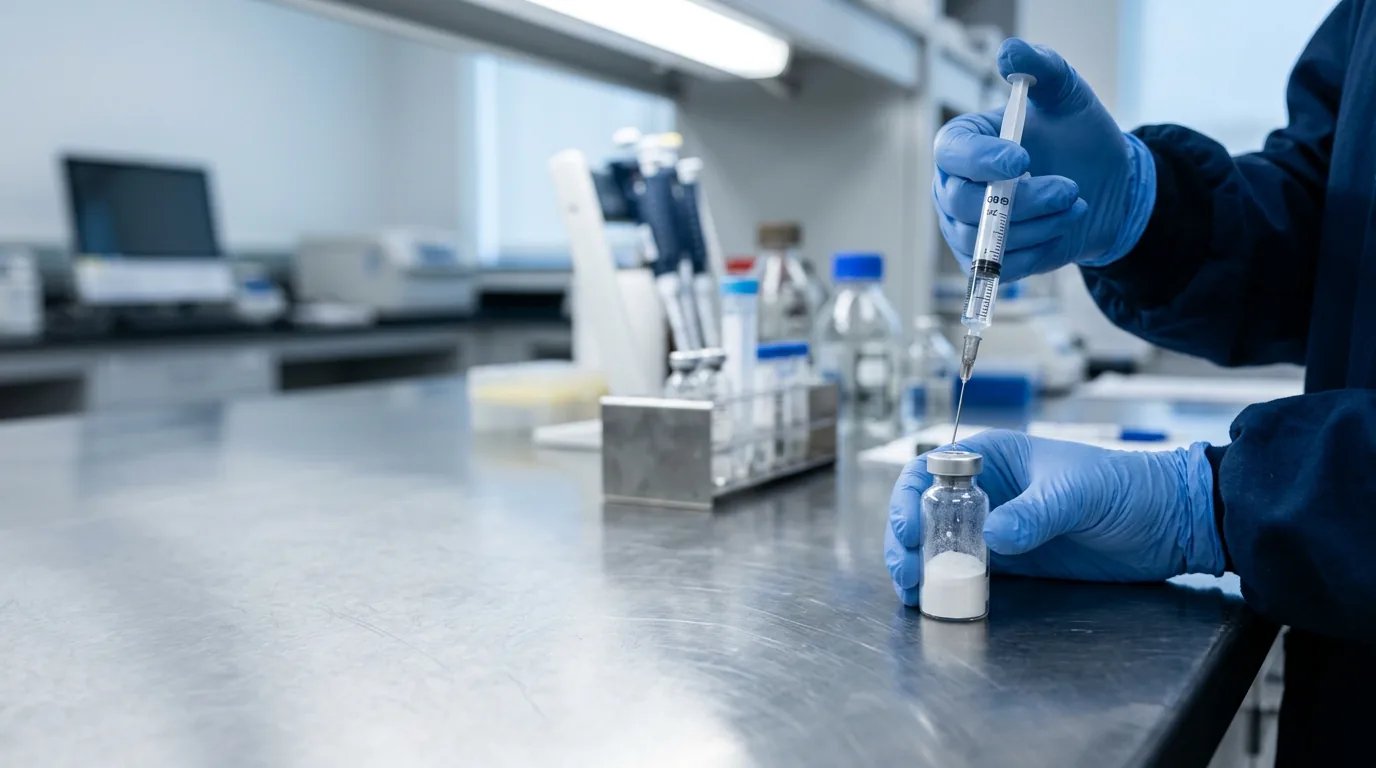
Reconstitution is the controlled laboratory process of adding a sterile solvent, typically bacteriostatic water, to a lyophilized research peptide to prepare it for in vitro study. This procedure ensures accurate molarity and preserves molecular stability for preclinical applications. All lyophilized peptides and reconstitution solvents provided by Nautilus Peptides are strictly for Research Use Only (RUO) and are never intended for human consumption, medical, veterinary, or cosmetic use.
Understanding how to reconstitute peptides correctly is essential for laboratory personnel handling sensitive compounds. This guide outlines standard sterile protocols for adding bacteriostatic water to freeze-dried peptides, selecting the appropriate solvent based on molecular characteristics, calculating precise in vitro concentrations, and maintaining optimal storage conditions to prevent degradation.
How do you reconstitute lyophilized peptides?
Reconstituting lyophilized peptides in a laboratory setting requires dissolving the dry compound in a sterile solvent under aseptic conditions, adding the liquid slowly down the vial wall, and mixing by gentle swirling rather than shaking[1][2][3]. For routine applications where a vial is accessed multiple times, bacteriostatic water is preferred because it contains 0.9% benzyl alcohol, which acts as an antimicrobial preservative[3][4].
Standard Laboratory Reconstitution Protocol
1. Temperature equilibration: Bring the lyophilized peptide vial and the chosen solvent to room temperature before reconstitution to minimize condensation[1][3].
2. Sterilization: Disinfect all rubber stoppers with alcohol and allow them to dry completely before puncturing[3][5].
3. Solvent addition: Withdraw the calculated solvent volume using a sterile syringe. Inject the liquid slowly along the inside glass wall of the peptide vial to prevent direct impact on the powder cake[1][3][6].
4. Dissolution: Mix the solution by gentle swirling or rolling. Never shake, vortex, or tap the vial vigorously, as this can cause foaming and structural damage to sensitive peptides[1][3][6].
5. Verification: Allow 15 to 30 minutes for full dissolution[1]. Inspect the solution for clarity; a 0.22 µm filter may be utilized if absolute sterility is required post-dissolution[1][2].
Solvent Selection Guide
Matching the solvent to the peptide’s specific chemical properties is critical for complete dissolution[1][2][7].
| Solvent Type | Recommended Laboratory Application | Key Characteristic |
|---|---|---|
| Bacteriostatic Water | Routine in vitro studies requiring multiple vial accesses | Contains 0.9% benzyl alcohol to inhibit microbial growth[3][6] |
| Sterile Water | Immediate or short-term use for neutral, hydrophilic peptides | Contains no preservatives[2][3] |
| Mild Acids (e.g., dilute acetic acid) | Basic, hydrophobic, or aggregation-prone peptides | Used for pre-solubilization before final dilution[7] |
How do you calculate peptide concentration and store reconstituted solutions?
For precise molarity in laboratory research, personnel calculate concentration by dividing the peptide mass by the exact volume of added bacteriostatic water, and to maintain compound stability, reconstituted research peptides must be stored at 2 to 8 degrees Celsius[8][9][10]. These strictly RUO compounds demand rigid temperature control and accurate mathematical modeling to ensure reproducible in vitro results.
Calculating In Vitro Concentration
When a lyophilized peptide is reconstituted, the standard formula used in laboratory settings is:
Concentration (mg/mL) = peptide mass (mg) ÷ volume of bacteriostatic water (mL)[8][11][12].
For example, if a researcher reconstitutes a 5mg peptide vial with 2mL of bacteriostatic water, the resulting concentration is 2.5mg/mL[8]. For advanced assays requiring molar concentration, personnel divide the mg/mL value by the molecular weight of the peptide (in g/mol) to determine the exact molarity[13].
Storage Protocols to Prevent Degradation
Once reconstituted, lyophilized research peptides transition from a stable freeze-dried state to a fragile aqueous solution. To minimize chemical degradation and microbial growth, personnel must place the reconstituted vial in a refrigerator at 2 to 8 degrees Celsius immediately[9][10].
- Refrigerated Shelf Life: Most reconstituted peptides remain stable for approximately 28 days under refrigeration at 2 to 8 degrees Celsius in bacteriostatic water[9][8]. After this period, chemical breakdown and microbial risks increase significantly.
- Avoid Freezing Solutions: While lyophilized powders can be frozen for long-term storage, freezing reconstituted aqueous peptide solutions is generally not recommended. Freeze-thaw cycles introduce physical stress that damages peptide structures, and the benzyl alcohol in bacteriostatic water undergoes phase changes that alter solution chemistry[9].
- Room Temperature Risks: Avoid leaving reconstituted solutions at room temperature beyond brief handling periods, as elevated temperatures accelerate peptide degradation[9][14][10].
Frequently Asked Questions
How do you reconstitute lyophilized peptides?
Reconstitute lyophilized peptides by injecting a sterile solvent, such as bacteriostatic water, slowly down the inside wall of the vial under aseptic laboratory conditions[1][3]. Mix the solution by gentle swirling rather than shaking to prevent structural damage to the compound[1][6]. These materials are for Research Use Only and not for human consumption.
What kind of water do you use to reconstitute research peptides?
Laboratory personnel typically use bacteriostatic water for routine research reconstitutions because its 0.9% benzyl alcohol content inhibits microbial growth when vials are accessed multiple times[3][4]. Sterile water is used for immediate applications, while mild acids may be required for poorly soluble peptides[2][7].
How do you calculate peptide concentration after adding bacteriostatic water?
To calculate in vitro concentration, divide the total peptide mass (in milligrams) by the volume of added bacteriostatic water (in milliliters)[8][11]. For example, a 10mg vial reconstituted with 4mL of solvent yields a concentration of 2.5mg/mL.
How should reconstituted research peptides be stored?
Reconstituted research peptides must be stored in a refrigerator at 2 to 8 degrees Celsius to minimize chemical degradation and prevent microbial growth[9][10]. Aqueous solutions should generally be utilized within 28 days and must never be subjected to freeze-thaw cycles[9][8].
References
- How to Reconstitute Peptides | JPT. https://www.jpt.com/blog/how-to-reconstitute-peptides/ (2026-06-29)
- How to Reconstitute Peptides: Lab-Ready Techniques and Solvent …. https://polarispeptides.com/how-to-reconstitute-peptides-lab-guide/ (2025-07-09)
- Bacteriostatic Water for Peptide Research: What It Is | | Palmetto …. https://palmettopeptides.com/blogs/news/bacteriostatic-water-for-peptide-research (2026-04-09)
- Reconstitution BAC (10ml) – Aero Peptides. https://aeropeptides.com/product/bacteriostatic-water-10mg (2026-07-01)
- How to Reconstitute Peptides: A Step-by-Step Walkthrough. https://agelessvitalitypeptides.com/how-to-reconstitute-peptides/ (2026-05-13)
- Complete Peptide Reconstitution Guide: Step-by-Step – Northline Labs. https://northlinelabs.org/complete-peptide-reconstitution-guide-step-by-step/ (2026-03-06)
- [PDF] Storage and Handling Synthetic Peptides – Sigma-Aldrich. https://www.sigmaaldrich.com/deepweb/assets/sigmaaldrich/marketing/global/documents/403/465/peptide_handling_guide.pdf (2026-06-26)
- Peptide Calculator: Reconstitution, Dosage & Syringe Units (Free). https://riteaid.com/tools/peptide-dosage-calculator (2026-07-02)
- Peptide Storage & Shelf Life: How to Store BPC-157, Tirzepatide …. https://www.durhampeptides.ca/post/peptide-storage-shelf-life-guide (2026-04-30)
- How to Store Peptides: Lyophilized vs Reconstituted, Shelf Life, and …. https://www.perfectb.com/how-to-store-peptides/
- Peptide Calculator – Cellgenic. https://cellgenic.com/peptide-calculator/ (2026-06-26)
- PEPTIDE DILUTION CALCULATOR – UKMEDI. https://us.ukmedi.co.uk/pages/peptide-dilution-calculator (2026-06-25)
- Peptide Calculation – Biochemistry – School of Medicine. https://lsom.uthscsa.edu/biochemistry/peptide-calculation/ (2018-04-17)
- Peptide Stability: How Long Do Peptides Last?. https://www.jpt.com/blog/how-long-last-peptides/ (2026-06-29)