
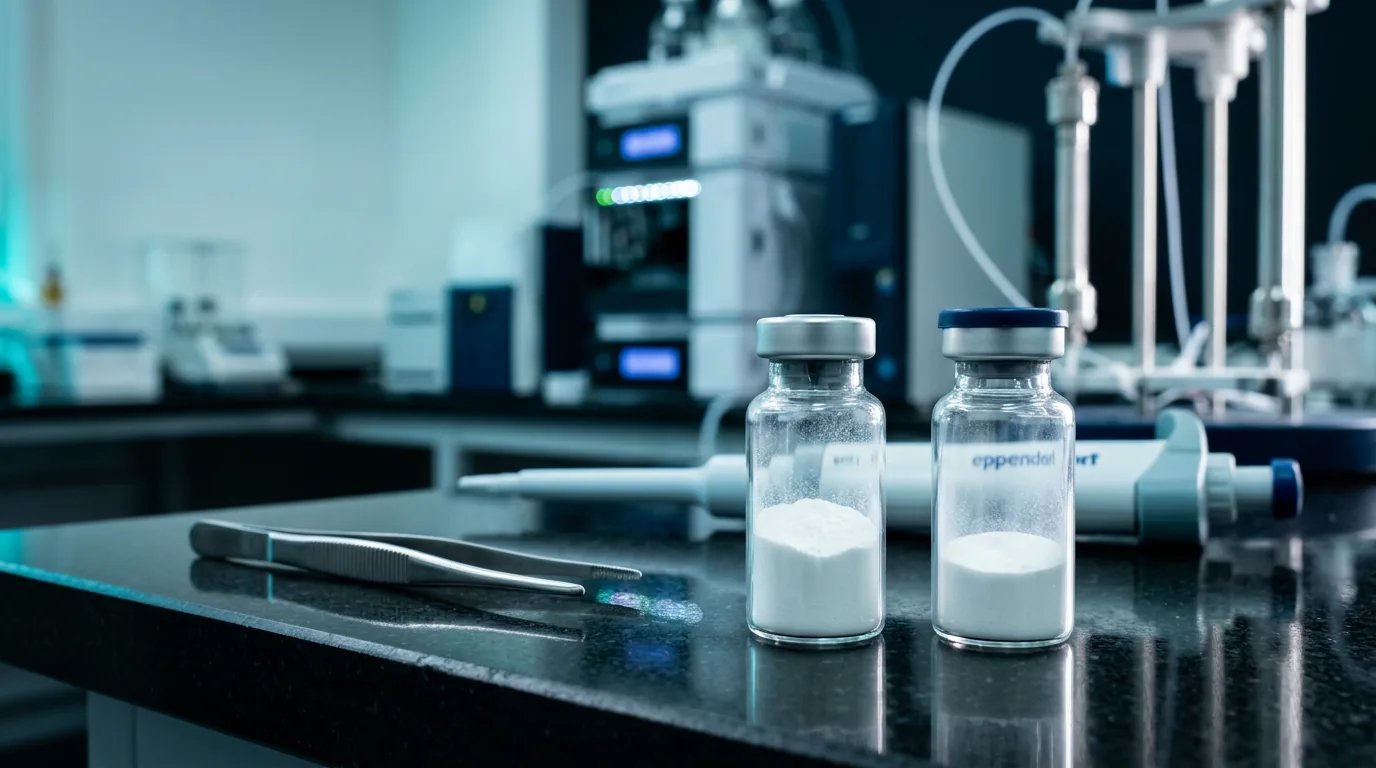
Tirzepatide is a dual GIP and GLP-1 receptor agonist, while Retatrutide is a tri-agonist that adds glucagon receptor affinity for laboratory research use only. In animal models, Retatrutide’s addition of glucagon receptor binding demonstrates distinct metabolic mechanisms compared to the dual-pathway profile of Tirzepatide. Both compounds are strictly for Research Use Only (RUO) and are not intended for human consumption, medical, or veterinary application.
This technical comparison explores the distinct receptor binding profiles of these incretin mimetics in preclinical settings, alongside established laboratory handling protocols. By examining the quantitative receptor affinity and structural differences, researchers can better understand how dual and triple agonism influence metabolic pathways in controlled in vitro and animal studies.
What is the difference between retatrutide and tirzepatide?
Tirzepatide functions as a dual GLP-1/GIP receptor agonist, whereas Retatrutide operates as a triple agonist by targeting the GLP-1, GIP, and glucagon (GCGR) receptors. In laboratory research, the fundamental difference lies in the addition of glucagon receptor affinity, which alters the metabolic pathways observed in animal models.
Tirzepatide exhibits an affinity for the GIP receptor roughly equivalent to native GIP, while its affinity for the GLP-1 receptor is approximately five times weaker than native GLP-1[1]. It shows strong cAMP bias at the GLP-1 receptor, leading to reduced receptor internalization and distinct downstream signaling compared to other incretin mimetics[1]. In contrast, Retatrutide exerts a powerful agonist effect across three targets: it displays enhanced potency at the human GIP receptor (by a factor of 8.9 compared to native GIP) while exhibiting reduced potency at the GCGR (0.3 factor) and GLP-1R (0.4 factor) compared to their native ligands[2].
In preclinical rodent studies, researchers observe that dual GLP-1/GIP agonists suppress caloric intake and improve glucose tolerance primarily through combined incretin action[1]. However, balanced triple agonists introduce glucagon-mediated hepatic glucose production and thermogenesis[3]. The addition of GCGR agonism in tri-agonists results in distinct preclinical outcomes, such as greater reductions in body weight, enhanced lipid lowering, and the reversal of steatohepatitis in obese mice compared to dual-agonists[4].
| Feature | Tirzepatide | Retatrutide |
|---|---|---|
| Receptor Class | Dual GLP-1/GIP agonist[1] | Triple GLP-1/GIP/glucagon agonist[2] |
| GIP Receptor Potency | Comparable to native GIP[1] | ~8.9x greater than native GIP[2] |
| GLP-1 Receptor Potency | ~5x weaker than native GLP-1[1] | ~0.4x native GLP-1 potency[2] |
| Glucagon Receptor (GCGR) | No meaningful agonism[1] | ~0.3x native glucagon potency[2] |
How do you store tirzepatide and retatrutide for research?
Both Tirzepatide and Retatrutide are strictly for Research Use Only (RUO) and require third-party HPLC testing to verify greater than 99% purity before laboratory handling. Researchers must strictly adhere to temperature and environmental controls to preserve the structural integrity of these lyophilized peptides. These compounds are not for human or veterinary administration, and their handling requires standard sterile laboratory protocols.
Standard laboratory practice dictates storing lyophilized research peptides at -20 °C for routine long-term use and -80 °C for maximal stability[5]. Reconstituted peptide solutions should be stored at 2-8 °C for short-term use[6].
- Verify the Certificate of Analysis: Before handling, confirm the batch-specific COA verifies HPLC purity exceeding 99% and mass spectrometry identity.
- Equilibrate the vial: Allow the lyophilized peptide vial to equilibrate to room temperature for approximately 15 to 20 minutes before opening to prevent condensation on the powder[6].
- Reconstitute with appropriate diluent: Add bacteriostatic water or sterile saline slowly down the side of the glass vial to avoid mechanical stress[7]. Do not shake or vortex; swirl gently until fully dissolved[8].
- Store short-term solutions properly: Place the reconstituted peptide solution at 2-8 °C immediately away from light. Solutions are generally stable for 1 to 4 weeks under refrigeration, depending on the specific peptide sequence and diluent utilized[7].
- Manage long-term aliquots: If long-term storage of solutions is necessary, aliquot the reconstituted peptide immediately into sterile vials and freeze at -20 °C or colder[9]. Avoid multiple freeze-thaw cycles, which can cause aggregation and significantly degrade peptide activity by 5 to 15 percent per cycle[7].
Frequently Asked Questions
What is the difference between retatrutide and tirzepatide?
Tirzepatide is a dual agonist targeting the GIP and GLP-1 receptors, while Retatrutide is a tri-agonist that also activates the glucagon receptor (GCGR)[1][2]. This added glucagon pathway introduces distinct thermogenic and lipid-lowering mechanisms observed in preclinical animal models[4].
Is retatrutide a tri-agonist?
Yes, Retatrutide is classified as a triple agonist because it binds and activates the GLP-1, GIP, and glucagon receptors[2]. In laboratory studies, it demonstrates particularly enhanced potency at the GIP receptor compared to native GIP[2].
How do you store tirzepatide and retatrutide for research?
Lyophilized (powdered) peptides should be stored in a laboratory freezer at -20 °C or -80 °C for long-term stability[5]. Once reconstituted with a laboratory diluent, the working solution must be kept refrigerated at 2-8 °C and typically utilized within one to four weeks[7][6].
What does research use only mean for peptides?
Research Use Only (RUO) designates that the peptides are manufactured strictly for in vitro laboratory studies or preclinical animal research. They are not approved for human consumption, medical treatment, veterinary applications, or cosmetic use under any circumstances.
References
- Mechanisms of action and therapeutic applications of GLP-1 and …. https://www.frontiersin.org/journals/endocrinology/articles/10.3389/fendo.2024.1431292/full (2024-07-24)
- Unleashing the power of retatrutide: A possible triumph over obesity …. https://pmc.ncbi.nlm.nih.gov/articles/PMC10844714/ (2024-02-05)
- Retatrutide – Wikipedia. https://en.wikipedia.org/wiki/Retatrutide (2023-07-05)
- The Road towards Triple Agonists: Glucagon-Like Peptide 1 … – PMC. https://pmc.ncbi.nlm.nih.gov/articles/PMC10901658/ (2024-02-14)
- Peptide Storage Best Practices: Temperature, Light & Humidity Guide. https://lonestarpeptideco.com/blog/peptide-storage-best-practices/ (2026-04-09)
- Peptide Handling, dissolution & Storage – NIBSC. https://nibsc.org/science_and_research/virology/cjd_resource_centre/available_samples/peptide_library/peptide_storage.aspx (2026-06-25)
- Complete Peptide Reconstitution Guide: Step-by-Step – Northline Labs. https://northlinelabs.org/complete-peptide-reconstitution-guide-step-by-step/ (2026-03-06)
- How to Reconstitute Peptides: Lab-Ready Techniques and Solvent …. https://polarispeptides.com/how-to-reconstitute-peptides-lab-guide/ (2025-07-09)
- Handling and Storage Guidelines for Peptides – Bachem. https://www.bachem.com/knowledge-center/handling-and-storage-guidelines-for-peptides/ (2026-03-15)