
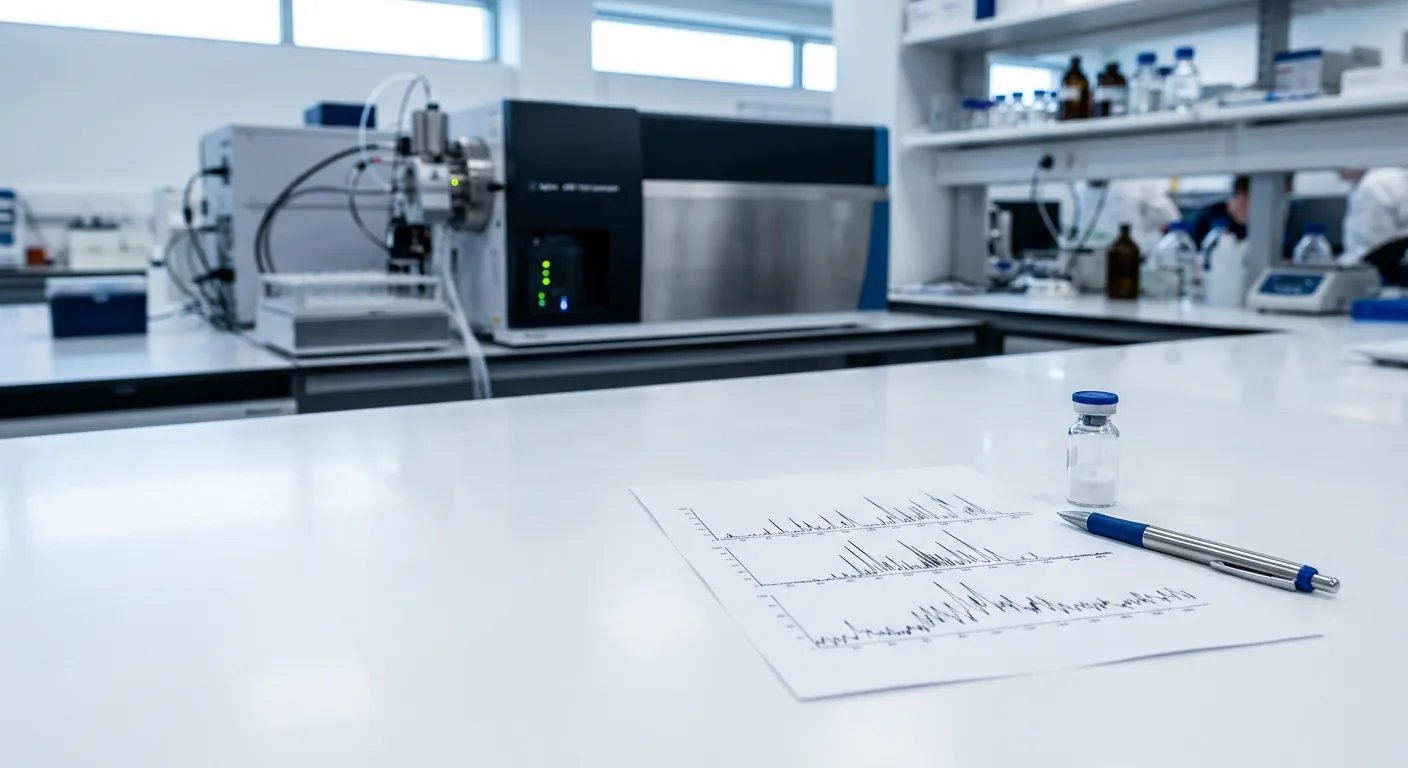
A peptide mass spectrometry report is a laboratory document that verifies a Research Use Only compound’s exact molecular weight and identity by measuring its mass-to-charge ratio. These compounds and their corresponding mass spectrometry reports are strictly for Research Use Only and are not intended for human consumption or medical use. While HPLC testing confirms a peptide’s purity is greater than 99 percent, mass spectrometry is required to prove the compound’s actual molecular identity. Researchers evaluating vendors like Nautilus Peptides should look for independent, batch-specific mass spectrometry reports that show clear major peaks matching the target molecular weight. This guide explains how laboratories interpret mass spectrometry data to verify chemical identity.
What is the difference between HPLC and mass spectrometry peptide testing?
While HPLC testing confirms a peptide’s purity is high, mass spectrometry is required to prove the compound’s actual molecular identity. Both analytical methods are essential for a complete evaluation, as HPLC measures the quantity of the main component versus impurities, whereas mass spectrometry confirms the exact chemical structure and sequence[1][2].
High-performance liquid chromatography separates UV-detectable components based on physicochemical properties such as hydrophobicity[3][4]. The resulting chromatogram calculates purity by dividing the area of the main peptide peak by the total area of all integrated peaks[1][5]. A result of 99.2% HPLC purity means that 99.2% of the separated material corresponds to the primary peak[1]. However, HPLC only measures chromatographic purity; it does not directly prove what that component actually is[1][6]. A sample can show a clean chromatogram and still be the wrong compound entirely if the peak’s identity was never confirmed through secondary testing[1][5].
Mass spectrometry answers the critical question of molecular structure and exact mass[7]. It measures the mass-to-charge ratio of peptide ions, enabling laboratories to determine the precise molecular weight[3][8]. Identity is successfully supported when the experimentally measured mass matches the theoretical mass within a specified tolerance[2][7]. For comprehensive laboratory protocols, researchers rely on both analytical methods to verify their Research Use Only peptides.
| Analytical Technique | Primary Research Question | Key Laboratory Readout | Primary Limitation |
|---|---|---|---|
| High-Performance Liquid Chromatography | How pure is the sample? | Chromatogram retention time and peak area percentage | Cannot independently prove molecular identity or sequence[1][6] |
| Mass Spectrometry | What is the exact molecule? | m/z spectrum; deconvoluted molecular weight | Does not provide a regulatory-grade chromatographic purity percentage[1][6] |
Researchers exploring testing protocols can review more about HPLC vs mass spectrometry peptide testing to understand standard laboratory requirements.
How do I read a peptide mass spectrometry report?
Researchers evaluating chemical vendors should look for independent mass spectrometry reports that show clear major peaks matching the target molecular weight. The mass-to-charge ratio (m/z) on the document represents the ionized peptide’s mass divided by its charge state, which laboratories use to calculate and verify the exact molecular weight[9][10].
Interpreting mass spectrometry data requires analyzing specific laboratory fields to verify the compound. Investigators use the following analytical methodology to evaluate the results of Research Use Only peptides:
- Locate the mass-to-charge ratio: The m/z value equals the mass of the ion divided by its charge number[9][10]. Because peptides are typically protonated in positive-ion mode, the measured ion usually appears as [M + zH]⁺ for a given charge state[10][11].
- Identify the charge state: The report indicates the integer number of charges on the ion. Multiply charged ions frequently bring large peptide masses into the analytical instrument’s measurable range[12][13].
- Calculate the observed neutral mass: If the report provides an m/z of 700.0 and a charge of +2, the calculation is: Mass = 2 × 700.0 – 2 × 1.0073[10][12]. This yields an observed neutral mass of 1397.9854 Da.
- Compare against theoretical mass: Check whether the observed neutral mass matches the theoretical molecular weight calculated from the chemical sequence[14][15]. High-resolution instruments typically show mass errors of less than 5 to 10 ppm[14][16].
- Check for impurities: Assess the spectrum for significant unexpected peaks that could indicate truncations, side products, or sample degradation[12][13].
To guarantee legitimacy, investigators must ensure the document is a batch-specific mass spectrometry report issued by a named, independent third-party laboratory. Researchers seeking verification should contact the laboratory supplier to request verifiable lot numbers for their compounds.
Frequently Asked Questions
How do I read a peptide mass spectrometry report?
Researchers read the report by locating the mass-to-charge ratio and the charge state, then calculating the observed molecular mass. They verify the identity by confirming that the observed neutral mass matches the theoretical molecular mass for that specific sequence[14][10].
What is the difference between HPLC and mass spectrometry peptide testing?
HPLC separates compounds based on hydrophobicity to determine the percentage purity of a sample, while mass spectrometry measures the mass-to-charge ratio to confirm the exact molecular identity and molecular weight[1][2]. Both are necessary to verify Research Use Only compounds.
How does mass spectrometry verify peptide identity?
Mass spectrometry verifies identity by ionizing the peptide and recording its exact mass-to-charge ratio. Identity is confirmed when the instrument’s measured mass matches the theoretical mass of the intended sequence within a very tight tolerance, typically less than 5 to 10 ppm[14][16].
What does the mass-to-charge ratio mean on a peptide COA?
The mass-to-charge ratio (m/z) represents the mass of the ionized peptide divided by its charge number[9][10]. Researchers use this mathematical value to calculate the neutral molecular weight of the compound, ensuring it matches the intended chemical structure[17][18].
References
- Peptide Testing: HPLC & Mass Spec Purity Guide – Apex Laboratory. https://apexlaboratory.org/hplc-testing-peptide-purity/ (2026-03-08)
- HPLC vs. LC-MS: Which Purity Test Actually Matters? – Prime Labs. https://getprimelabs.com/blogs/research-insights/hplc-vs-lc-ms-which-purity-test-actually-matters (2026-02-12)
- Detection of Peptide Purity by RP-HPLC and Mass Spectrometry. https://www.mtoz-biolabs.com/detection-of-peptide-purity-by-rp-hplc-and-mass-spectrometry.html (2024-11-05)
- RP-HPLC Peptide Purity Analysis – Creative Proteomics. https://www.creative-proteomics.com/peptidomics/rp-hplc-peptide-purity-analysis.html (2026-07-08)
- The Ultimate Guide to HPLC Testing for Peptides. https://vanguardlaboratory.com/resources/the-ultimate-guide-to-hplc-testing-for-peptides-9/ (2026-03-09)
- The Role of HPLC Analysis in Peptide Characterization. https://verifiedpeptides.com/knowledge-hub/the-role-of-hplc-analysis-in-peptide-characterization/ (2025-11-20)
- HPLC and Mass Spectrometry for Peptide Validation. https://www.creative-peptides.com/resources/analytical-services-hplc-and-mass-spectrometry-for-peptide-validation.html (2025-09-19)
- High-performance liquid chromatography–tandem mass … – PMC. https://pmc.ncbi.nlm.nih.gov/articles/PMC2359828/ (2008-03-15)
- Mass-to-Charge Ratio – Chemistry LibreTexts. https://chem.libretexts.org/Ancillary_Materials/Reference/Organic_Chemistry_Glossary/Mass-to-Charge_Ratio (2022-02-28)
- Mass Spec Terminology – Wang Bioinformatics Lab @ UCR. https://www.cs.ucr.edu/~mingxunw/terminology/ (2025-03-28)
- What is Mass Spectrometry | Scripps Research. https://masspec.scripps.edu/learn/ms/ (2026-07-07)
- Analyzing crude peptide samples by Mass Spectrometry – Biotage. https://www.biotage.com/blog/analyzing-crude-peptide-samples-by-mass-spectrometry-what-are-the-options (2023-01-30)
- Mass Spectrometry in Peptide and Protein Analysis – Mabion. https://www.mabion.eu/science-hub/articles/mass-spectrometry-in-peptide-and-protein-analysis/ (2025-12-30)
- Peptide Sequencing Reports: Structure and Interpretation Guide. https://www.creative-proteomics.com/proteinseq/resource/peptide-sequencing-report-interpretation.htm (2026-06-11)
- Calculation of m/z for Polypeptides in Mass Spectrometry. https://www.mtoz-biolabs.com/calculation-of-m-z-for-polypeptides-in-mass-spectrometry.html (2025-03-15)
- Protein Mass Spectrometry Made Simple – PMC – NIH. https://pmc.ncbi.nlm.nih.gov/articles/PMC6054340/ (2018-05-03)
- 2.2.2: B2. Sequence Determination Using Mass Spectrometry. https://bio.libretexts.org/Courses/Ouachita_Baptist_University/Reyna_Cell_Biology/02:_2-(T2-first_lecture)_Protein_Structure/2.02:_Composition_Sequence_and_Conformational_Analysis_of_Proteins/2.2.02:_B2._Sequence_Determination_Using_Mass_Spectrometry (2021-08-16)
- [PDF] Calculating Molecular Mass by. https://nativems.gatech.edu/sites/default/files/2022-08/Calculating_Molecular_Weights%20VW%20revision_LL.pdf (2026-06-26)