
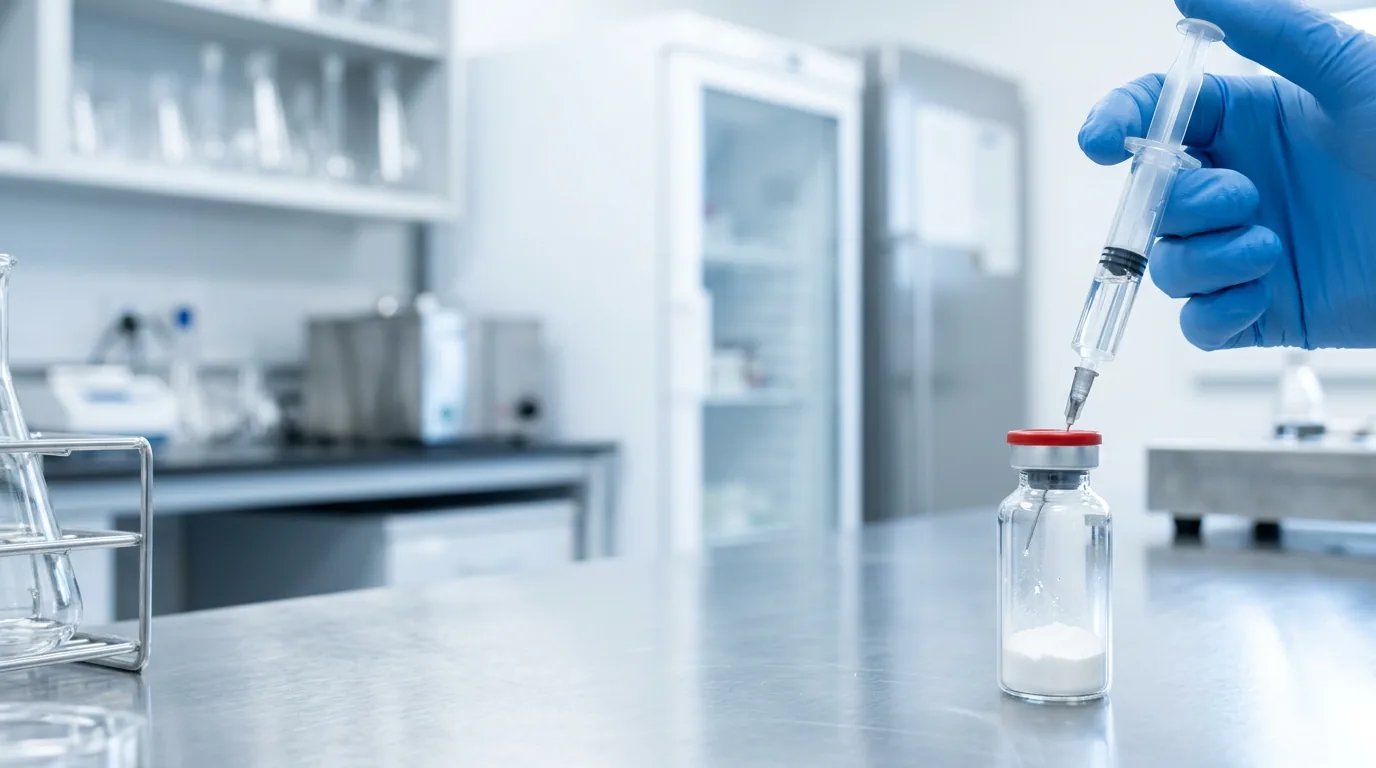
Reconstituting research peptides requires adding a precise volume of bacteriostatic water to a lyophilized vial, strictly for laboratory Research Use Only (RUO). This standard methodology ensures the structural integrity of the compound for in vitro testing. All peptide reconstitution protocols and bacteriostatic water supplies are strictly for laboratory research and are explicitly not for human consumption, medical, veterinary, or cosmetic use.
This guide outlines the standard laboratory procedures for how to reconstitute research peptides and store lyophilized compounds. By following precise solvent addition techniques and strict temperature controls, laboratory personnel can prevent compound degradation and ensure valid experimental results.
How do you reconstitute a lyophilized research peptide?
Reconstituting a lyophilized research peptide requires adding a calculated volume of solvent—typically bacteriostatic water—slowly down the inner vial wall to prevent mechanical denaturation and foaming[1][2]. This laboratory procedure ensures the freeze-dried cake dissolves uniformly, preserving the compound’s structural integrity for in vitro research. Laboratory personnel must never inject the solvent stream directly onto the powder, as rapid impact can disrupt fragile peptide bonds[3][2].
Standard laboratory methodology for peptide reconstitution follows these precise steps:
- Calculate the required solvent volume: Determine the necessary volume of bacteriostatic water based on the target concentration for the experimental protocol. The standard calculation divides the total peptide mass (mg) by the desired concentration (mg/mL)[4][2].
- Equilibrate temperatures: Allow both the lyophilized peptide vial and the bacteriostatic water to reach room temperature (typically 18–25 °C) for 15 to 30 minutes prior to reconstitution[5][4].
- Disinfect the vials: Swab the rubber stoppers of both vials with 70% isopropyl alcohol and allow approximately 30 seconds for the surfaces to air dry[4][6].
- Draw the solvent: Using a sterile syringe, draw the exact calculated volume of bacteriostatic water, ensuring no air bubbles remain in the barrel[2][7].
- Add solvent down the vial wall: Pierce the peptide vial septum at a 45-degree angle so the needle tip contacts the inner glass wall[4][3]. Depress the plunger slowly, taking 15 to 30 seconds per 1–2 mL, allowing the liquid to run gently down the glass rather than striking the peptide cake directly[3][2].
- Dissolve via gentle swirling: Once the solvent is added, gently swirl or roll the vial until the solution is clear and homogeneous. Never shake or vortex the vial vigorously, as this can cause aggregation and compromise the research compound[4][8].
What temperature should reconstituted research peptides be stored at?
Unreconstituted lyophilized peptides should be stored at -20 degrees Celsius for long-term stability, while reconstituted solutions typically require refrigeration at 2 to 8 degrees Celsius[9][10]. Reconstituted research peptides are highly sensitive to thermal degradation, hydrolysis, and physical agitation, which limits their stable shelf life in liquid form[11][12]. Strict adherence to these temperature protocols is necessary to maintain compound integrity for valid in vitro laboratory testing.
The storage requirements shift dramatically once the lyophilized powder is hydrated. While freeze-dried compounds can remain stable for years under deep freeze conditions, aqueous peptide solutions degrade much faster[13][14].
| Peptide State | Recommended Temperature | Maximum Stable Duration |
|---|---|---|
| Lyophilized (Unreconstituted) | -20 °C or below | Long-term (months to years)[10][15] |
| Lyophilized (Short-term) | 2 to 8 °C | 6 to 12 months[9][16] |
| Reconstituted (Bacteriostatic Water) | 2 to 8 °C | Approximately 28 days[9][17] |
| Reconstituted (Sterile Water) | 2 to 8 °C | 48 hours to 7 days[11][18] |
When laboratory personnel reconstitute peptides using bacteriostatic water, the 0.9% benzyl alcohol preservative inhibits microbial growth, generally allowing the solution to remain usable for about 28 days (4 weeks) at 2 to 8 degrees Celsius[9][19]. This 28-day benchmark is a conservative standard widely recognized in research and compounding guidelines[9][17]. Conversely, peptides reconstituted in plain sterile water lack a preservative and typically degrade or risk contamination within 48 hours to one week under the same refrigerated conditions[11][18]. Beyond these established timeframes, expert guidelines recommend discarding the remaining solution or freezing aliquots at -20 degrees Celsius to prevent experimental variables caused by compound degradation[20][16]. For questions regarding proper storage protocols or batch-specific documentation, researchers can contact our team for assistance.
Frequently Asked Questions
How do you reconstitute a lyophilized research peptide?
Laboratory personnel reconstitute a lyophilized research peptide by calculating the required solvent volume, drawing the bacteriostatic water with a sterile syringe, and injecting it slowly down the inner wall of the peptide vial[4][2]. The vial is then gently swirled—never shaken—until the powder dissolves completely into a clear solution[4][8].
What temperature should reconstituted research peptides be stored at?
Reconstituted research peptides must be stored in a refrigerator at 2 to 8 degrees Celsius immediately after mixing[9][19]. Unlike unreconstituted lyophilized powders, which require storage at -20 degrees Celsius for long-term stability, liquid peptide solutions are highly susceptible to thermal degradation and should not be left at room temperature[10][12].
How much bacteriostatic water is needed for peptide reconstitution?
The exact volume of bacteriostatic water depends entirely on the target concentration required for the specific in vitro experimental protocol. Researchers calculate this by dividing the total peptide mass in the vial (mg) by the desired concentration (mg/mL)[4][2].
How long do reconstituted research peptides last in the refrigerator?
When reconstituted with bacteriostatic water, most research peptides remain stable for approximately 28 days when stored continuously at 2 to 8 degrees Celsius[9][17]. If reconstituted with plain sterile water, the usable window drops significantly to between 48 hours and 7 days[11][18].
References
- How to Reconstitute Peptides: Lab-Ready Techniques and Solvent …. https://polarispeptides.com/how-to-reconstitute-peptides-lab-guide/ (2025-07-09)
- Complete Peptide Reconstitution Guide: Step-by-Step – Northline Labs. https://northlinelabs.org/complete-peptide-reconstitution-guide-step-by-step/ (2026-03-06)
- How to Reconstitute Peptides: Step-by-Step Guide for Beginners. https://peptidenerds.com/blog/how-to-reconstitute-peptides (2026-03-22)
- Complete Guide to Research Peptide Reconstitution (2025). https://www.bioinfinitylab.com/research/guides/peptide-reconstitution (2025-02-14)
- Bacteriostatic Water for Peptide Research: What It Is | | Palmetto …. https://palmettopeptides.com/blogs/news/bacteriostatic-water-for-peptide-research (2026-04-09)
- The Complete Peptide Guide: Reconstitution, Injection & Storage. https://extension.health/the-complete-peptide-guide-reconstitution-injection-storage/ (2026-01-16)
- Peptide Reconstitution Instructions – YouTube. https://www.youtube.com/watch?v=b08QwxZW0Ig (2025-09-18)
- How to Reconstitute Peptides | JPT. https://www.jpt.com/blog/how-to-reconstitute-peptides/ (2026-06-29)
- How to Store Peptides: Temperature, Light & Shelf Life. https://peptidenerds.com/blog/how-to-store-peptides-properly (2026-03-03)
- Peptide handling & storage guidelines – How to store a peptide?. https://www.sb-peptide.com/support/handling-storage/ (2026-02-11)
- Handling and Storage Guidelines for Peptides and Proteins. https://www.sigmaaldrich.com/US/en/technical-documents/technical-article/research-and-disease-areas/cell-and-developmental-biology-research/handling-and-storage (2023-10-14)
- Recommendations for the generation, quantification, storage and …. https://pmc.ncbi.nlm.nih.gov/articles/PMC4830481/ (2026-07-08)
- How to Store Peptides | Best Practices for Researchers. https://www.jpt.com/blog/how-to-store-peptides/ (2026-06-19)
- Handling and Storage Guidelines for Peptides – Bachem. https://www.bachem.com/knowledge-center/handling-and-storage-guidelines-for-peptides/ (2026-03-15)
- Peptide Solubility and Storage Tips | Product Guides – Biosynth. https://www.biosynth.com/resources-and-educational-material/product-guides/peptide-solubility-and-storage-tips
- Peptide solubility and storage – AltaBioscience. https://altabioscience.com/articles/peptide-storage-and-solubility/ (2020-02-11)
- Peptide Storage & Shelf Life: How to Store BPC-157, Tirzepatide …. https://www.durhampeptides.ca/post/peptide-storage-shelf-life-guide (2026-04-30)
- How to Store Research Peptides: Best Practices. https://www.regenpeptides.co.uk/blogs/news/how-to-store-research-peptides (2026-03-25)
- How Long Do Peptides Last at Room Temperature?. https://www.creative-peptides.com/resources/how-long-do-peptides-last.html (2025-01-10)
- How Long Do Reconstituted Peptides Last in Fridge? Storage Guide. https://www.seekpeptides.com/blog/articles/how-long-reconstituted-peptides-last-fridge (2025-12-26)