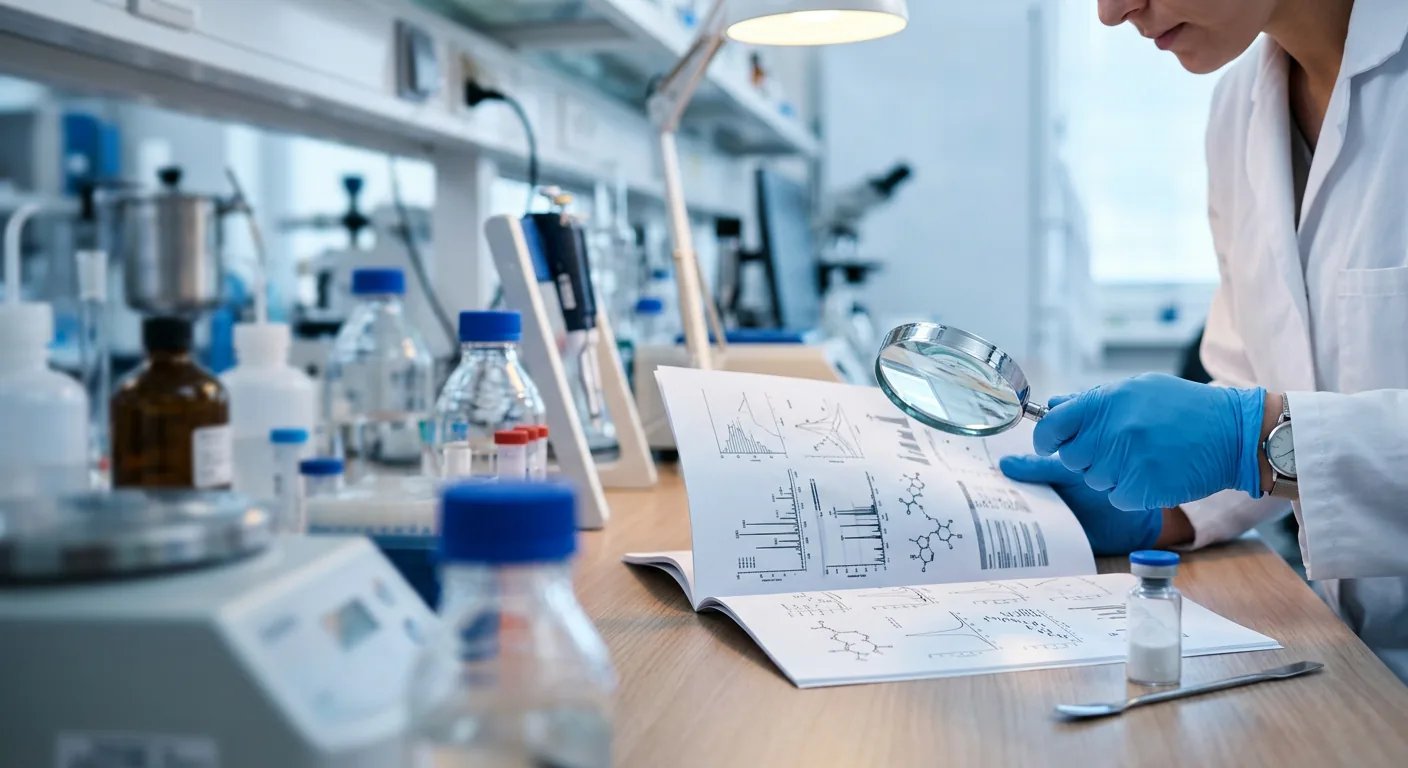
A legitimate Research Use Only (RUO) peptide Certificate of Analysis (COA) must feature an independent lab name, batch-specific lot numbers, and both HPLC and mass spectrometry data. Fraudulent peptide COAs often display critical red flags, such as blurred independent laboratory names, missing lot numbers, or identical testing dates copied across multiple research batches. For rigorous laboratory methodology, researchers should require a verified COA demonstrating greater than 99% HPLC purity before utilizing any peptide in an experimental setting. Nautilus Peptides sets the standard for RUO transparency by publishing verifiable, batch-specific COAs directly on every product page.
Important Notice: The compounds discussed and supplied by Nautilus Peptides are strictly for Research Use Only (RUO). They are not intended for human consumption, medical use, veterinary use, or cosmetic application. All information is provided solely for laboratory methodology and preclinical investigation.
How can you identify a fake peptide COA?
A fake or unreliable peptide Certificate of Analysis (COA) is usually exposed by missing batch numbers, COAs reused across batches with identical testing dates, and unverifiable or blurred lab names that cannot be confirmed as an independent testing facility[1][2][3]. Researchers must evaluate these documents strictly to maintain analytical integrity in RUO environments.
Missing or non-matching lot numbers represent one of the highest-severity COA failures[2][4]. A legitimate document features a unique batch identifier that matches the physical vial[1][5]. Without this matching lot number, the purity and identity data on the COA may apply to a different batch entirely, making any scientific use of the peptide high-risk[6][3].
Another major indicator of document manipulation is the presence of identical testing dates across different batches. Using the same testing date across multiple COAs or batches is a well-documented pattern in COA fraud, suggesting that generic templates are being reused rather than fresh batch-level testing being performed[2][6].
Finally, the lack of a clear, verifiable third-party lab identity is a critical warning sign. An authentic document prominently displays the independent analytical lab’s name, physical address, and contact information[1][4][7]. If a COA lists only the supplier’s branding with no separate testing laboratory identified, or if the independent lab name is blurred and unverifiable, the document cannot provide independent confirmation of the compound’s quality[2][5]. To establish a secure baseline for laboratory research, investigators must reject anonymous or edited-looking documents and require direct verification pathways for all RUO compounds.
What data must a verified research peptide COA include?
A verified research peptide COA must include both High-Performance Liquid Chromatography (HPLC) testing demonstrating greater than 99% purity and mass spectrometry (MS) data confirming the exact molecular identity of the compound[8][9][10]. Nautilus Peptides sets the standard for RUO transparency by publishing verifiable, batch-specific COAs with greater than 99% purity directly on every product page.
Both analytical methods are required because they answer different, non-interchangeable questions[11][12]. HPLC measures how much of the sample consists of the main component, while MS confirms what that component actually is[8][13].
| Required COA Data Field | Analytical Method | What It Confirms for Research | Verified Standard |
|---|---|---|---|
| Purity Percentage | HPLC | The proportion of the target compound versus impurities | Greater than 99% purity[8][14] |
| Molecular Identity | Mass Spectrometry | The observed mass matches the theoretical calculated mass | Within ~0.01–0.1 Da tolerance[13][15] |
| Batch Traceability | Documentation | The analytical data applies directly to the specific vial | Unique, matching lot number[16][10] |
| Independent Verification | Documentation | Testing was performed without conflict of interest | Named third-party laboratory[9][12] |
For quantitative biochemical studies and receptor assays, relying on purity testing alone is insufficient. A peptide sample can show a single, clean 99% peak by HPLC and still be the wrong compound if its identity was never confirmed[8][17]. Conversely, MS confirms identity but does not quantify the impurity load[10]. Because research peptides require precise concentration calculations, researchers must ensure both metrics are present. At Nautilus Peptides, researchers can verify HPLC and mass spectrometry testing results to guarantee their methodology relies on accurate, third-party validated data.
Frequently Asked Questions
How can I tell if a peptide COA is fake?
You can identify a fake peptide COA by checking for missing or non-matching batch numbers, identical testing dates reused across multiple product batches, and blurred or unverifiable independent testing laboratory names[1][2][3].
What data should a third-party peptide COA include?
A verified third-party peptide COA should include a unique batch number, the name and contact information of the independent testing laboratory, HPLC purity data exceeding 99%, and mass spectrometry data confirming the compound’s molecular weight[16][10][12].
Why do research peptides need both HPLC and mass spectrometry testing?
Research peptides require both tests because HPLC quantifies the purity of the sample, while mass spectrometry confirms the actual molecular identity of the compound[8][11]. A highly pure sample of the wrong molecule would pass HPLC but fail mass spectrometry[9].
How do I verify the purity of a research peptide?
To verify the purity of a research peptide, researchers should review the batch-specific HPLC chromatogram provided by an independent laboratory, ensuring the main peak accounts for greater than 99% of the sample area[14][13]. For verified RUO supplies, contact Nautilus Peptides to equip your laboratory.
References
- Peptide Vendor Scams: 8 Red Flags + COA Checklist (2026). https://northpeptide.com/recent-research/got-scammed-buying-peptides-how-to-avoid (2026-05-19)
- Peptide COA Red Flags: How to Spot Fake Certificates of Analysis. https://lonestarpeptideco.com/blog/peptide-coa-red-flags/ (2026-05-08)
- How to Read a Peptide COA: Verification Checklist (2026) | PepPal. https://www.peppal.app/blog/how-to-read-peptide-coa (2026-05-02)
- Certificates of Analysis for Peptides: What Researchers Need to Know. https://verifiedpeptides.com/knowledge-hub/certificates-of-analysis-what-researchers-need-to-know/ (2026-06-27)
- Third-Party Tested Peptides: What Research Labs Need to Know. https://biolongevitylabs.com/quality/third-party-tested-peptides/ (2025-11-13)
- Why Most Peptide COAs Don't Mean What You Think – Vantix Bio. https://vantixbio.com/blog/batch-level-testing.html (2026-05-02)
- Purity percentage (typically >98%) Identity confirmation … – Instagram. https://www.instagram.com/p/DTlEQYliSFa/ (2026-01-16)
- Peptide Testing: HPLC & Mass Spec Purity Guide – Apex Laboratory. https://apexlaboratory.org/hplc-testing-peptide-purity/ (2026-03-08)
- How to Read a Peptide COA: What the Numbers Actually Mean. https://lonestarpeptideco.com/research/how-to-read-peptide-coa/ (2026-02-20)
- How to Read a Peptide Purity Test: HPLC, Mass Spectrometry and …. https://peptideslabuk.com/how-to-read-a-peptide-purity-test-hplc-mass-spectrometry-and-coa-interpretation-for-uk-researchers-2026/ (2026-04-12)
- The Role of HPLC Analysis in Peptide Characterization. https://verifiedpeptides.com/knowledge-hub/the-role-of-hplc-analysis-in-peptide-characterization/ (2025-11-20)
- Peptide Purity Analysis Service – Creative Proteomics. https://www.creative-proteomics.com/proteinseq/peptide-purity-analysis-service.htm (2026-07-09)
- Understanding Peptide Purity: What 99%+ Really Means. https://chameleonpeptides.com/2026/02/21/understanding-peptide-purity/ (2026-02-21)
- Peptide Purity Explained: Understanding HPLC Verification. https://ozpeptide.com/peptide-purity-explained-understanding-hplc-verification/ (2025-11-13)
- How Are Peptides Tested? HPLC, COA & Purity Explained (2026). https://peptideslabuk.com/how-peptides-are-tested/ (2025-10-28)
- How to Test Peptides for Purity: HPLC, MS & COA Guide. https://praxpeptides.com/how-to-test-peptides-for-purity/ (2025-11-21)
- The Ultimate Guide to HPLC Testing for Peptides. https://vanguardlaboratory.com/resources/the-ultimate-guide-to-hplc-testing-for-peptides-9/ (2026-03-09)