
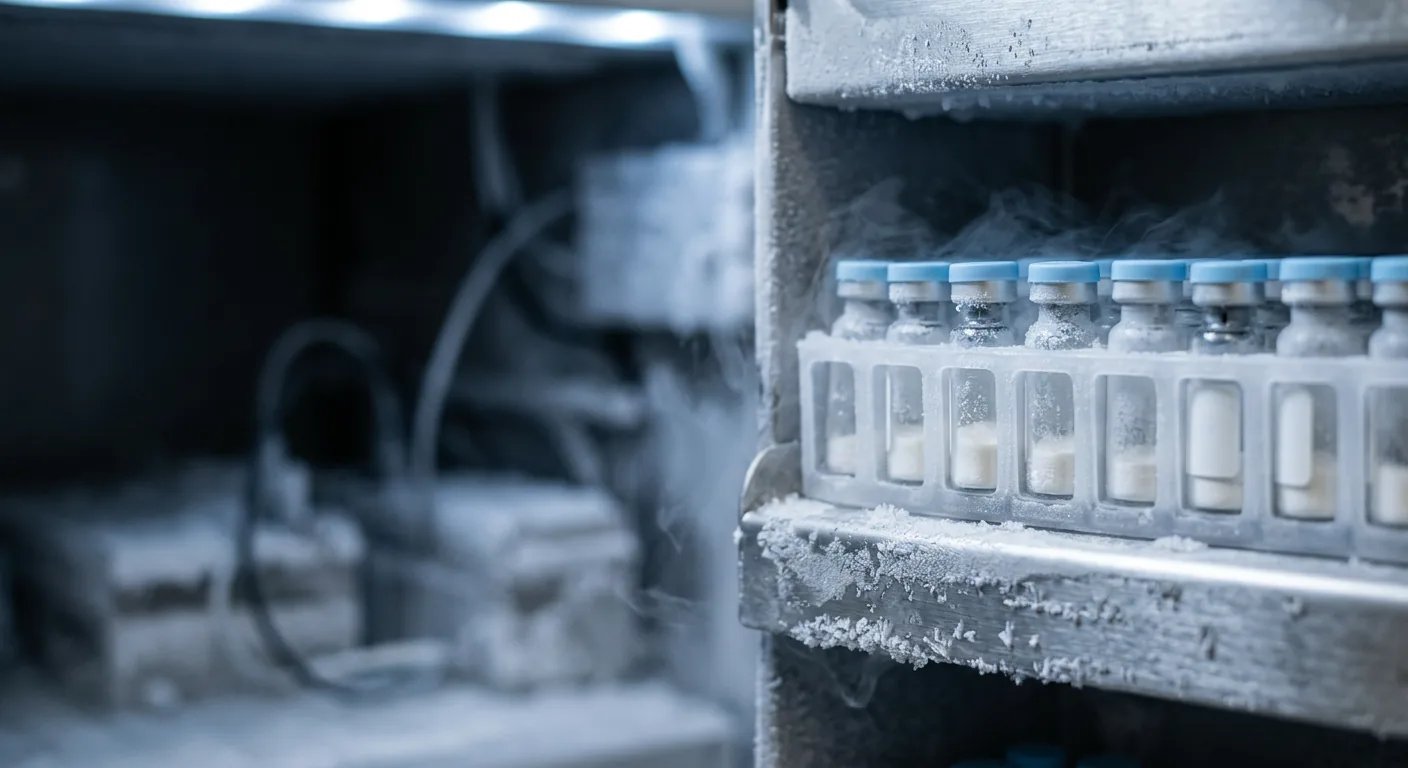
To maintain structural integrity, laboratory professionals must know exactly how to store research peptides correctly: lyophilized compounds require storage at -20 degrees Celsius or colder for long-term stability, while reconstituted peptides require refrigeration at 4 degrees Celsius. Proper temperature control prevents rapid degradation and ensures reproducible assays.
Mandatory RUO Note: All Nautilus Peptides products and storage protocols are strictly for in vitro Research Use Only (RUO). They are never intended for human consumption, medical, veterinary, or cosmetic use.
Understanding the difference between freeze-dried stability and liquid solution degradation is critical for precision laboratory workflows. Reconstituted solutions become highly susceptible to structural disruption from environmental variables, particularly freeze-thaw cycles and ultraviolet light exposure. By implementing standard operating procedures for temperature and light management, researchers can maximize the shelf life of their experimental compounds. To discuss bulk ordering, contact our team.
What temperature is best for long-term lyophilized peptide storage?
Lyophilized research peptides should be stored at -20 degrees Celsius or colder for long-term stability, while reconstituted peptides require refrigeration at 4 degrees Celsius. When stored correctly at -20 degrees Celsius in a freeze-dried state, most research-grade peptides maintain greater than 99 percent purity for up to 24 months[1][2][3][4][5][6].
All peptide storage and handling protocols are strictly for in vitro Research Use Only (RUO) and are never intended for human consumption or medical use. Lyophilization removes water from the compound, creating a stable powder that resists immediate degradation. However, ambient heat and moisture can initiate hydrolytic damage. Standard protocols require researchers to keep these vials sealed in dedicated freezers.
Once a researcher introduces a solvent, the compound’s stability profile changes dramatically. Reconstituted peptide solutions are significantly less stable and are considered short-term reagents for immediate assay use. At 4 degrees Celsius, typical usable stability ranges from one to four weeks, with many guidelines adopting a strict 28-day limit under proper sterile conditions[1][2][7][8][9].
| Storage Format | Recommended Temperature | Expected Shelf Life |
|---|---|---|
| Lyophilized (Freeze-Dried) | -20°C to -80°C | Up to 24 months[1][4][5] |
| Reconstituted (in Bacteriostatic Water) | 4°C (2°C to 8°C) | Approximately 28 days[1][2][9] |
| Reconstituted (in Sterile Water) | 4°C (2°C to 8°C) | 5 to 7 days[2][7][10] |
To ensure maximum longevity, researchers must protect vials from atmospheric moisture. When removing a lyophilized vial from -20 degrees Celsius storage, personnel should allow the container to equilibrate to room temperature before opening. This prevents condensation from forming on the cold powder. For more details on quality control, review our solid-phase peptide synthesis (SPPS) standards.
How do you store reconstituted research peptides to prevent degradation?
To prevent rapid degradation, standard laboratory protocols dictate that reconstituted peptides must avoid direct UV light exposure and be limited to a single freeze-thaw cycle. Reconstituted peptides should be aliquotted into single-use vials before freezing to preserve structural integrity for subsequent analytical assays.
Repeated freeze-thaw cycles are cumulatively damaging to reconstituted peptides; even a single cycle can reduce activity by 20 to 50 percent, and repeated cycles significantly accelerate degradation[11][12][7][13]. During freezing, ice crystals create mechanical stress that physically disrupts the peptide structure. Simultaneously, solutes become concentrated in unfrozen microvolumes, creating local pH shifts that promote oxidation and deamidation[1][11][12][14]. To mitigate this, researchers must follow strict handling steps.
- Reconstitute under sterile conditions: Introduce the solvent slowly to the lyophilized powder, swirling gently rather than shaking, to prevent mechanical shearing.
- Aliquot immediately: Divide the total liquid volume into single-use low-binding tubes. This ensures only the exact volume needed for a specific assay is thawed.
- Protect from ultraviolet light: UV light is particularly damaging to peptides containing tryptophan, tyrosine, and phenylalanine, driving photo-oxidation and free radical reactions[11][15][16][17][18]. Store all vials in dark conditions, using amber glass or opaque containers.
- Maintain strict temperature control: Store short-term aliquots at 4 degrees Celsius for up to 28 days[1][2][9]. For intermediate storage, freeze single-use aliquots at -20 degrees Celsius, ensuring they are never refrozen after their initial thaw[19][15][7][2][14].
By strictly controlling light and temperature, researchers maintain the chemical stability required for reproducible in vitro investigations. Consult our peptide reconstitution guide for specific solvent protocols.
Frequently Asked Questions
How do you store lyophilized research peptides?
Lyophilized research peptides must be stored in a sealed vial at -20 degrees Celsius or colder for long-term stability. Researchers should keep the vials protected from light and allow them to equilibrate to room temperature before opening to prevent destructive moisture condensation.
What temperature is best for long-term peptide storage?
For long-term storage, lyophilized peptides should be kept at -20 degrees Celsius to -80 degrees Celsius, which can preserve structural integrity for up to 24 months[1][4][5]. Reconstituted solutions should not be stored long-term; they must be aliquotted and frozen if immediate use is not possible.
How long do reconstituted peptides last in the fridge?
When stored at 4 degrees Celsius, reconstituted peptides in bacteriostatic water typically remain stable for up to 28 days[1][2][9]. Solutions mixed with unpreserved sterile water degrade much faster and are generally only viable for 5 to 7 days[2][7][10].
Do freeze-thaw cycles damage research peptides?
Yes, freeze-thaw cycles are cumulatively damaging to reconstituted peptides, as ice crystal formation causes mechanical stress and localized pH shifts[1][11][12][14]. Laboratory protocols require aliquotting solutions into single-use vials to ensure the compound undergoes no more than one freeze-thaw event.
References
- Peptide Storage & Shelf Life: How to Store BPC-157, Tirzepatide …. https://www.durhampeptides.ca/post/peptide-storage-shelf-life-guide (2026-04-30)
- How Long Do Peptides Last at Room Temperature?. https://www.creative-peptides.com/resources/how-long-do-peptides-last.html (2025-01-10)
- Everything You Need to Know About Reconstituting / Mixing Peptides. https://www.uk-peptides.com/reconstituting-for-peptides (2026-06-30)
- Peptide Storage & Stability Reference Guide. https://www.pathtopeptides.com/StorageGuide.html (2026-04-08)
- Peptide Storage and Handling Guidelines – GenScript. https://www.genscript.com/peptide_storage_and_handling.html (2026-07-09)
- Peptide Solubility and Storage Tips | Product Guides – Biosynth. https://www.biosynth.com/resources-and-educational-material/product-guides/peptide-solubility-and-storage-tips
- Handling and Storage Guidelines for Peptides and Proteins. https://www.sigmaaldrich.com/US/en/technical-documents/technical-article/research-and-disease-areas/cell-and-developmental-biology-research/handling-and-storage (2023-10-14)
- Standard Procedure For Storing Peptides. https://biotechpeptides.com/2021/08/11/standard-procedure-for-storing-peptides/ (2021-08-11)
- How Long Do Reconstituted Peptides Last. https://peptidestack.io/blog/how-long-do-reconstituted-peptides-last (2026-06-09)
- How Long Does Reconstituted Peptides Last in Fridge – Omizzur. https://www.omizzur.com/how-long-does-reconstituted-peptides-last-in-fridge.html (2026-07-09)
- How to Store Research Peptides: Complete UK Guide to Stability …. https://peptideslabuk.com/how-to-store-research-peptides-complete-uk-guide-to-stability-and-shelf-life-2026/ (2026-04-12)
- Peptide Stability Guide: Freezer vs. Refrigerator Storage Protocols. https://onyxbiolabs.com/2026/01/25/peptide-stability-guide-freezer-vs-refrigerator-storage-protocols/ (2026-01-25)
- Peptide Handling, dissolution & Storage – NIBSC. https://nibsc.org/science_and_research/virology/cjd_resource_centre/available_samples/peptide_library/peptide_storage.aspx (2026-06-25)
- A Comparative Study of Peptide Storage Conditions Over an … – PMC. https://pmc.ncbi.nlm.nih.gov/articles/PMC3630641/ (2026-06-22)
- How to Reconstitute Lyophilized Peptides: Step-by-Step Guide. https://biolongevitylabs.com/quality/how-to-reconstitute-peptides/ (2025-11-26)
- How Long Do Peptides Last in Powder Form? 2026 Stability Guide. https://koipeptides.com/how-long-do-peptides-last-in-powder-form-lyophilized-peptide-stability-explained/ (2026-06-11)
- Peptide solubility and storage – AltaBioscience. https://altabioscience.com/articles/peptide-storage-and-solubility/ (2020-02-11)
- How to Store Research Peptides: Best Practices. https://www.regenpeptides.co.uk/blogs/news/how-to-store-research-peptides (2026-03-25)
- How to Store Peptides | Best Practices for Researchers. https://www.jpt.com/blog/how-to-store-peptides/ (2026-06-19)