
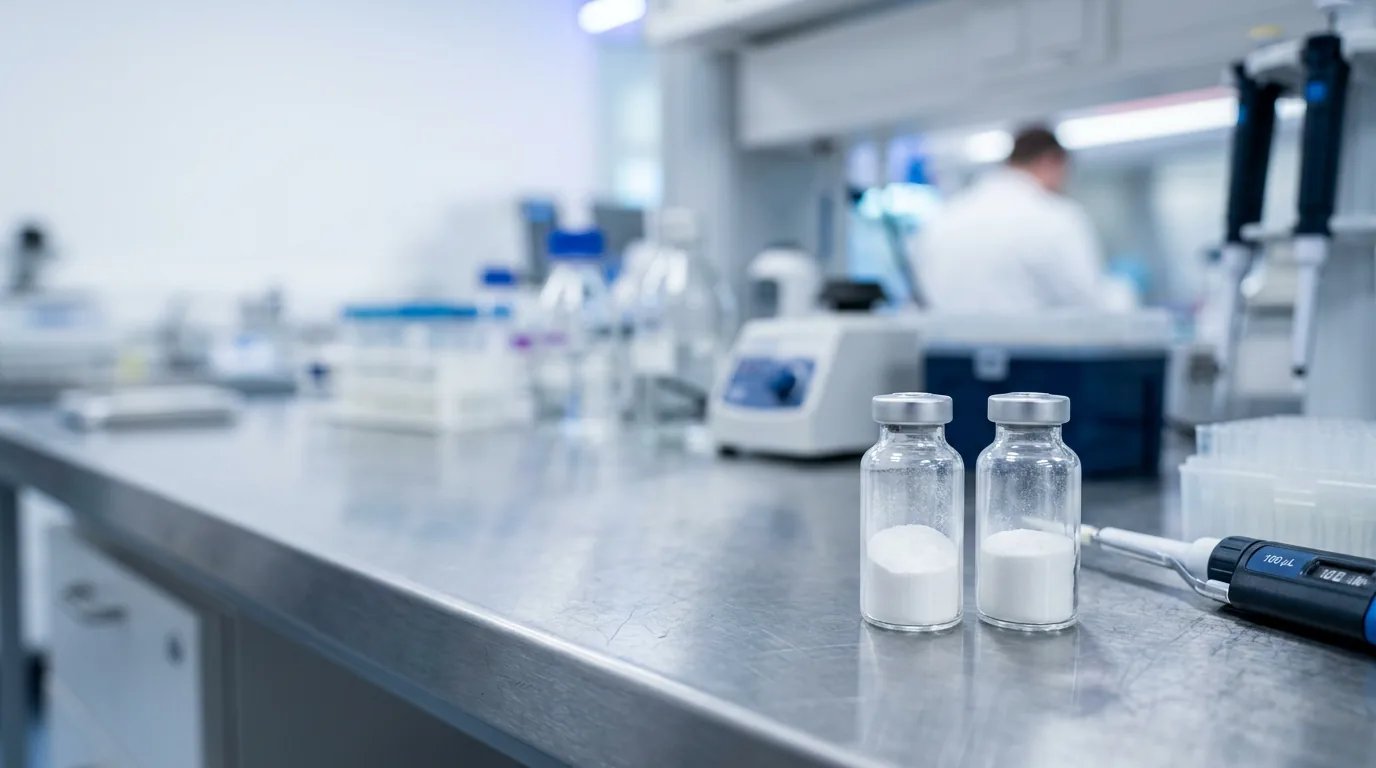
In preclinical research, Tirzepatide acts as a dual-agonist targeting GLP-1 and GIP receptors, while Retatrutide functions as a tri-agonist targeting GLP-1, GIP, and Glucagon receptors. Laboratory studies indicate that Retatrutide’s addition of the Glucagon receptor target alters cellular metabolic pathways differently than the dual-receptor affinity observed in Tirzepatide models. Both Tirzepatide and Retatrutide compounds supplied by Nautilus Peptides are strictly for Research Use Only (RUO) and undergo independent third-party testing to verify greater than 99% purity. Proper laboratory methodology requires storing these GLP-1 research peptides as lyophilized powders and reconstituting them with bacteriostatic water strictly for in vitro investigations.
This guide provides a comparative overview of dual-agonist versus tri-agonist mechanisms in preclinical metabolic models. All compounds discussed are for laboratory investigation strictly and are not for human consumption, medical, veterinary, or cosmetic use.
What is the difference between retatrutide and tirzepatide in research?
In preclinical research, Tirzepatide acts as a dual-agonist targeting GLP-1 and GIP receptors, while Retatrutide functions as a tri-agonist targeting GLP-1, GIP, and Glucagon receptors[1][2][3]. The primary mechanistic distinction observed in laboratory studies is that retatrutide adds glucagon-receptor agonism, which is associated with increased energy expenditure and fat oxidation in preclinical models[1][4][5]. Both Tirzepatide and Retatrutide compounds supplied by Nautilus Peptides are strictly for Research Use Only (RUO) and are not for human consumption, medical, veterinary, or cosmetic use.
Researchers investigate these compounds to understand how multiple receptor engagements influence metabolic pathways. Tirzepatide is a GLP-1R and GIPR dual incretin agonist[1][6][7]. In laboratory models, GLP-1R activation is observed to slow gastric emptying and support glucose-dependent insulin secretion, while GIPR activation augments insulin secretion and contributes to improved metabolic control[8][2][5]. Retatrutide, by contrast, engages three distinct targets: GLP-1R, GIPR, and the glucagon receptor (GCGR)[1][2][3]. The addition of the GCGR target shifts substrate use toward fat oxidation and can raise thermogenesis and energy expenditure in preclinical models[8][2][5].
This broader receptor profile makes retatrutide a broader energy balance agent in laboratory studies, whereas tirzepatide remains primarily focused on dual incretin pathways[1][5][6]. Experimental data indicate that retatrutide shows greater potency at the human GIPR than at the human GLP-1R or GCGR, with reported EC50 values of 0.0643 nM at GIPR, 0.775 nM at GLP-1R, and 5.79 nM at GCGR in pharmacological evaluations[5]. As a supplier of high-purity laboratory compounds, Nautilus Peptides mandates strict adherence to our research use only policy, ensuring these peptides are utilized exclusively for in vitro and preclinical investigations by qualified researchers.
What receptors does retatrutide target compared to tirzepatide?
Laboratory studies indicate that Retatrutide’s addition of the Glucagon receptor target alters cellular metabolic pathways differently than the dual-receptor affinity observed in Tirzepatide models. Nautilus Peptides provides both compounds verified by independent third-party testing to ensure greater than 99% purity for in vitro investigations.
The molecular architecture of these peptides dictates their specific receptor engagements. Tirzepatide engages the GLP-1 and GIP receptors, functioning as a dual incretin agent[1][6][7]. Retatrutide engages the GLP-1, GIP, and Glucagon receptors, functioning as a triple agonist[1][2][3]. Researchers utilize these compounds to compare how dual versus triple agonism influences metabolic signaling pathways in controlled laboratory environments.
| Feature | Tirzepatide | Retatrutide (GLP-3R) |
|---|---|---|
| Receptor Targets | GLP-1R, GIPR[1][6][7] | GLP-1R, GIPR, GCGR[1][2][3] |
| Agonist Classification | Dual incretin agonist[1][2] | Triple hormone receptor agonist[3] |
| Observed Preclinical Effects | Gastric emptying delay, glucose regulation[8][2] | Gastric emptying delay, increased fat oxidation, energy expenditure[1][4][5] |
| GIPR Potency (EC50) | High affinity | 0.0643 nM[5] |
| GLP-1R Potency (EC50) | High affinity | 0.775 nM[5] |
| GCGR Potency (EC50) | None | 5.79 nM[5] |
| Laboratory Application | Research Use Only (RUO) | Research Use Only (RUO) |
In a laboratory setting, the distinction in receptor targets is profound. Animal studies demonstrate that retatrutide can delay gastric emptying and promote weight reduction in animal models through pathways that involve the glucagon receptor, showing superior efficacy versus older incretin-based comparators in preclinical work[5]. For instance, in mouse models lacking the MC4R pathway, tirzepatide and retatrutide both produced anti-obesity effects, underscoring their ability to influence energy pathways even when canonical hypothalamic signaling is disrupted[9]. Researchers must strictly observe that all investigations utilizing these compounds are for preclinical laboratory research only.
How do researchers store and handle GLP-1 research peptides?
Proper laboratory methodology requires storing these GLP-1 research peptides as lyophilized powders and reconstituting them with bacteriostatic water strictly for in vitro investigations. Reconstituted solutions must be handled under sterile laboratory conditions and maintained at controlled refrigerated temperatures to prevent degradation.
GLP-1 analogues are long, multi-domain peptides susceptible to hydrolysis, deamidation, oxidation, and aggregation if exposed to improper temperatures, light, or repeated freeze-thaw cycles[10][11][12][13][14]. Laboratory protocols dictate specific handling procedures to maintain the structural integrity and bioactivity of these compounds during preclinical research.
- Store lyophilized powder at sub-zero temperatures: Unreconstituted peptide vials should be stored at -20°C or below, in tightly closed containers, protected from bright light and moisture[10][15][11][12][13][14][16][17]. For long-term archival material, -80°C is preferred[15][11][18][12][19][13].
- Equilibrate before opening: Vials must be brought to room temperature in a dry environment before opening to avoid moisture condensation on the cold powder, which causes instant hydrolysis[10][20][21][18][14][17].
- Reconstitute with appropriate sterile diluent: Researchers typically use bacteriostatic water (sterile water containing 0.9% benzyl alcohol) for multi-dose research vials, as the preservative inhibits bacterial growth[22][15][20][21][18][23].
- Dissolve gently without shaking: The diluent should be injected slowly along the vial wall[21][18]. Vials must be swirled gently and allowed 1-2 minutes for dissolution, as vigorous shaking introduces air bubbles and promotes surface denaturation and aggregation[21][18][12][19].
- Refrigerate reconstituted solutions: Working solutions must be stored at 2-8°C, never frozen, and protected from light[24][20][21][25][23]. Research protocols recommend utilizing reconstituted solutions within 28 days to minimize chemical degradation[15][20][21][25][23].
These methodologies ensure the compounds remain stable for precise in vitro testing. All handling must adhere strictly to Research Use Only guidelines.
Frequently Asked Questions
What is the difference between retatrutide and tirzepatide in research?
In preclinical research, Tirzepatide acts as a dual-agonist targeting GLP-1 and GIP receptors, while Retatrutide functions as a tri-agonist targeting GLP-1, GIP, and Glucagon receptors[1][2][3]. The addition of the Glucagon receptor target in retatrutide alters cellular metabolic pathways, leading to increased energy expenditure and fat oxidation in laboratory models[1][4][5].
What receptors does retatrutide target compared to tirzepatide?
Tirzepatide targets the GLP-1 and GIP receptors[1][6][7]. Retatrutide targets the GLP-1, GIP, and Glucagon receptors[1][2][3]. This triple agonism makes retatrutide a distinct compound for researchers investigating broader energy balance pathways in controlled in vitro environments.
How do I store and handle GLP-1 research peptides?
Proper laboratory methodology requires storing these GLP-1 research peptides as lyophilized powders at -20°C or below[10][15][11][12]. They should be reconstituted with bacteriostatic water strictly for in vitro investigations, and the resulting solutions must be maintained at 2-8°C and utilized within 28 days[15][20][21][25][23].
What does Research Use Only mean for peptide compounds?
Research Use Only (RUO) means the compounds are sold exclusively for laboratory and preclinical investigation. They are strictly not for human consumption, medical, veterinary, or cosmetic use, and must be handled by qualified researchers in controlled laboratory settings.
References
- Retatrutide: A Triple GLP-1/GIP/Glucagon Receptor Agonist. https://superpower.com/guides/retatrutide (2026-04-18)
- Efficacy and safety of retatrutide, a novel GLP-1, GIP, and glucagon …. https://pmc.ncbi.nlm.nih.gov/articles/PMC12026077/ (2025-02-05)
- Lilly's triple agonist, retatrutide, delivered powerful weight loss in …. https://investor.lilly.com/news-releases/news-release-details/lillys-triple-agonist-retatrutide-delivered-powerful-weight-loss (2026-05-21)
- 151: Why Retatrutide May Outperform GLP-1 Drugs – YouTube. https://www.youtube.com/watch?v=TcKD-mv1FnY (2026-05-25)
- Retatrutide—A Game Changer in Obesity Pharmacotherapy – PMC. https://pmc.ncbi.nlm.nih.gov/articles/PMC12190491/ (2025-05-30)
- Efficacy of Tirzepatide, Retatrutide, and Semaglutide for Weight Loss …. https://thennt.com/nnt/efficacy-of-tirzepatide-retatrutide-and-semaglutide-for-weight-loss-in-obese-individuals-without-diabetes/ (2025-06-29)
- Retatrutide vs. Tirzepatide: The Next-Gen GLP-1 Showdown – Dr Sobo. https://drsobo.com/blog/next-gen-weight-loss-retatrutide-vs-tirzepatide/
- Retatrutide (Triple Agonist) – Research Peptide – Peptpedia. https://peptpedia.org/peptide/retatrutide (2026-05-07)
- Efficacy of GLP-1 analog peptides, semaglutide, tirzepatide, and …. https://pubmed.ncbi.nlm.nih.gov/41723268/ (2026-04-26)
- Peptide Handling, dissolution & Storage – NIBSC. https://nibsc.org/science_and_research/virology/cjd_resource_centre/available_samples/peptide_library/peptide_storage.aspx (2026-06-25)
- Handling and Storage Guidelines for Peptides and Proteins. https://www.sigmaaldrich.com/US/en/technical-documents/technical-article/research-and-disease-areas/cell-and-developmental-biology-research/handling-and-storage (2023-10-14)
- Handling and Storage Guidelines for Peptides – Bachem. https://www.bachem.com/knowledge-center/handling-and-storage-guidelines-for-peptides/ (2026-03-15)
- Peptide Stability: How Long Do Peptides Last?. https://www.jpt.com/blog/how-long-last-peptides/ (2026-06-29)
- Peptide Storage and Handling Guidelines – GenScript. https://www.genscript.com/peptide_storage_and_handling.html (2025-01-01)
- How Long Do Peptides Last at Room Temperature?. https://www.creative-peptides.com/resources/how-long-do-peptides-last.html (2025-01-10)
- Peptide handling & storage guidelines – How to store a peptide?. https://www.sb-peptide.com/support/handling-storage/ (2026-02-11)
- Handling and Storage of Peptides – FAQ | AAPPTEC. https://www.peptide.com/faqs/handling-and-storage-of-peptides/ (2022-09-16)
- Storing Retatrutide: Stability Guide – Alpha Carbon Labs. https://alphacarbonlabs.com/blog/maintaining-bioactivity-best-practices-for-handling-and-storing-retatrutide-in-the-lab (2026-02-27)
- How to Store Peptides | Best Practices for Researchers. https://www.jpt.com/blog/how-to-store-peptides/ (2026-06-19)
- Best Ways to Store Retatrutide Research Peptide: Tips for Maximum …. https://palmettopeptides.com/blogs/news/07-how-to-store-retatrutide-research-peptide (2026-03-30)
- How to Reconstitute Tirzepatide Research Peptide Powder: Step-by …. https://palmettopeptides.com/blogs/news/01-how-to-reconstitute-tirzepatide-research-peptide (2026-03-29)
- How Much Bac Water to Mix With 10 mg Tirzepatide – TrimRX. https://trimrx.com/blog/how-to-properly-mix-10-mg-tirzepatide-with-bacteriostatic-water/ (2026-06-28)
- How Much Bac Water for 10mg Tirzepatide? Doctor's Mixing Guide. https://freemedicaljournals.com/blog/how-much-bac-water-for-10mg-tirzepatide/ (2026-05-27)
- Retatrutide Storage and Handling: Temperature and Shelf Life – Trimi. https://trytrimi.com/blog/retatrutide-storage (2026-04-03)
- Tirzepatide Bac Water Calculator: Mixing & Reconstitution Chart. https://freemedicaljournals.com/blog/tirzepatide-bac-water-calculator/ (2026-05-28)