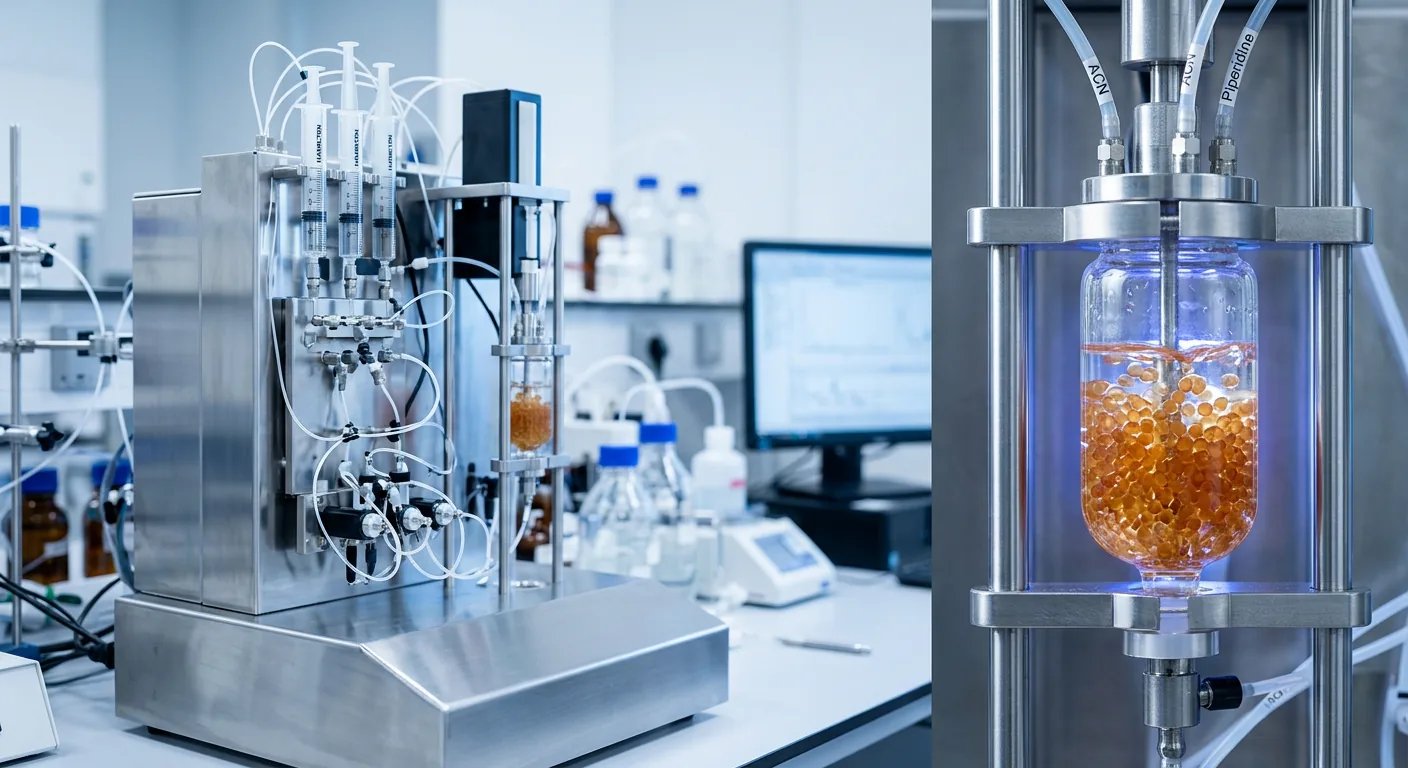
Solid-Phase Peptide Synthesis (SPPS) is the standard laboratory methodology used to manufacture high-purity, research-grade peptides strictly for in-vitro research use only. This automated chemical process constructs chains sequentially on a resin support, allowing researchers to obtain precise sequences for laboratory investigation.
Important Notice: All compounds discussed are strictly designated for Research Use Only (RUO). They are not intended for human consumption, medical, clinical, veterinary, or cosmetic use. The information provided is strictly for laboratory researchers investigating in-vitro methodologies.
Understanding the SPPS manufacturing cycle – comprising deprotection, coupling, washing, and cleavage – is essential for buyers evaluating compound integrity. This guide details the methodology, compares it to liquid-phase synthesis, and explains how high-performance liquid chromatography (HPLC) verifies purity.
What is Solid-Phase Peptide Synthesis and how does the cycle work?
Solid-Phase Peptide Synthesis (SPPS) builds research-grade peptides by repeating a precise four-step cycle – deprotection, washing, coupling, and washing – on a solid resin support, followed by acidic cleavage[1][2][3][4]. This iterative process allows for rapid assembly while facilitating the easy removal of excess reagents, making it the preferred method for synthesizing compounds strictly for in-vitro laboratory research.
The SPPS manufacturing cycle operates through the following steps to ensure maximum yield:
1. Deprotection: The cycle begins by removing a temporary protecting group (typically Fmoc) from the N-terminal amine of the resin-bound chain using a base solution[5][6].
2. Washing: The resin is washed to remove deprotection reagents and by-products, preventing unwanted side reactions[7][8][5].
3. Coupling: An activated amino acid is introduced, forming a stable peptide bond with the exposed amine on the growing chain[9][10][6].
4. Washing: A second washing phase clears away excess reagents, preparing the chain for the next cycle[7][5].
This cycle is repeated for every amino acid in the target sequence. Once assembled, researchers apply a strong acid, such as trifluoroacetic acid (TFA), to cleave the peptide from the resin and remove side-chain protecting groups[11][12][13][14]. All compounds manufactured through this process are strictly designated for Research Use Only (RUO). For laboratories prioritizing compound integrity, reviewing Nautilus Peptides quality control standards ensures that the SPPS methodology aligns with strict in-vitro requirements.
How does SPPS compare to liquid-phase synthesis and how is purity verified?
Compared to liquid-phase methods, SPPS allows vendors to consistently achieve greater than 99% final purity for sequences of 10 to 50 amino acids, verified via third-party HPLC testing[15][16][17][4]. While liquid-phase peptide synthesis (LPPS) conducts reactions in solution and purifies intermediates at every step, SPPS anchors the growing chain to a solid support, enabling faster cycle times and automated processing[18][19][2].
| Specification | Solid-Phase Peptide Synthesis (SPPS) | Liquid-Phase Peptide Synthesis (LPPS) |
|---|---|---|
| Primary Application | 10 to 50 amino acid sequences[18][4] | Short sequences (under 15 amino acids)[18][19] |
| Synthesis Speed | Faster, highly automatable[15][20][2] | Slower, labor-intensive steps[19][2] |
| Final Purity | Routinely ≥98% to 99% after HPLC[16][17] | Routinely ≥98% to 99% after HPLC[15][21] |
Because SPPS carries every resin-bound chain forward without intermediate purification, incomplete reactions can generate truncated or deletion sequences[16][22][4]. To resolve this, HPLC testing acts as the primary analytical method to verify that the final SPPS product is free of truncated peptide impurities before laboratory distribution[16][23]. Analytical reversed-phase HPLC separates components based on hydrophobicity, allowing laboratories to quantify purity and identify co-eluting deletion sequences[24][25]. Preparative HPLC then isolates the target compound, ensuring the final product meets the stringent >99% purity threshold required for reproducible in-vitro investigations.
Researchers evaluating compound integrity should review a guide to reading third-party HPLC peptide testing results to confirm the absence of synthesis errors. To source SPPS-manufactured compounds with transparent analytical documentation, researchers can contact Nautilus Peptides.
Frequently Asked Questions
What is Solid-Phase Peptide Synthesis?
Solid-Phase Peptide Synthesis (SPPS) is the standard chemical methodology used to construct research-grade peptides by anchoring a growing amino acid chain to a solid resin support. This process allows for automated assembly and is utilized to manufacture high-purity compounds strictly for in-vitro laboratory research.
What are the steps in the SPPS cycle?
The SPPS manufacturing cycle consists of four precise sequential steps: deprotection (removing the temporary protecting group), washing, coupling (adding the next amino acid), and a final washing phase[1][2][3]. This cycle repeats until the sequence is complete, followed by acidic cleavage to release the peptide[13][14].
How does SPPS compare to liquid-phase peptide synthesis?
SPPS is significantly faster and more automation-friendly for sequences of 10 to 50 amino acids, whereas liquid-phase peptide synthesis (LPPS) is slower but can provide higher crude purity for very short sequences[18][19][2]. Both methodologies rely on rigorous HPLC purification to achieve final research-grade purity[15][4].
How is SPPS peptide purity verified by HPLC testing?
HPLC testing verifies SPPS peptide purity by separating the target compound from any truncated or deletion sequences generated during the synthesis cycle[16][22]. By analyzing retention times, laboratories confirm that the final product meets the >99% purity standard required for in-vitro research use[24][25].
References
- Solid Phase Peptide Synthesis (SPPS) explained. https://www.bachem.com/knowledge-center/solid-phase-peptide-synthesis-spps-explained/ (2026-03-15)
- Introduction to Peptide Synthesis Methods – Bachem. https://www.bachem.com/knowledge-center/introduction-to-peptide-synthesis-methods/ (2026-07-01)
- What is SPPS? Solid-Phase Peptide Synthesis Guide. https://www.americanpeptides.us/blogs/news/solid-phase-peptide-synthesis-spps (2026-06-06)
- Peptide synthesis – Wikipedia. https://en.wikipedia.org/wiki/Peptide_synthesis (2004-12-09)
- Solid-Phase Peptide Synthesis (SPPS). https://www.benchchem.com/pdf/Technical_Support_Center_Solid_Phase_Peptide_Synthesis_SPPS.pdf (2025-11-20)
- Peptide Synthesis for Beginners. https://americanpeptidesociety.org/primers/spps-basics/ (2026-07-15)
- A Rapid Manual Solid Phase Peptide Synthesis Method for …. https://pmc.ncbi.nlm.nih.gov/articles/PMC12129042/ (2026-07-12)
- [PDF] An In-depth Technical Guide to Fmoc Solid-Phase Peptide Synthesis. https://www.benchchem.com/pdf/An_In_depth_Technical_Guide_to_Fmoc_Solid_Phase_Peptide_Synthesis.pdf (2025-12-14)
- Solid-phase Peptide Synthesis Services. https://www.amerigoscientific.com/solid-phase-peptide-synthesis-services.html (2026-06-26)
- The SPPS. https://www.medsci.org/v11p0697.pdf (2025-10-07)
- What is Solid-phase Peptide Synthesis?. https://powdersystems.com/2025/01/what-is-solid-phase-peptide-synthesis/ (2025-11-25)
- Peptide Design: Principles & Methods | Thermo Fisher Scientific – AU. https://www.thermofisher.com/us/en/home/life-science/protein-biology/protein-biology-learning-center/protein-biology-resource-library/pierce-protein-methods/peptide-synthesis.html (2026-07-15)
- TFA-Cocktails for Full Cleavages in Fmoc-SPPS. https://iris-biotech.de/global/blog/tfa-cocktails-for-full-cleavages-in-fmoc-spps.html (2025-07-15)
- Greening the synthesis of peptide therapeutics: an industrial … – PMC. https://pmc.ncbi.nlm.nih.gov/articles/PMC9057961/ (2020-11-24)
- Phase Synthesis of Peptide Derivatives. https://www.benchchem.com/pdf/A_Head_to_Head_Battle_Solution_Phase_vs_Solid_Phase_Synthesis_of_Peptide_Derivatives.pdf (2025-12-16)
- Peptide Purity & Yield Optimizing in SPPS | PurePep Blog. https://www.gyrosproteintechnologies.com/purepep-blog/peptide-purity-yield-spps (2020-11-04)
- High-Efficiency Solid Phase Peptide Synthesis (HE-SPPS). https://pubs.acs.org/doi/abs/10.1021/ol4036825 (2014-01-23)
- Peptide Synthesis Methods: How to Choose the Right Approach for Your API Program. https://www.neulandlabs.com/en/insights/stories/how-to-select-peptide-synthesis-method (2026-05-22)
- [PDF] Improved Tag-Assisted Liquid-Phase Peptide Synthesis – Sci-Hub. https://2024.sci-hub.se/8265/03e982326ce838a85f621b4b31636aa5/okada2019.pdf (2025-09-05)
- [PDF] High-Efficiency Solid Phase Peptide Synthesis (HE-SPPS). https://www.luxembourg-bio.com/wp-content/uploads/2017/07/OxymaPure-High-Efficiency-Solid-Phase-Peptide-Synthesis-DIC_Oxyma-1.pdf (2026-07-05)
- Fast Solution-Phase and Liquid-Phase Peptide Syntheses …. https://pmc.ncbi.nlm.nih.gov/articles/PMC10609394/ (2023-10-19)
- Troubleshooting Impurities in Synthetic Peptide Synthesis. https://www.benchchem.com/pdf/Technical_Support_Center_Troubleshooting_Impurities_in_Synthetic_Peptide_Synthesis.pdf (2025-12-16)
- Peptide Synthesis & Impurity Profiling. https://www.daicelpharmastandards.com/blog/peptide-synthesis-importance-of-impurity-profiling-in-therapeutic-peptides/ (2023-04-07)
- How Peptides Are Synthesized and Tested: From SPPS to HPLC and Mass Spec (2026). https://peptideresearchreviews.com/articles/how-peptides-are-synthesized-and-tested (2026-06-14)
- Fundamental Aspects of SPPS and Green Chemical Peptide Synthesis. https://pmc.ncbi.nlm.nih.gov/articles/PMC11985259/ (2025-04-10)