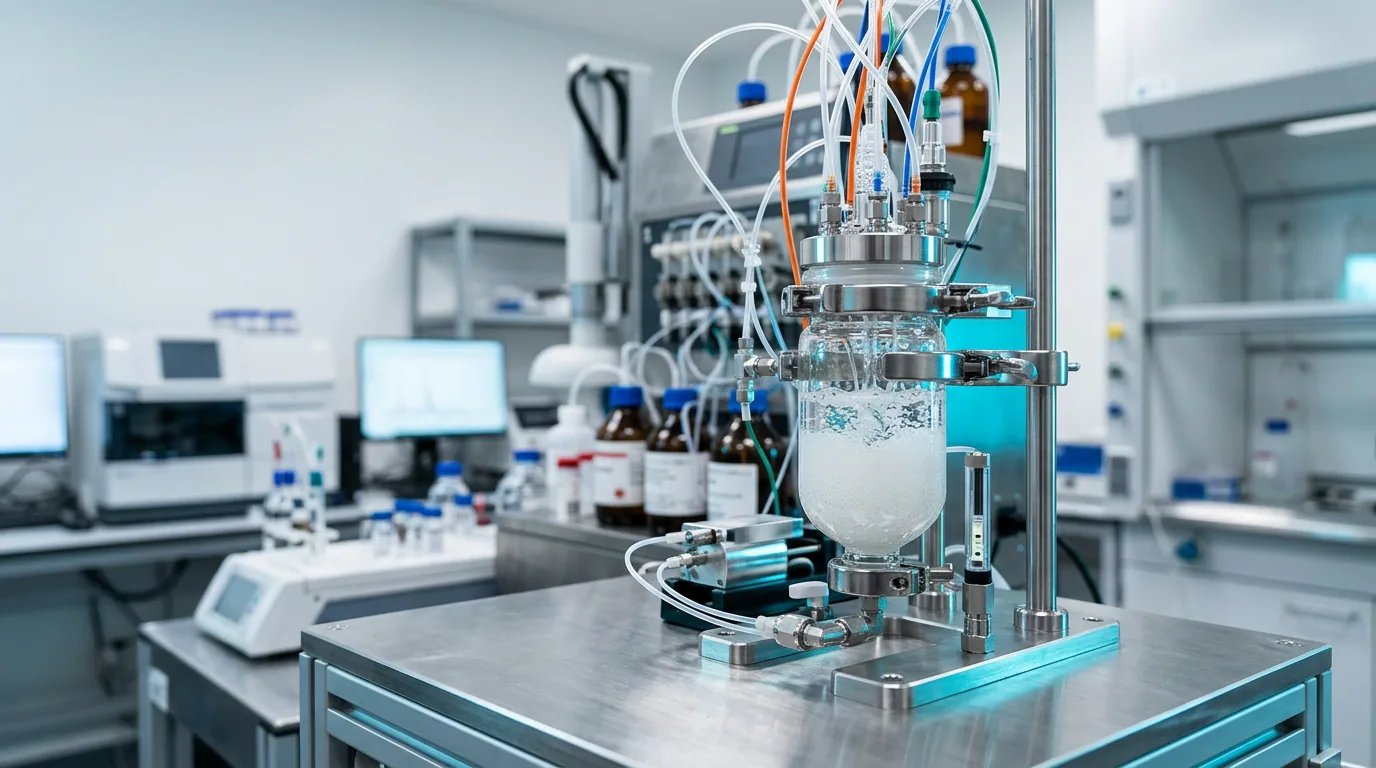
Solid-Phase Peptide Synthesis (SPPS) is the standard laboratory methodology used by vendors like Nautilus Peptides to manufacture research compounds strictly for non-human Research Use Only. By assembling complex amino acid chains on an insoluble solid support, researchers can easily wash away excess reagents to consistently yield greater than 99% purity[1][2]. Modern SPPS allows for the rapid, automated synthesis of custom sequences required for rigorous preclinical investigation.
The SPPS manufacturing process relies on three sequential chemical steps – deprotection, coupling, and cleavage – to build peptides with exact precision[1][3]. Because these compounds are synthesized for specific experimental applications, their final purity and molecular identity must be rigorously verified by independent analytical testing.
Strict Compliance Notice: All SPPS-manufactured compounds are exclusively for laboratory Research Use Only (RUO). They are never intended for human consumption, medical treatment, veterinary applications, or cosmetic use. The methodologies described in this guide are strictly for educational purposes regarding laboratory synthesis and quality control.
What is Solid-Phase Peptide Synthesis (SPPS)?
Solid-Phase Peptide Synthesis (SPPS) is a chemical methodology for assembling peptides by sequentially adding protected amino acids to a growing chain anchored to an insoluble solid resin support[1][2]. This process is the universally adopted standard for manufacturing high-purity research-grade peptides. All SPPS-manufactured peptides are strictly for laboratory Research Use Only and are never intended for human consumption, medical treatment, or veterinary applications.
Invented by Robert Bruce Merrifield in the late 1950s – a breakthrough that earned him the 1984 Nobel Prize in Chemistry – SPPS transformed peptide manufacturing[4][5][6]. Before SPPS, peptide synthesis required arduous liquid-phase methods with complicated purifications after every single step[7]. Merrifield’s innovation was covalent attachment: by keeping the growing peptide immobilized on a solid resin, laboratories could drive reactions to near completion using excess soluble reagents, which are then rapidly filtered and washed away[1][5][7].
Today, modern Fmoc-based SPPS is the dominant technology for routine research-use-only (RUO) peptide synthesis[8][9]. It provides a highly automated, efficient platform capable of producing exact, custom sequences for rigorous laboratory investigation.
What are the steps in the SPPS cycle?
The SPPS cycle consists of three sequential laboratory steps – deprotection, coupling, and cleavage – which allow researchers to assemble complex amino acid chains with precision[1][3]. The use of a solid resin support allows excess reagents to be washed away easily between steps, minimizing side reactions and impurities[10][11].
- Deprotection: The cycle begins by removing a temporary protecting group (such as Fmoc) from the N-terminus of the resin-bound amino acid[2][12]. This exposes a free amine, preparing the molecule for the next chemical reaction[3].
- Coupling: A new protected amino acid is introduced alongside a coupling reagent. The carboxyl group of the incoming amino acid is activated and reacts with the exposed amine on the resin, forming a new amide bond[2][11]. Laboratories use excess reagents – often 5 to 10 equivalents – to drive this coupling reaction to near completion, typically achieving efficiencies around 99.5% per step[5][13].
- Cleavage: Once the full sequence is assembled through repeated cycles of deprotection and coupling, researchers perform a final global cleavage. This step uses an acid solution (such as trifluoroacetic acid) to sever the linker bond, releasing the completed peptide from the solid resin while simultaneously removing all remaining side-chain protecting groups[14][12][15].
Between each of these steps, researchers thoroughly wash the resin with solvents to eliminate unreacted materials, ensuring the chain continues to grow accurately[3][13].
Is solid-phase peptide synthesis better than liquid-phase?
Compared to liquid-phase methods, modern SPPS manufacturing consistently yields research peptides with greater than 99% purity when verified by independent third-party HPLC and mass spectrometry testing. SPPS is highly automated and scalable, allowing for the rapid synthesis of longer, more complex peptide sequences compared to traditional liquid-phase synthesis[16][14].
Liquid-Phase Peptide Synthesis (LPPS) and SPPS both serve critical roles in chemical manufacturing, but they excel in different laboratory environments. SPPS is the preferred method for routine small-to-medium peptide work, while LPPS is often reserved for fragment-based assembly or massive industrial-scale production[17][18][19].
| Manufacturing Feature | Solid-Phase Peptide Synthesis (SPPS) | Liquid-Phase Peptide Synthesis (LPPS) |
|---|---|---|
| Purity Control | High purity for routine sequences; excess reagents are easily washed away[16][14] | High purity achieved through intermediate isolation and purification at each step[18][19] |
| Automation | Highly automation-friendly, enabling rapid, high-throughput laboratory synthesis[16][20] | Traditionally labor-intensive, though continuous-flow systems are emerging[18][21] |
| Sequence Length | Optimal for short to medium sequences; efficiency can drop for extremely long chains[22][18] | Advantageous for highly complex or extremely long sequences using fragment condensation[22][23] |
| Scalability | Ideal for discovery, research, and milligram-to-gram scale laboratory production[16][14] | Better suited for large-scale, bulk industrial manufacturing[19] |
How do labs verify the purity of SPPS peptides?
Independent third-party HPLC testing is required to confirm that the SPPS process has successfully achieved a purity level of greater than 99%[24][25]. Mass spectrometry is utilized alongside HPLC to verify the exact molecular weight and identity of the synthesized peptide sequence[26][27].
Because SPPS can occasionally produce truncated or deletion sequences if a coupling step is incomplete, rigorous HPLC and mass spectrometry testing is non-negotiable for research-grade compounds.
- High-Performance Liquid Chromatography (HPLC): Reversed-phase HPLC separates the target peptide from synthesis by-products based on hydrophobicity[28][29]. Purity is calculated by integrating the area under the main UV-absorbing peak. A result of >99% indicates that 99% of the detectable material in the batch is the target compound[24][30].
- Mass Spectrometry (MS): While HPLC measures chromatographic purity, it cannot confirm structural identity. MS measures the mass-to-charge ratio of the ionized peptide, confirming that the observed molecular mass matches the theoretical mass of the intended sequence[28][25].
- Tandem Mass Spectrometry (MS/MS): For complex sequences, MS/MS fragments the peptide backbone to provide sequence-level verification, ensuring no single-residue substitutions occurred during synthesis[28][31].
Frequently Asked Questions
What is Solid-Phase Peptide Synthesis?
Solid-Phase Peptide Synthesis (SPPS) is a laboratory methodology where amino acids are sequentially added to a growing chain anchored to an insoluble solid resin support[1][2]. This allows excess reagents to be washed away easily, making it the standard method for producing highly pure research compounds[1][9].
What are the steps in the SPPS cycle?
The SPPS cycle consists of three sequential chemical steps: deprotection (removing a protective group to expose the chain), coupling (adding the next amino acid), and cleavage (releasing the finished peptide from the resin)[1][3]. The resin is thoroughly washed between each step to remove impurities[10][11].
Is solid-phase peptide synthesis better than liquid-phase?
SPPS is generally preferred for research applications because it is highly automated and efficiently produces high-purity peptides at the milligram-to-gram scale[16][14]. Liquid-phase synthesis is typically better suited for massive industrial-scale production or assembling extremely long sequences via fragment condensation[18][19].
How do labs verify the purity of SPPS peptides?
Laboratories verify SPPS peptide purity using High-Performance Liquid Chromatography (HPLC) to ensure the target compound exceeds 99% of the sample[24][25]. They simultaneously use Mass Spectrometry (MS) to confirm the correct molecular weight and structural identity of the peptide[26][27].
References
- Solid-phase synthesis – Wikipedia. https://en.wikipedia.org/wiki/Solid-phase_synthesis (2004-12-20)
- Solid Phase Peptide Synthesis (SPPS) explained – Bachem. https://www.bachem.com/knowledge-center/solid-phase-peptide-synthesis-spps-explained/ (2026-03-15)
- Overview of Solid Phase Peptide Synthesis (SPPS). https://www.peptide.com/resources/solid-phase-peptide-synthesis/overview-of-solid-phase-peptide-synthesis-spps/ (2019-10-18)
- Robert Bruce Merrifield – Wikipedia. https://en.wikipedia.org/wiki/Robert_Bruce_Merrifield (2004-12-08)
- 1984 Nobel Prize in Chemistry – The Rockefeller University. https://www.rockefeller.edu/our-scientists/r-bruce-merrifield/2398-nobel-prize/ (2018-10-23)
- Bruce Merrifield | Nobel Prize, Peptide Synthesis & Research. https://www.britannica.com/biography/Bruce-Merrifield (2026-05-10)
- What is solid phase peptide synthesis? – Biotage. https://www.biotage.com/blog/what-is-solid-phase-peptide-synthesis (2023-01-31)
- Advances in Fmoc solid‐phase peptide synthesis – PMC – NIH. https://pmc.ncbi.nlm.nih.gov/articles/PMC4745034/ (2016-01-20)
- Introduction to Peptide Synthesis – PMC – NIH. https://pmc.ncbi.nlm.nih.gov/articles/PMC3564544/ (2026-06-08)
- Peptide Synthesis | Solid-Phase | SPPS – Vapourtec. https://www.vapourtec.com/applications-of-flow-chemistry/solid-phase-peptide-synthesis/ (2026-06-18)
- What is Solid-phase Peptide Synthesis? – Powder Systems. https://powdersystems.com/2025/01/what-is-solid-phase-peptide-synthesis/ (2025-01-07)
- Solid Phase Peptide Synthesis Process and Applications 2025. https://www.neulandlabs.com/en/insights/stories/solid-phase-peptide-synthesis (2025-05-16)
- Universal peptide synthesis via solid-phase methods fused with …. https://www.nature.com/articles/s41467-025-62344-2 (2025-08-08)
- Mastering Solid Phase Peptide Synthesis (SPPS). https://www.jpt.com/blog/solid-phase-peptide-synthesis-spps/ (2026-03-21)
- Fmoc Resin Cleavage and Deprotection – Sigma-Aldrich. https://www.sigmaaldrich.com/US/en/technical-documents/technical-article/chemistry-and-synthesis/peptide-synthesis/fmoc-cleavage-deprotection (2024-06-13)
- Solid vs Liquid Phase Peptide Synthesis: Which Method Is Better?. https://resolvemass.ca/solid-vs-liquid-phase-peptide-synthesis-which-method-is-better/ (2025-07-10)
- Controversial Nomenclature in Peptide Synthesis: A Call for Clarity. https://onlinelibrary.wiley.com/doi/full/10.1002/psc.70044 (2025-07-27)
- Introduction to Peptide Synthesis Methods – Bachem. https://www.bachem.com/knowledge-center/introduction-to-peptide-synthesis-methods/ (2026-03-14)
- Next-Generation Peptide Manufacturing: Green Chemistry and …. https://www.acs.org/green-chemistry-sustainability/green-chemistry-nexus/articles/next-generation-peptide-manufacturing-green-chemistry-and-sustainable-development.html (2026-03-17)
- Solid-Phase or Liquid-Phase? How Has Peptide Synthesis …. https://www.bioduro.com/news-resources/insights/solid-phase-or-liquid-phase-how-has-peptide-synthesis-revolutionized-drug-discovery.html (2025-06-18)
- A Scale Down Approach to Liquid Phase Peptide Synthesis. https://aiche.confex.com/aiche/2025/meetingapp.cgi/Paper/718430
- Solid-Phase vs Liquid-Phase Peptide Synthesis – Adesis. https://adesisinc.com/solid-phase-vs-liquid-phase-peptide-synthesis/ (2025-09-30)
- On-Demand Complex Peptide Synthesis: An Aspirational (and …. https://pubs.acs.org/doi/10.1021/jacs.6b08663 (2016-10-14)
- Peptide Testing: HPLC & Mass Spec Purity Guide – Apex Laboratory. https://apexlaboratory.org/hplc-testing-peptide-purity/ (2026-03-08)
- Understanding Peptide Purity: What 99%+ Really Means. https://chameleonpeptides.com/2026/02/21/understanding-peptide-purity/ (2026-02-21)
- The Role of HPLC Analysis in Peptide Characterization. https://verifiedpeptides.com/knowledge-hub/the-role-of-hplc-analysis-in-peptide-characterization/ (2025-11-20)
- Understanding Peptide Purity Percentages. https://lonestarpeptideco.com/research/peptide-purity-percentages/ (2026-02-20)
- HPLC and Mass Spectrometry for Peptide Validation. https://www.creative-peptides.com/resources/analytical-services-hplc-and-mass-spectrometry-for-peptide-validation.html (2025-09-19)
- [PDF] Analysis and Purification of Synthetic Peptides by Liquid … – Agilent. https://www.agilent.com/cs/library/brochures/br-synthetic-peptide-ordering-guide-5994-6704en-agilent.pdf (2026-03-04)
- How to Read a Peptide Purity Test: HPLC, Mass Spectrometry and …. https://peptideslabuk.com/how-to-read-a-peptide-purity-test-hplc-mass-spectrometry-and-coa-interpretation-for-uk-researchers-2026/ (2026-04-12)
- Enhanced Peptide Identification Using Capillary UHPLC and …. https://www.chromatographytoday.com/article/liquid-chromatography/65/thermo-fisher-scientific/enhanced-peptide-identification-using-capillary-uhplc-and-orbitrap-mass-spectrometry/2241