
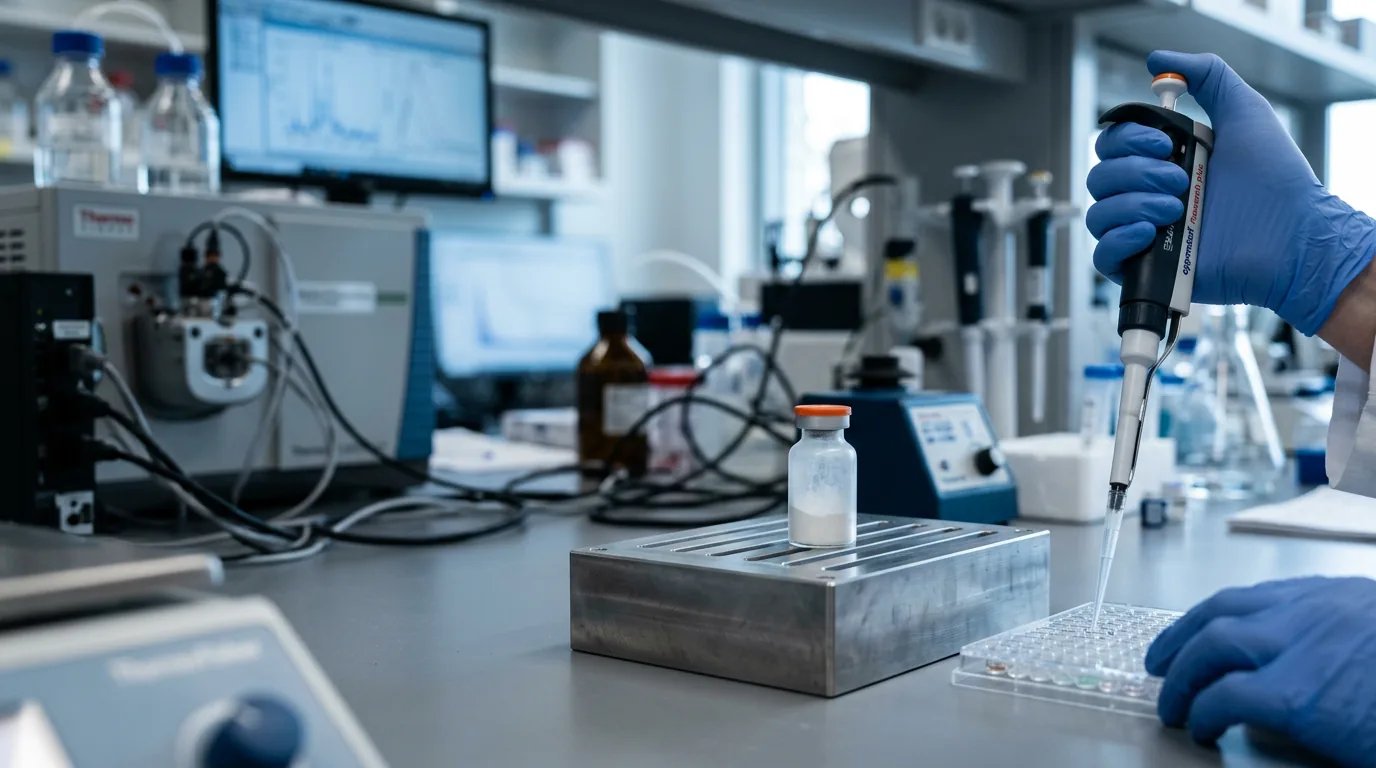
SS-31, also known as elamipretide, is a mitochondria-targeted tetrapeptide sold strictly for laboratory research use only (RUO) and not for human consumption. ⚠️ RESEARCH USE ONLY DISCLAIMER: The information provided in this article and the compounds discussed are intended strictly for in vitro and in vivo preclinical laboratory research. SS-31 is not approved for human or veterinary use, and it must not be used for the diagnosis, treatment, cure, mitigation, or prevention of any disease. All content is for informational purposes in a laboratory context.
In preclinical studies, the SS-31 peptide demonstrates a unique mechanism by selectively binding to cardiolipin, a phospholipid located on the inner mitochondrial membrane. This interaction provides researchers with a targeted tool to investigate cellular respiration, electron transport chain efficiency, and mitochondrial bioenergetics. For optimal laboratory stability, lyophilized SS-31 research peptides should be stored at -20 degrees Celsius until ready for reconstitution. Nautilus Peptides provides laboratory-grade SS-31 verified by independent third-party mass spectrometry and HPLC testing to ensure greater than 99 percent purity for preclinical research. This guide details the SS-31 peptide’s structure, its cardiolipin-targeting mechanism, and the rigorous handling protocols required to maintain compound stability in experimental models.
What is the SS-31 peptide used for in research?
SS-31, also known as elamipretide, is a mitochondria-targeted tetrapeptide sold strictly for laboratory research use only (RUO) and not for human consumption. Synthesized as D-Arg-dimethylTyr-Lys-Phe-NH2, this positively charged compound is highly cell-permeable and accumulates rapidly within the mitochondrial matrix[1][2]. Preclinical researchers investigate SS-31 to evaluate its impact on mitochondrial bioenergetics and cellular respiration in vitro and in vivo.
In laboratory settings, SS-31 serves as a highly specific probe for interrogating mitochondrial dysfunction and energy production[3]. Because it localizes directly to the inner mitochondrial membrane, investigators utilize the SS-31 peptide to study oxidative phosphorylation without the confounding variables associated with broader cellular antioxidants[1]. Preclinical models frequently employ this tetrapeptide to measure changes in maximum mitochondrial ATP production, electron transfer efficiency, and reactive oxygen species (ROS) generation[1][4].
Furthermore, research involving isolated mitochondria demonstrates that SS-31 can maintain mitochondrial membrane potential under experimentally induced stress[5]. By preventing the opening of the mitochondrial permeability transition pore (mPTP), the compound preserves cristae integrity and sustains ATP generation during energy deficits[6][7]. These characteristics make SS-31 an essential reagent for scientists mapping cellular bioenergetics, mitochondrial turnover, and redox homeostasis in controlled laboratory environments[8][5].
How does the SS-31 mechanism target cardiolipin in mitochondria?
In preclinical studies, the SS-31 peptide demonstrates a unique mechanism by selectively binding to cardiolipin, a phospholipid located on the inner mitochondrial membrane. This interaction helps stabilize mitochondrial membrane curvature and supports electron transport chain function under research conditions. Carrying a net charge of +3 at physiological pH, the peptide is electrostatically attracted to the negatively charged inner mitochondrial membrane[9][10].
Once localized, SS-31 binds selectively to cardiolipin via electrostatic interactions with anionic phosphate headgroups and hydrophobic interactions with lipid acyl chains[5][3]. This targeted binding alters the membrane’s biophysical properties, tightly packing the lipids and promoting the self-association of cardiolipin molecules[11][10].
| Mechanism Attribute | SS-31 (Elamipretide) Action | Non-Targeted Compounds |
|---|---|---|
| Membrane Localization | Accumulates thousands-fold in the inner mitochondrial membrane[12] | Diffuse cellular distribution |
| Binding Target | Selectively binds cardiolipin via electrostatic and hydrophobic forces[5][3] | Non-specific or indirect interactions |
| Structural Impact | Stabilizes cristae curvature and respiratory supercomplexes[11][13] | No direct structural membrane stabilization |
| Cytochrome c Effect | Promotes electron-carrier function and inhibits peroxidase activity[6][9] | Does not modulate cytochrome c peroxidase activity |
By stabilizing cardiolipin, the SS-31 mechanism facilitates the proper assembly of respiratory supercomplexes (Complex I, III, and IV)[6][3]. This architectural support optimizes electron flux, increases ATP synthesis, and simultaneously limits electron leak, making it a critical asset for researchers investigating mitochondrial mechanism of action pathways in complex cellular models[14][12].
How should lyophilized SS-31 be stored in the laboratory?
For optimal laboratory stability, lyophilized SS-31 research peptides should be stored at -20 degrees Celsius until ready for reconstitution. Researchers should minimize freeze-thaw cycles and store reconstituted aliquots at -80 degrees Celsius for short-term experimental use. Proper handling is critical to preventing degradation and ensuring reproducible outcomes in bioenergetic assays.
Laboratory personnel should follow strict temperature controls to maintain the integrity of the 639.80 g/mol compound[15]. Whether utilizing bacteriostatic water or sterile water for reconstitution, researchers must adhere to standardized protocols.
- Lyophilized Storage: Keep the unmixed, lyophilized powder sealed, desiccated, and protected from light at -20 degrees Celsius[15][16]. For extended archiving, -80 degrees Celsius offers additional protection against ambient moisture[17].
- Reconstitution Protocol: Introduce the solvent slowly, allowing the powder to dissolve without aggressive shaking, which can shear the peptide bonds.
- Aliquot Preparation: Immediately divide the reconstituted solution into single-use experimental aliquots to avoid exposing the entire batch to temperature fluctuations[15][17].
- Frozen Liquid Storage: Store the working aliquots at -80 degrees Celsius. Do not subject any single aliquot to more than three total freeze-thaw cycles, as repeated thermal stress severely compromises peptide stability and experimental validity[15][16].
Where can researchers buy verified SS-31 peptide for preclinical studies?
Nautilus Peptides provides laboratory-grade SS-31 verified by independent third-party mass spectrometry and HPLC testing to ensure greater than 99 percent purity for preclinical research. Sourcing from transparent vendors who provide lot-specific analytical data is critical to ensuring experimental reproducibility.
When procuring SS-31 (elamipretide) for sensitive bioenergetic assays, investigators must evaluate vendors based on strict analytical criteria. Even minor synthetic impurities can significantly distort oxygen consumption rates and ATP synthesis measurements in vitro[18][19].
- HPLC Purity: High-Performance Liquid Chromatography (HPLC) estimates the quantitative purity of the sample. Research-grade SS-31 should demonstrate an HPLC purity exceeding 99 percent, ensuring the target compound is free from synthesis by-products that could confound cellular responses[19][20].
- Mass Spectrometry: While HPLC confirms purity, mass spectrometry is required to confirm the molecular identity of the peptide. LC-MS/MS verifies that the isolated peak precisely matches the theoretical mass of the D-Arg-dimethylTyr-Lys-Phe-NH2 sequence[19][20].
- Lot-Specific COAs: A universal, site-wide certificate is insufficient. Researchers must source from suppliers that publish downloadable, batch-matched Certificates of Analysis (COAs).
- Synthesis Methodology: Premium HPLC and mass spectrometry verified peptides are produced via Solid-Phase Peptide Synthesis (SPPS), yielding the structural precision required for cardiolipin-binding studies.
Frequently Asked Questions
What is the SS-31 peptide used for in research?
In preclinical laboratory research, the SS-31 peptide is utilized to study mitochondrial bioenergetics, cellular respiration, and electron transport chain efficiency. It serves as a targeted tool to investigate oxidative phosphorylation and membrane potential in isolated mitochondria and cellular models.
How does SS-31 bind to cardiolipin in mitochondria?
SS-31 carries a positive +3 charge that electrostatically attracts it to the negatively charged inner mitochondrial membrane[9][10]. It selectively binds to the phospholipid cardiolipin via electrostatic and hydrophobic interactions, which stabilizes cristae curvature and supports respiratory supercomplex assembly[5][3].
How should lyophilized SS-31 be stored in the laboratory?
Lyophilized SS-31 powder should be stored sealed, desiccated, and protected from light at -20 degrees Celsius[15][16]. Once reconstituted, the solution should be divided into single-use aliquots and frozen at -80 degrees Celsius to prevent degradation from repeated freeze-thaw cycles[15][17].
Where can I buy third-party tested SS-31 for research?
Researchers can purchase third-party tested SS-31 from Nautilus Peptides. Every batch is synthesized for research use only (RUO) and undergoes independent HPLC and mass spectrometry testing to verify greater than 99 percent purity and molecular identity.
References
- Structure-activity relationships of mitochondria-targeted tetrapeptide …. https://elifesciences.org/articles/75531 (2022-08-01)
- SS-31 Peptide: Mitochondrial Repair for Energy and Longevity. https://revolutionhealth.org/blogs/news/peptide-therapy-ss-31 (2025-05-09)
- Elamipretide: A Review of Its Structure, Mechanism of Action, and …. https://pmc.ncbi.nlm.nih.gov/articles/PMC11816484/ (2025-01-23)
- In vivo mitochondrial ATP production is improved in older adult …. https://journals.plos.org/plosone/article?id=10.1371%2Fjournal.pone.0253849 (2021-07-15)
- Mitochondrial protein interaction landscape of SS-31 – PNAS. https://www.pnas.org/doi/10.1073/pnas.2002250117 (2020-06-30)
- [PDF] SS-31 (also known as Elamipretide®, Bendavia®, and MTP-131). https://www.alzdiscovery.org/uploads/cognitive_vitality_media/SS-31-Cognitive-Vitality-For-Researchers.pdf (2026-06-26)
- Neuroprotective Effects of a Small Mitochondrially-Targeted … – PMC. https://pmc.ncbi.nlm.nih.gov/articles/PMC8801496/ (2022-01-17)
- Improving mitochondrial function with SS-31 reverses age-related …. https://pmc.ncbi.nlm.nih.gov/articles/PMC6588449/ (2018-12-28)
- SS-31, a Mitochondria-Targeting Peptide, Ameliorates Kidney Disease. https://pmc.ncbi.nlm.nih.gov/articles/PMC9192202/ (2022-06-06)
- [PDF] Molecular Mechanism of Action of Mitochondrial Therapeutic SS-31 …. https://www.biorxiv.org/content/10.1101/735001v1.full.pdf (2019-08-14)
- Contemporary insights into elamipretide's mitochondrial mechanism …. https://pmc.ncbi.nlm.nih.gov/articles/PMC12164653/ (2025-04-27)
- Elamipretide – an overview | ScienceDirect Topics. https://www.sciencedirect.com/topics/pharmacology-toxicology-and-pharmaceutical-science/elamipretide (2025-09-29)
- Mitochondrial protein interaction landscape of SS-31 – PMC – NIH. https://pmc.ncbi.nlm.nih.gov/articles/PMC7334473/ (2020-06-17)
- SS-31 (Elamipretide) — Peptide Evidence Score – Biomeme. https://biomeme.com/applications/wellness/peptide-evidence/ss-31/ (2026-06-25)
- SS-31 Reconstitution & Long-Term Storage Protocols | Palmetto …. https://palmettopeptides.com/blogs/news/reconstitution-and-long-term-storage-protocols-for-ss-31-research-peptide-in-the-laboratory (2026-04-22)
- SS-31 Research Peptide Guide: Mitochondria & Cardiolipin …. https://palmettopeptides.com/blogs/news/ss-31-research-peptide-complete-guide-to-mitochondrial-targeting-cardiolipin-binding-and-laboratory- (2026-04-22)
- SS-31 – Peptide Calculator – Bergdorf Bioscience. https://bergdorfbio.com/en/us/peptide-calculator/ss-31 (2026-06-21)
- Peptide Characterization by RP-HPLC for Regulatory Submissions. https://resolvemass.ca/what-is-peptide-purity-by-hplc-and-why-it-matters/ (2026-01-01)
- [PDF] Recommendations for the generation, quantification, storage and …. https://cdr.lib.unc.edu/downloads/4t64gv39r (2024-07-30)
- Peptide Testing: HPLC & Mass Spec Purity Guide – Apex Laboratory. https://apexlaboratory.org/hplc-testing-peptide-purity/ (2026-03-08)