
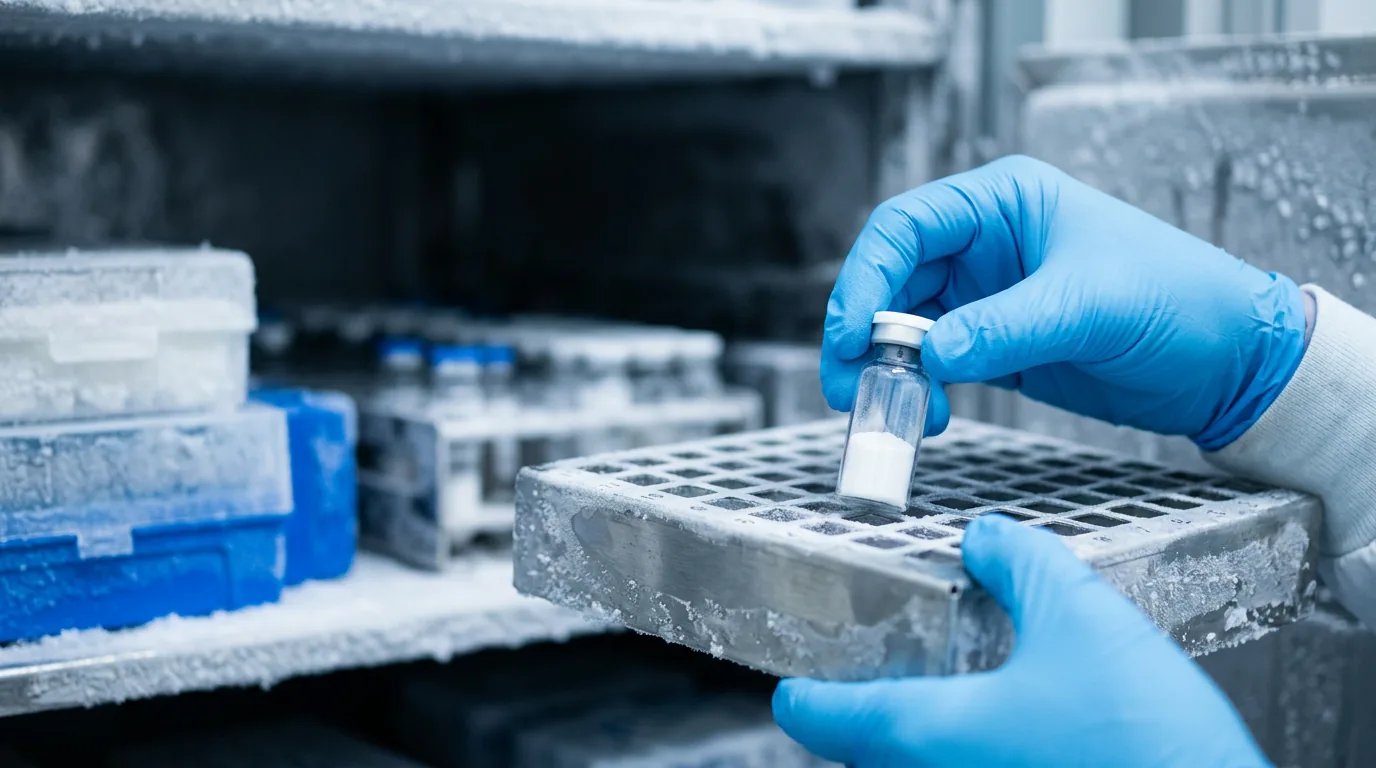
For laboratory research, lyophilized peptides should be stored in a deep freeze at -20 degrees Celsius to maximize shelf life and maintain compound stability. Once reconstituted with bacteriostatic water, Research Use Only (RUO) peptides must be refrigerated between 2 and 8 degrees Celsius and utilized within 30 days. Proper handling protocols are critical to prevent moisture degradation and ensure the integrity of high-purity compounds in preclinical settings.
All peptide storage protocols outlined in this guide are strictly for preclinical laboratory environments. These compounds are strictly for Research Use Only and not for human consumption, medical, veterinary, or cosmetic use. This guide details how to store research peptides correctly, covering exact temperature thresholds, handling procedures for lyophilized powders, and the shelf-life limitations of reconstituted solutions.
How do you store lyophilized research peptides?
For laboratory research, lyophilized peptides should be stored in a deep freeze at -20 degrees Celsius to maximize shelf life and maintain compound stability. At this temperature, most lyophilized research peptides maintain 95% or greater integrity for roughly 24 to 36 months[1][2][3][4]. All peptide storage protocols are strictly for preclinical laboratory environments, as these compounds are strictly for Research Use Only and not for human consumption.
Lyophilization removes water from the peptide, drastically slowing hydrolysis and degradation pathways[5][6][7][8]. However, even in a freeze-dried state, these compounds remain highly sensitive to environmental factors like heat, light, and ambient humidity[7][9][10]. Researchers must ensure that vials remain hermetically sealed and protected from light exposure during long-term storage[5][7][11][9][10]. For multi-year storage horizons or particularly unstable sequences, laboratories often utilize ultra-low freezers set to -80 degrees Celsius, which can extend practical shelf life beyond five years[1][6][2][8][3][4].
Short-term storage at room temperature is occasionally necessary during shipping or preparation, but it is not acceptable for deliberate storage[12][9][10]. Degradation becomes measurable within weeks at ambient temperatures[13][2][9][4].
| Storage Environment | Temperature Range | Expected Shelf Life | Laboratory Application |
|---|---|---|---|
| Deep Freeze (Ultra-low) | -80 degrees Celsius | 5+ years[1][6] | Maximum preservation for sensitive or multi-year storage |
| Deep Freeze (Standard) | -20 degrees Celsius | 2 to 3 years[1][2][3] | Standard long-term storage for unopened lyophilized vials |
| Refrigeration | 2 to 8 degrees Celsius | 6 to 12 months[13][2][14] | Short-term storage of unopened vials |
| Room Temperature | 20 to 25 degrees Celsius | Days to weeks[13][2] | Transit or immediate preparation only |
Laboratories preparing to utilize these compounds should consult a standard peptide reconstitution guide to transition the powder into a liquid state accurately.
What temperature should reconstituted peptides be kept at?
Once reconstituted with bacteriostatic water, Research Use Only (RUO) peptides must be refrigerated between 2 and 8 degrees Celsius and utilized within 30 days. To prevent moisture degradation, laboratory technicians must allow frozen Nautilus Peptides vials to reach room temperature before opening the sealed cap.
Reconstituting a peptide introduces water, which fundamentally changes its stability profile. Once mixed, reconstituted peptides are best stored refrigerated at 2 to 8 degrees Celsius (36 to 46 degrees Fahrenheit) and must never be frozen[14][15][16][17]. Freezing a liquid peptide solution causes freeze-thaw stress that destroys the compound’s structural integrity[14][16][17].
The standard laboratory protocol for handling and storing these solutions involves strict moisture and temperature management. Before introducing bacteriostatic water, technicians must manage the transition from the deep freeze to the laboratory benchtop.
- Equilibrate the sealed vial: Remove the lyophilized peptide vial from the -20 degrees Celsius freezer and let it sit at room temperature for 15 to 30 minutes[17]. It must remain sealed during this time to prevent ambient moisture from condensing on the cold powder[7][9][18][19].
- Reconstitute in low humidity: Once the vial reaches room temperature, open it and add bacteriostatic water. Working in a low-humidity environment minimizes the risk of introducing excess moisture[7].
- Refrigerate immediately: Transfer the reconstituted solution to a refrigerator set between 2 and 8 degrees Celsius[14][20][15][16][17]. Protect the vial from direct light exposure.
- Observe the 30-day limit: Utilize the reconstituted peptide within 28 to 30 days[14][15][16][17]. Beyond this window, stability and microbial safety decline.
Maintaining these precise conditions ensures the reliability of the high-purity Nautilus compounds catalog during active preclinical investigations.
Frequently Asked Questions
How do you store lyophilized research peptides?
For laboratory research, lyophilized peptides should be stored in a deep freeze at -20 degrees Celsius to maximize shelf life[5][1][21][7]. Vials must remain hermetically sealed and protected from light to maintain compound stability over a typical 24 to 36-month period[1][2][3].
What temperature should reconstituted peptides be kept at?
Reconstituted peptides must be refrigerated between 2 and 8 degrees Celsius (36 to 46 degrees Fahrenheit)[14][15][16][17]. Laboratories must never freeze reconstituted peptide solutions, as freeze-thaw stress degrades the structural integrity of the compound[14][16][17].
How long do research peptides last in the fridge?
Unopened lyophilized peptides can last 6 to 12 months in a refrigerator[13][2][14]. However, once reconstituted with bacteriostatic water, the solution must be utilized within 28 to 30 days while stored between 2 and 8 degrees Celsius[14][15][16][17].
How do I prevent moisture from ruining freeze-dried peptides?
To prevent moisture degradation, laboratory technicians must allow frozen vials to reach room temperature before opening the sealed cap[7][9][18][19]. Opening a cold vial exposes the powder to ambient air, causing water vapor to condense inside the vial and compromise the compound’s stability.
References
- Peptide Storage Guide: Temperature, Stability & Shelf Life. https://apexlaboratory.org/peptide-storage-guide/ (2026-03-08)
- How Long Do Peptides Last in the Fridge? Complete…. https://ironpeakpeptides.com/how-long-peptides-last-in-fridge-research-guide/ (2026-03-13)
- How Long Do Peptides Last in Powder Form? 2026 Stability Guide. https://koipeptides.com/how-long-do-peptides-last-in-powder-form-lyophilized-peptide-stability-explained/ (2026-06-11)
- How long do peptides last in powder form: the complete lyophilized …. https://www.seekpeptides.com/blog/articles/how-long-do-peptides-last-in-powder-form (2026-04-07)
- How to Store Peptides | Best Practices for Researchers. https://www.jpt.com/blog/how-to-store-peptides/ (2026-06-19)
- How Long Do Lyophilized Peptides Last? Shelf Life Explained. https://verifiedpeptides.com/knowledge-hub/how-long-do-lyophilized-peptides-last/ (2025-05-19)
- Lyophilized Peptide Storage: Temperature, Humidity, & Light. https://verifiedpeptides.com/knowledge-hub/lyophilized-peptide-storage-temperature-humidity-light/ (2025-08-27)
- How Long Do Peptides Last? The Science | Iron Peak Peptides. https://ironpeakpeptides.com/how-long-do-peptides-last-the-science-of-stability-storage-and-shelf-life/ (2026-03-16)
- Peptide Handling, dissolution & Storage – NIBSC. https://nibsc.org/science_and_research/virology/cjd_resource_centre/available_samples/peptide_library/peptide_storage.aspx (2026-06-25)
- Handling and Storage of Peptides – FAQ | AAPPTEC. https://www.peptide.com/faqs/handling-and-storage-of-peptides/ (2022-09-16)
- Peptide Stability & Storage — Lyophilized Guide. https://remypeptides.com/research/peptide-stability-storage-guide (2026-02-26)
- How to Store Research Peptides: The Complete Guide to …. https://elarapeptides.com/2026/04/01/how-to-store-research-peptides/ (2026-04-01)
- Peptide solubility and storage – AltaBioscience. https://altabioscience.com/articles/peptide-storage-and-solubility/ (2020-02-11)
- Peptide Storage & Shelf Life: How to Store BPC-157, Tirzepatide …. https://www.durhampeptides.ca/post/peptide-storage-shelf-life-guide (2026-04-30)
- How Long Do Peptides Last at Room Temperature?. https://www.creative-peptides.com/resources/how-long-do-peptides-last.html (2025-01-10)
- Peptide Stability Guide: Freezer vs. Refrigerator Storage Protocols. https://onyxbiolabs.com/2026/01/25/peptide-stability-guide-freezer-vs-refrigerator-storage-protocols/ (2026-01-25)
- The Complete Peptide Storage & Handling Guide for Beginners. https://www.youtube.com/watch?v=9Vjbq3qjaFw (2026-01-12)
- Handling and Storage Guidelines for Peptides and Proteins. https://www.sigmaaldrich.com/US/en/technical-documents/technical-article/research-and-disease-areas/cell-and-developmental-biology-research/handling-and-storage (2023-10-14)
- How to Store and Handle Synthesized Peptides | LifeTein®. https://www.lifetein.com/How-to-store-and-handle-synthesized-peptides.html (2017-01-01)
- Can bacteriostatic water be refrigerated? – Dr.Oracle. https://www.droracle.ai/articles/156294/can-bacteriostatic-water-be-refrigerated (2025-06-09)
- Peptide handling & storage guidelines – How to store a peptide?. https://www.sb-peptide.com/support/handling-storage/ (2026-02-11)