
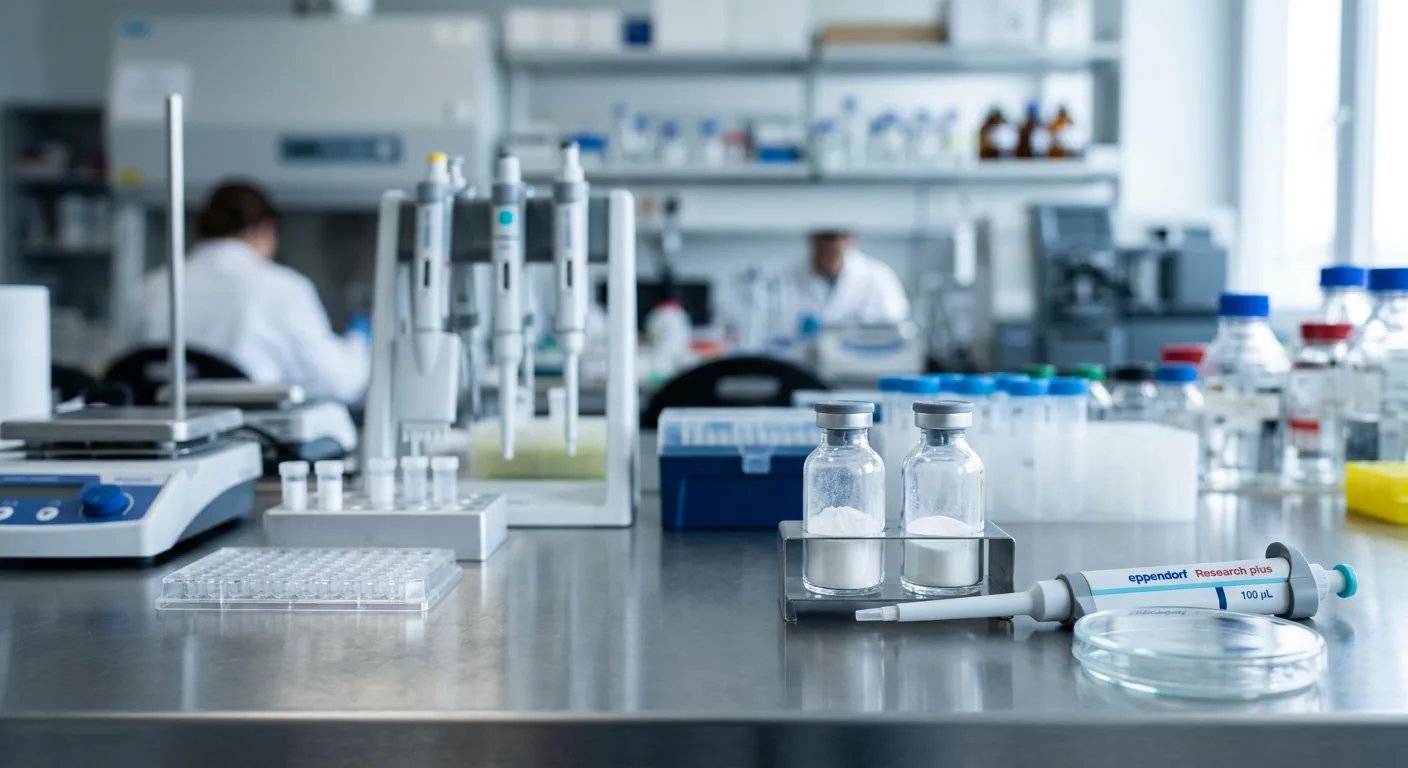
In preclinical research, comparing retatrutide vs tirzepatide reveals distinct incretin mimetic architectures: Tirzepatide functions as a dual GIP and GLP-1 receptor agonist, while Retatrutide operates as a triple agonist targeting GIP, GLP-1, and glucagon receptors. Laboratory models indicate that Retatrutide’s addition of glucagon receptor agonism alters its molecular binding affinity compared to the dual-action structure of Tirzepatide. Both compounds are synthetic peptides designed to investigate metabolic pathways, energy expenditure, and lipid oxidation in vitro and in animal models.
CRITICAL COMPLIANCE NOTE: Both Retatrutide and Tirzepatide are classified strictly for Research Use Only (RUO) and require precise laboratory reconstitution using bacteriostatic water for in vitro stability testing. These compounds are not for human consumption, medical, veterinary, or cosmetic use. This technical overview is intended solely for scientific investigators examining GLP-1 research peptides in controlled laboratory environments.
What is the structural and receptor difference between retatrutide and tirzepatide?
In preclinical research, Tirzepatide functions as a dual GIP and GLP-1 receptor agonist, while Retatrutide operates as a triple agonist targeting GIP, GLP-1, and glucagon receptors. Laboratory models indicate that Retatrutide’s addition of glucagon receptor agonism alters its molecular binding affinity compared to the dual-action structure of Tirzepatide.
Tirzepatide is a 39-amino-acid synthetic peptide engineered primarily around the native GIP sequence, featuring multiple aminoisobutyric acid substitutions to enhance stability[1]. It incorporates a C20 fatty diacid side chain to prolong its half-life[2][3]. Structurally, it acts as an imbalanced dual agonist. It exhibits native-like affinity and full agonism at the GIP receptor, but demonstrates roughly 5-fold weaker affinity and partial, G-protein-biased agonism at the GLP-1 receptor[4][1][5]. This biased signaling reduces GLP-1 receptor desensitization[6][7].
Conversely, retatrutide is a 39-amino-acid synthetic unimolecular triple agonist designed to simultaneously engage the GLP-1, GIP, and glucagon (GCGR) receptors[8][9][10]. The addition of GCGR agonism is the defining pharmacological difference, layering an energy expenditure and fat oxidation component onto the incretin effects[11][12]. Retatrutide is highly GIP-preferring; it is approximately 8.9-fold more potent than native GIP at the GIP receptor[9]. At the GLP-1 receptor, retatrutide is roughly 0.4-fold as potent as native GLP-1, and at the glucagon receptor, it is about 0.3-fold as potent as native glucagon[9].
Researchers studying the tirzepatide dual agonist pathway observe robust insulinotropic actions driven primarily by GIP and GLP-1 synergy. In contrast, investigations into the retatrutide triple agonist architecture examine how the simultaneous activation of three distinct receptors shifts metabolic regulation, specifically through the added glucagon-mediated lipid catabolism.
How do retatrutide and tirzepatide compare in laboratory models?
Both compounds are synthetic peptides designed to mimic endogenous incretin hormones but differ fundamentally in their receptor activation profiles. Comparative laboratory assays evaluate how triple-receptor activation alters metabolic pathways differently than dual-receptor activation.
In hepatocyte models, dual GLP-1/GIP agonists like tirzepatide activate AMPK and SIRT1 pathways, which inhibit the master regulator of de novo lipogenesis, SREBP-1c[13]. This suppresses lipid synthesis and enhances fatty acid oxidation[13]. The retatrutide triple agonist architecture provides these same anti-lipogenic actions via GLP-1 and GIP, but adds direct GCGR-driven cAMP/PKA signaling[13]. This robustly enhances mitochondrial beta-oxidation and ketogenesis, mobilizing stored triglycerides within hepatocytes[13][14]. Consequently, preclinical liver models demonstrate that triagonists produce more pronounced reductions in hepatic steatosis than dual agonists[14].
In metabolic chamber studies using obese animal models, both peptides decrease energy intake. However, retatrutide directly increases energy expenditure and thermogenesis through its GCGR component[15][13]. One comparative preclinical study found that 21 days of repeated administration reduced body weight by approximately 31.6% for tirzepatide and 24.1% for retatrutide, with tirzepatide producing the most pronounced decrease in respiratory quotient, indicating a strong shift toward fat oxidation[16].
| Specification | Tirzepatide | Retatrutide |
|---|---|---|
| Classification | Dual incretin receptor agonist | Triple incretin receptor agonist |
| Receptor Targets | GIPR, GLP-1R[13][14] | GIPR, GLP-1R, GCGR[15][17] |
| GIPR Binding | Native-like affinity; full agonist[4][5] | High potency; ~8.9-fold vs native GIP[9] |
| Hepatic Lipogenesis | Suppressed via AMPK/SIRT1[13] | Suppressed via GLP-1/GIP + GCGR modulation[13] |
| Energy Expenditure | Improved via fat oxidation shift[16] | Directly increased via GCGR thermogenesis[15][14] |
When laboratories source and buy retatrutide research peptide compounds alongside tirzepatide, they are primarily investigating this precise divergence: the isolated impact of glucagon receptor activation on systemic energy balance and lipid metabolism.
How do researchers reconstitute and handle these peptides for laboratory use?
Both Retatrutide and Tirzepatide are classified strictly for Research Use Only (RUO) and require precise laboratory reconstitution using bacteriostatic water for in vitro stability testing. These compounds are not for human consumption, medical, veterinary, or cosmetic use, and must be stored at controlled sub-zero temperatures post-reconstitution.
To reconstitute research peptides, investigators must utilize sterile bacteriostatic water containing 0.9% benzyl alcohol, which inhibits microbial growth and preserves the multi-dose viability of the solution[18][19]. The standard protocol begins by allowing the lyophilized vial to equilibrate to room temperature for 15 to 20 minutes, preventing moisture condensation that can degrade the peptide[20][21].
Using aseptic technique in a laminar flow hood, researchers swab the stoppers with 70% isopropyl alcohol[22]. The calculated volume of bacteriostatic water is injected slowly down the inner glass wall of the vial to minimize foaming and mechanical stress on the peptide structure[23][24]. The solution should be gently swirled – never shaken or vortexed – until it is clear and colorless, which typically takes 30 to 60 seconds[18][22].
Post-reconstitution, GLP-1 research peptides must be stored at 2 to 8 degrees Celsius and protected from light[23][25]. When reconstituted with bacteriostatic water, these solutions are generally stable for up to 28 days under refrigeration[26][20]. Multiple peptide laboratories strongly advise against freezing reconstituted solutions containing bacteriostatic water, as the phase changes of benzyl alcohol and ice crystal formation can mechanically damage the peptide structure and destroy activity[18][26][21]. For long-term archiving, peptides should remain in their lyophilized state at -20 degrees Celsius or colder[27][28].
Frequently Asked Questions
What is the structural difference between retatrutide and tirzepatide?
Incretin mimetic architectures differ primarily in receptor targets. Tirzepatide is a 39-amino-acid synthetic peptide that functions as a dual agonist at the GIP and GLP-1 receptors. Retatrutide is also a 39-amino-acid peptide, but it is engineered as a unimolecular triple agonist that simultaneously activates GIP, GLP-1, and glucagon receptors.
Is retatrutide a triple agonist?
Yes, in laboratory models, retatrutide operates as a triple incretin receptor agonist. It is designed to engage the GLP-1, GIP, and glucagon receptors, providing an added mechanism for investigating glucagon-mediated energy expenditure and lipid oxidation in preclinical research.
How do researchers reconstitute retatrutide and tirzepatide for laboratory use?
Researchers reconstitute these lyophilized peptides using sterile bacteriostatic water containing 0.9% benzyl alcohol. The solvent is injected slowly down the vial wall to prevent mechanical damage, gently swirled until dissolved, and the resulting solution is stored at 2 to 8 degrees Celsius for up to 28 days.
What does Research Use Only mean for GLP-1 peptides?
Research Use Only (RUO) designates that these synthetic peptides are manufactured strictly for in vitro and animal model laboratory testing. They are not approved for human consumption, medical treatment, veterinary use, or cosmetic application, and all laboratory handling must adhere to strict safety protocols.
References
- Structural determinants of dual incretin receptor agonism by tirzepatide. https://www.pnas.org/doi/10.1073/pnas.2116506119 (2022-03-25)
- Comparing Semaglutide, Tirzepatide, and Retatrutide Peptide Designs. https://www.linkedin.com/posts/broadpharm_semaglutide-tirzepatide-retatrutide-activity-7374852284775833600-5Yf1 (2025-09-19)
- Dual GIP and GLP-1 Receptor Agonist Tirzepatide Improves Beta …. https://academic.oup.com/jcem/article/106/2/388/6000489 (2021-01-23)
- Tirzepatide is an imbalanced and biased dual GIP and GLP-1 …. https://insight.jci.org/articles/view/140532 (2020-07-30)
- Clinical perspectives on the use of the GIP/GLP-1 receptor agonist …. https://www.frontiersin.org/journals/endocrinology/articles/10.3389/fendo.2022.1004044/full (2022-10-13)
- Decoding tirzepatide's dual agonism with advanced pharmacology …. https://www.revvity.com/blog/decoding-tirzepatides-dual-agonism-advanced-pharmacology-assays (2026-01-08)
- Spatiotemporal GLP-1 and GIP receptor signaling and trafficking …. https://www.sciencedirect.com/science/article/pii/S2212877821000211 (2024-10-16)
- Retatrutide: A Triple GLP-1/GIP/Glucagon Receptor Agonist. https://superpower.com/guides/retatrutide (2026-04-18)
- Structural insights into the triple agonism at GLP-1R, GIPR … – Nature. https://www.nature.com/articles/s41421-024-00700-0 (2024-07-17)
- Retatrutide—A Game Changer in Obesity Pharmacotherapy – PMC. https://pmc.ncbi.nlm.nih.gov/articles/PMC12190491/ (2025-05-30)
- Retatrutide vs Tirzepatide: Key Differences for Researchers. https://agelessvitalitypeptides.com/retatrutide-vs-tirzepatide/ (2026-05-21)
- Investigators to share new data on retatrutide triple therapy. https://www.adameetingnews.org/investigators-to-share-new-data-on-retatrutide-triple-therapy/ (2023-06-25)
- Glucagon-like peptide-1 and dual/triple receptor agonists in the …. https://www.frontiersin.org/journals/medicine/articles/10.3389/fmed.2026.1763185/full (2026-02-12)
- Triple Agonist Therapy: A New Frontier in Treating Type 2 Diabetes …. https://pmc.ncbi.nlm.nih.gov/articles/PMC12304557/ (2025-02-28)
- Retatrutide: Triple Incretin Receptor Agonist Overview – Newtropin. https://newtropin.com/peptides/retraglutide (2026-03-24)
- Efficacy of GLP-1 analog peptides, semaglutide, tirzepatide, and …. https://www.nature.com/articles/s41366-026-02025-2 (2026-02-21)
- What is the mechanism of action of Retatrutide? – Patsnap Synapse. https://synapse.patsnap.com/article/what-is-the-mechanism-of-action-of-retatrutide (2025-03-07)
- Reconstituting Peptides: A Beginner's Guide. https://emiratespeptides.com/beginners-guide-reconstituting-peptides-bacteriostatic-water/ (2026-03-10)
- Reconstitution BAC (10ml) – Aero Peptides. https://aeropeptides.com/product/bacteriostatic-water-10mg (2026-07-01)
- Complete Peptide Reconstitution Guide: Step-by-Step – Northline Labs. https://northlinelabs.org/complete-peptide-reconstitution-guide-step-by-step/ (2026-03-06)
- Complete Guide to Research Peptide Reconstitution (2025). https://www.bioinfinitylab.com/research/guides/peptide-reconstitution (2025-02-14)
- Peptide Reconstitution Calculator: BAC Water ml to Units | Regimen. https://helloregimen.com/blog/peptide-reconstitution-calculator-guide (2026-01-20)
- Bacteriostatic Water for Peptide Research: What It Is | | Palmetto …. https://palmettopeptides.com/blogs/news/bacteriostatic-water-for-peptide-research (2026-04-09)
- Reconstitution Protocols for BPC-157 and TB-500 Research Peptides. https://palmettopeptides.com/blogs/news/bpc-157-tb-500-reconstitution-protocols (2026-04-06)
- Doctor Explains How To CORRECTLY Prepare And Inject Your …. https://www.youtube.com/watch?v=L65S1xmKY44&vl=en (2025-12-19)
- Peptide Storage & Shelf Life: How to Store BPC-157, Tirzepatide …. https://www.durhampeptides.ca/post/peptide-storage-shelf-life-guide (2026-04-30)
- Handling and Storage Guidelines for Peptides – Bachem. https://www.bachem.com/knowledge-center/handling-and-storage-guidelines-for-peptides/ (2026-03-15)
- Peptide Handling, dissolution & Storage – NIBSC. https://nibsc.org/science_and_research/virology/cjd_resource_centre/available_samples/peptide_library/peptide_storage.aspx (2026-06-25)